
Introduction
A solar developer knocks on the door with a lease offer that sounds too good to pass up. Meanwhile, the same acre needs to keep feeding livestock, growing corn, or supporting a tenant's operating loan for another generation.
That's the real tension behind solar on farmland: it can create new income and cut energy costs, but it can also compete with the agricultural use that made the land valuable in the first place.
"Solar on farmland" isn't one thing. It might mean a rooftop system on a barn, a ground-mounted array powering an irrigation pump, a multi-decade utility-scale lease, or agrivoltaics, where panels and crops or livestock share the same acreage.
This article walks through how each option works, where solar and agriculture genuinely coexist, what to evaluate before any agreement is signed, and how whole-system farm planning helps avoid decisions that look good on paper but hurt the operation later.
Key Takeaways
- Solar can diversify farm income and cut energy costs, but results depend entirely on site, design, and contract terms.
- Agrivoltaics keeps farming active under panels; a standard solar lease usually does not.
- Soil, equipment access, and decommissioning terms matter as much as the rent check.
- Incentives, zoning, and interconnection rules vary by state and utility — always verify current guidance.
Solar Options for Farms
Photovoltaic (PV) panels convert sunlight directly into electricity, which a farm can use on-site, store in batteries, or send back to the grid. Photovoltaic is one type of solar technology; "solar" is the broader category that also includes solar thermal systems used for heating water or air. For most farms, PV is the relevant technology to understand.
Four models show up most often on agricultural land:
- Rooftop and building-mounted solar — Panels on barns, homes, or processing buildings. Minimal land disturbance, and power typically serves on-site loads.
- Ground-mounted, on-farm systems — Arrays sized to run irrigation pumps, refrigeration, electric fencing, or other farm equipment, without turning the land into a leased energy site.
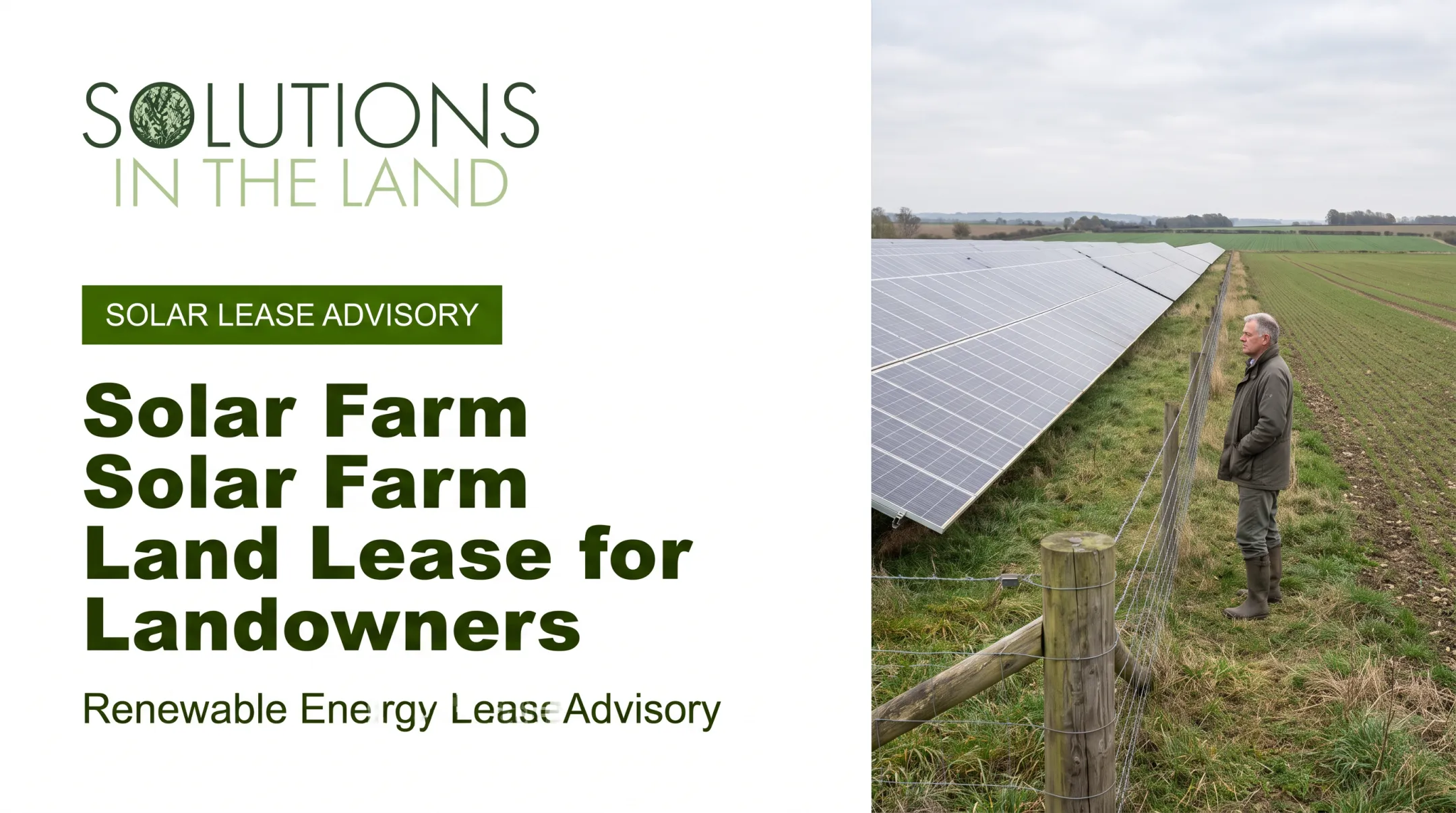
- Utility-scale solar leases — A developer controls part of the property, often for 25 to 40+ years, and sells electricity to the grid.
- Agrivoltaics — Panels intentionally co-located with crops, grazing, or pollinator habitat, so farming continues alongside power generation.
The Department of Energy's farmer's guide to going solar notes that utility-scale projects are commonly 1 megawatt or larger—a size description, not a permitting threshold.
Decision point: Before evaluating any offer, get clear on one question: does this system sell electricity, reduce your own purchases, pay land rent, or combine two of those? Each answer points to a different land footprint and a different set of risks.
How Solar and Agriculture Can Work Together
Solar can support farm income in several concrete ways:
- Diversified revenue from leases or power sales
- Lower electricity bills for farm operations
- On-site power for irrigation or cold storage
- Stronger resilience against energy price swings
In some crop and climate combinations, panel shade can also reduce plant water stress. That is not the same as a guaranteed cut in irrigation demand.
Crop Performance Under Panels Varies by Species
Panel shade changes temperature, moisture, and wind exposure. Some crops respond well; others don't.
In a University of Arizona field trial, chiltepin pepper production ran roughly three times higher and cherry tomato production roughly two times higher under panels than in open plots, with irrigation applied at the same rate to both. Jalapeno peppers responded differently in the same study.
Shade-tolerant, heat-sensitive crops may thrive under panels, while full-sun crops may lose yield. Local trials matter more than any published list.
Grazing and Habitat Applications
- Sheep are the go-to livestock for vegetation management under panels. Their size fits standard array clearance, and they reduce mowing needs.
- Cattle generally require taller panels and sturdier fencing, which raises construction costs.
- Pollinator plantings beneath and around arrays can build biodiversity, but establishment takes time. Some native species need 5-6 years to fully establish.
The Height-and-Spacing Trade-Off
Raising panels and widening rows makes room for equipment and grazing animals, but it costs more per watt installed. An NREL-modeled comparison found that increasing tracker clearance from 4.6 feet to 8.2 feet raised installed cost from $1.97 to $2.40 per watt, while capacity per acre stayed roughly the same:
| Configuration | Clearance | Installed Cost | Capacity per Acre |
|---|---|---|---|
| Standard tracker | 4.6 ft | $1.97/W | 169.5 kW/acre |
| Elevated tracker | 8.2 ft | $2.40/W | 169.5 kW/acre |

Source: NREL's Jackson County agrivoltaics feasibility assessment. Wider fixed-tilt row spacing uses a different layout entirely and shouldn't be compared directly to tracker height changes.
Farm Planning and Solar Design Considerations
A solar decision made apart from the rest of the farm plan creates problems later. Start with a site-specific assessment: soils, slope, drainage, flood exposure, sunlight, wind, grid access, and the agricultural value of each field. Highly productive cropland deserves different treatment than marginal or hard-to-farm acres.
Design Around How the Farm Actually Operates
Panel height, row spacing, access lanes, cabling routes, and fencing all need to match:
- Equipment movement: Combines, sprayers, and grazing animals must pass through without damage.
- Harvest schedules: The layout must allow timely field access during peak season.
- Emergency access: Fire equipment and vet vehicles need a clear path to every area.
Protecting Soil Before, During, and After Construction
Layout choices only hold if construction protects the ground underneath. Compaction, grading, and topsoil disturbance are the main risks. USDA's NRCS conservation guidance for utility-scale solar projects recommends:
- Documenting baseline soil conditions before work begins
- Avoiding construction on wet soils
- Retaining topsoil for post-construction restoration
Day-to-day operations have to fit the array as well. Dust from tillage, herbicide drift, snow removal, and panel cleaning all need to coexist with farm work.
This is where a whole-system farm plan earns its keep. Rather than treating solar as a standalone deal, the plan weighs the array alongside crop rotations, grazing systems, watershed goals, labor, and long-term land stewardship.
Solutions in the Land builds these plans with a six-part process that answers well over a hundred site-specific questions, from regional resource background through farm policy eligibility, before any lease terms get finalized.
Pre-development checklist:
- Define the agricultural objective for the property
- Map the most productive versus marginal acres
- Identify compatible crops, grazing systems, or habitat plans
- Model access routes for equipment and livestock
- Estimate on-site energy demand
- Consult local utilities and zoning regulators
- Secure independent legal, tax, engineering, and conservation advice
Financial, Land-Use, and Contract Risks
Solar income can take several forms, and each carries different obligations:
- Owning a system — Full control, full responsibility for financing and maintenance.
- Financing an on-farm installation — Lower upfront cost, ongoing loan payments.
- Power purchase agreement (PPA) — A third party owns the system; the farm buys the electricity.
- Land lease to a developer — Rent income, but reduced control over the acreage for decades.
- Community or shared-solar participation — Bill credits from an off-site array, no land committed.
Rent Offers Vary Widely — and Aren't the Whole Story
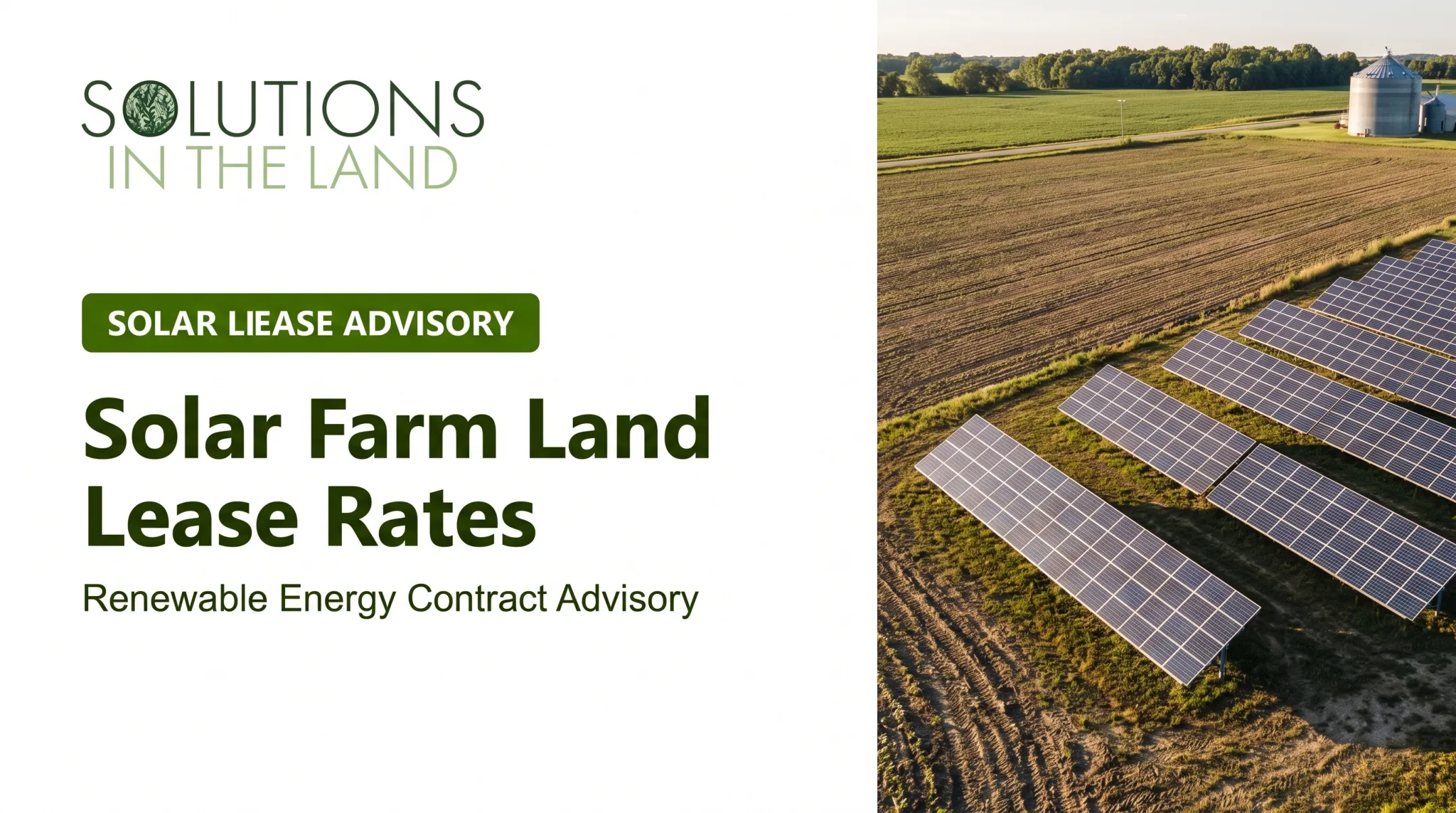
Independent benchmarking for utility-scale solar rent runs $800 to $2,500-plus per acre per year, depending on region, interconnection value, and developer pipeline pressure.

An Arkansas Extension review of reported offers found a similarly wide $450 to $2,500 per acre per year range — proof that local factors move the number, not a national rate anyone should expect.
A higher per-acre number doesn't automatically mean higher profit. Net returns shrink once you account for:
- Property taxes (including potential loss of agricultural-use assessment)
- Insurance and legal review costs
- Lost crop or grazing revenue
- Financing costs and opportunity cost of the land
The "best" offer on paper may not be the best deal in practice.
Contract Terms That Need Professional Review
- Lease duration, renewal rights, and assignment to another developer
- Access, easements, and construction damage liability
- Escalation clauses (CPI-based or fixed annual increases)
- Agricultural program eligibility and environmental compliance
- Decommissioning obligations — who removes panels, foundations, roads, and cabling, and what happens if the project owner becomes insolvent
North Carolina now requires decommissioning plans and financial assurance for qualifying utility-scale projects before construction begins — a sign that states are starting to formalize these protections, though rules still vary widely by location.
Solutions in the Land's renewable-energy lease advisory works exclusively on the landowner's side of these negotiations. The firm coordinates with the landowner's own attorney to review terms like these before anything gets signed and never represents the developer.
Operating and Stewarding a Solar-Agriculture Site
Signing the lease isn't the finish line. Ongoing management needs a plan for vegetation control, grazing rotations, stormwater, erosion, fencing, fire prevention, and wildlife interactions around the array.
What to monitor separately:
- Electricity generation (metered output)
- Crop yield or livestock performance
- Soil organic matter, compaction, and water infiltration
- Biodiversity and pollinator activity
- Maintenance costs and net farm income
A six-year NREL monitoring effort across Minnesota solar sites found that native vegetation and pollinator activity increased over time, while cooler module temperatures produced little measurable gain in annual electricity output. The lesson: don't expect one metric to substitute for another. Crop yield, habitat improvement, and power generation are separate outcomes that each need their own baseline and tracking.

Scheduled reviews involving the farmer, landowner, solar operator, and conservation professionals allow adjustments when conditions change — a drought year, a fencing failure, a shift in the tenant's cropping plan. Lease advisory work, like the farm and solar lease consulting Solutions in the Land provides, often builds these review checkpoints directly into the lease language so responsibilities don't have to be renegotiated later.
Proceed only when the system:
- Supports the landowner's actual long-term goals
- Protects soil and water resources
- Preserves workable agricultural access
- Has clearly assigned maintenance and decommissioning responsibilities
- Remains financially viable under conservative assumptions
Frequently Asked Questions
How much money does 1 acre of solar panels make?
Income depends on ownership structure, sunlight, grid access, and contract terms. U.S. lease offers often range from $450 to $2,500-plus per acre annually, so get a site-specific analysis rather than relying on any published average.
What crops are best for agrivoltaics?
Suitable crops depend on panel height, row spacing, climate, shade tolerance, and market demand. Research has studied peppers, tomatoes, leafy greens, and berries in specific regions, but there's no universal "best crop." Local trials matter more.
Why are farmers using sheep in agrivoltaics?
Sheep graze vegetation beneath and between panels, cutting mowing and herbicide needs while adding grazing income. Fencing, water access, shelter, and animal-safety planning around electrical equipment are essential before turning animals loose.
What does the term "agrivoltaic" mean?
Agrivoltaics means co-locating solar photovoltaic generation with active agricultural use (crops, livestock grazing, or pollinator habitat) on the same acreage, rather than replacing farming with power generation.
Is photovoltaic better than solar?
Photovoltaic is one type of solar technology, not a separate alternative to it. PV makes sense when the goal is generating electricity; the right system still depends on the farm's energy needs and site conditions.