Introduction
You're in the middle of a land deal — or just beginning to think seriously about a farm purchase — and someone tells you a Phase II Environmental Site Assessment is needed. The term sounds technical, the cost is unclear, and you're not sure whether this is a routine formality or a red flag worth losing sleep over.
The answer depends on what's actually there. A Phase II ESA is a scientific field investigation that physically collects and tests samples from soil, groundwater, and/or air to confirm or rule out environmental contamination on a property. It doesn't clean anything up — it tells you what you're dealing with.
What follows covers how a Phase II ESA differs from a Phase I, what the process involves step by step, realistic timelines and costs, and what the results mean for agricultural landowners, farmland buyers, and anyone making a serious land use decision.
Key Takeaways
- A Phase II ESA is triggered when a Phase I identifies Recognized Environmental Conditions (RECs) that need physical verification
- It involves on-site sampling of soil, groundwater, and/or vapor with accredited lab analysis
- Costs range from roughly $5,000 for limited sampling to $50,000+ for complex sites
- The typical timeline runs 4–8 weeks from field work to final report
- Results either clear the property (No Further Action) or lead to a remediation plan through a Phase III ESA
Phase I vs. Phase II ESA: How They're Connected
What a Phase I Does — and Doesn't Do
A Phase I ESA, governed by ASTM E1527-21, is a non-invasive investigation. It reviews historical records, regulatory databases, and site reconnaissance to identify Recognized Environmental Conditions — but it collects zero physical samples. No soil is touched, no wells are drilled.
A REC, under the updated E1527-21 definition, is "the presence or likely presence of hazardous substances or petroleum products in, on, or at a property due to a release to the environment." A Phase I documents that a REC exists — it cannot confirm whether contamination is actually present.
When a Phase II Gets Triggered
When a Phase I identifies one or more RECs, a Phase II ESA is the logical next step. The Phase II — governed by ASTM E1903-19 — shifts from records review to physical investigation. It answers the question the Phase I couldn't: Is contamination actually present, and if so, how much?
The ASTM E1527-21 standard also defines two related categories worth knowing:
| Term | What It Means |
|---|---|
| Historical REC (HREC) | A past release addressed by regulators — may not require Phase II if documented closure exists |
| Controlled REC (CREC) | A past release with contamination left in place under regulatory controls — may require Phase II to confirm controls are working |
An Important Distinction
A Phase II confirms or rules out contamination — it does not remediate it.
It also differs from a "limited Phase II," which is a narrower sampling effort used when a Phase I REC is minor or tightly defined. Knowing which approach applies upfront directly affects your project scope and budget.
What Does a Phase II Environmental Site Assessment Include?
Selection of a Qualified Environmental Professional
Phase II ESAs must be completed or directly overseen by a qualified Environmental Professional (EP). Under the EPA's All Appropriate Inquiries rule, an EP must meet one of these credential thresholds:
- Licensed PE or PG with 3+ years of relevant experience
- Science or engineering degree with 5+ years of relevant experience
- 10 years of relevant experience without a degree
Professional judgment about sample locations, drilling methods, and contaminant selection directly shapes investigation quality. Hiring an underqualified EP risks incomplete sampling, defensibility gaps, and findings that won't hold up to regulatory scrutiny.
Developing the Sampling Plan
Before any drilling begins, the consultant builds a site-specific sampling plan that defines:
- Where samples will be collected
- Which environmental media will be tested (soil, groundwater, vapor, or a combination)
- Which contaminants of concern will be targeted based on Phase I findings
- An estimated cost and timeline
Review and approval before fieldwork starts ensures the scope directly reflects the risks identified in your Phase I findings — not a generic template.
Media Sampling: Soil, Groundwater, and Vapor
The three primary types of samples collected during a Phase II ESA:
Soil samples are collected using:
- Direct push/push-probe technology (fast, minimal waste, effective for shallow investigations)
- Hollow-stem auger drilling rigs (enables continuous sampling at depth)
- Hand augers or test pits (for near-surface or limited-access areas)
Groundwater samples are gathered through temporary or permanent monitoring wells installed to the depth of the water table.
Soil vapor and sub-slab gas samples detect volatile organic compounds (VOCs) and assess potential vapor intrusion — particularly relevant near former fuel storage areas.
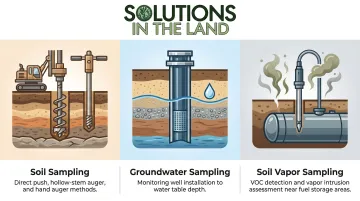
Not all three media are sampled on every site. Scope depends on what the Phase I identified.
Laboratory Analysis and Chain of Custody
Once collected, every sample travels under strict chain-of-custody documentation from field collection through lab delivery. This is a legal requirement — it protects the integrity and defensibility of results if findings are ever challenged.
Laboratories must hold accreditation through the National Environmental Laboratory Accreditation Program (NELAP), administered by The NELAC Institute (TNI). Your consultant then compares results against applicable regulatory benchmarks, including EPA Regional Screening Levels and state-specific cleanup standards set by agencies like the Illinois EPA, Wisconsin DNR, or Iowa DNR.
The Phase II ESA Report
The final report is the primary deliverable buyers, lenders, and regulators use to make decisions. It must include:
- A summary of field methods and investigation approach
- Laboratory results with data interpretation
- A risk assessment based on findings
- Clear recommendations — either no further action required, or a path forward involving remediation
How Long Does a Phase II ESA Take, and How Much Does It Cost?
Timeline
A Phase II ESA typically takes 4–8 weeks from field mobilization to report delivery. Here's where that time goes:
| Phase | Typical Duration |
|---|---|
| Scheduling, utility clearance, mobilization | 1–2 weeks |
| Field sampling and drilling | 1–3 days |
| Laboratory analysis | 5–10 business days (standard) |
| Report preparation | 1–2 weeks |
Expedited lab turnaround is available at extra cost. Hiring a firm that coordinates both sampling and lab logistics can compress total timelines.
Cost Variables
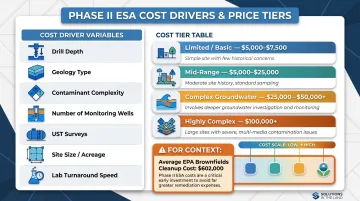
Cost varies considerably depending on site conditions and scope. The factors with the most impact:
- Number of sample locations and depth of drilling required
- Subsurface geology (rock versus sand/gravel affects drilling difficulty)
- Type of contaminants suspected and analytical methods required
- Whether new monitoring wells need to be installed
- Presence of underground storage tanks requiring geophysical surveys
- Property size and site accessibility
- Whether expedited lab turnaround is needed
Cost Context
Phase II ESA costs typically fall into these ranges:
| Scope | Approximate Cost |
|---|---|
| Limited/basic sampling | $5,000–$7,500 |
| Typical mid-range scope | $5,000–$25,000 |
| Complex sites with extensive groundwater monitoring | $25,000–$50,000+ |
| Highly complex, multi-phase sites | Up to $100,000+ |
For comparison, Phase I ESAs generally run $2,000–$5,000 — a non-invasive records review versus active field investigation.
The cost differential is worth keeping in perspective: the average cleanup cost across 271 EPA Brownfields-funded sites was $602,000, according to Northeast-Midwest Institute analysis of EPA data. A $10,000 Phase II ESA that surfaces a contamination problem before closing can prevent a liability that runs 60 times that figure.
What Happens After a Phase II Environmental Site Assessment?
Outcome 1: No Further Action
If contaminant concentrations fall at or below applicable regulatory thresholds, the Environmental Professional may recommend a No Further Action (NFA) determination. This means:
- The property can move forward without environmental cleanup
- The transaction, development plan, or land use project proceeds
- The NFA provides documented evidence that identified RECs don't represent active contamination concerns
For buyers, NFA documentation is valuable collateral for lenders and a clean record for future transactions.
Outcome 2: Remediation Required (Phase III ESA)
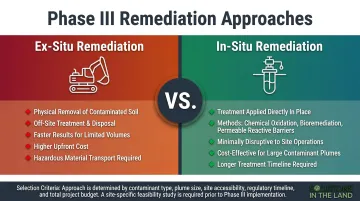
When contamination exceeds acceptable thresholds, a Phase III ESA initiates remediation planning and implementation. The two primary remediation approaches are:
- Ex-situ remediation: physical removal and off-site treatment of contaminated material. More controllable and faster for limited volumes, but more expensive and involves hazardous waste transport.
- In-situ remediation: treating contamination in place using methods like chemical oxidation, bioremediation, or soil vapor extraction. Less disruptive and often more cost-effective for larger plumes, though treatment timelines are typically longer.
The right approach depends on contamination type, plume size, site conditions, and budget — factors the Phase III ESA team will evaluate before recommending a path forward.
The Decision-Making Power of Results
Phase II results give every party at the table concrete data to act on:
- Buyers can renegotiate the purchase price or require remediation before closing
- Sellers understand their liability exposure before it becomes a legal dispute
- Lenders have documented basis for financing decisions
- Landowners can budget for cleanup as part of the acquisition rather than discovering it afterward
For landowners and agricultural stakeholders especially, having this documentation in hand before closing gives you negotiating leverage and a clear picture of what the land will actually cost to steward responsibly.
Why Phase II ESA Results Matter for Agricultural Landowners
The Contamination Risks Farmland Actually Carries
Agricultural and rural properties carry contamination risks that often go unrecognized precisely because the land "looks clean." Common REC triggers on farms and rural parcels include:
- Underground fuel storage tanks — older farm USTs installed before 1988 federal regulations frequently leak benzene, toluene, ethylbenzene, xylenes (BTEX), and MTBE into surrounding soil and groundwater
- Legacy pesticide and herbicide residues — historical use of arsenical pesticides (lead arsenate, calcium arsenate) on orchards and cropland has left persistent arsenic and lead contamination in soils that remains detectable decades later
- Proximity to industrial operations — parcels that border or previously hosted industrial tenants may carry solvent or heavy metal contamination unrelated to farming activity
- Agricultural nonpoint source pollution — fertilizer and pesticide applications can leach into groundwater depending on local geology and land use history
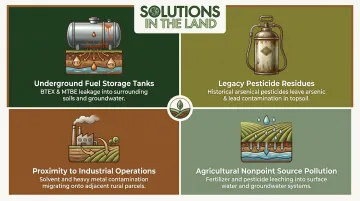
In the Midwest especially, land frequently transitions between agricultural, industrial, and commercial uses across generations — making contamination history harder to trace and easier to overlook at the point of sale.
Environmental Clearance as a Foundation for Sustainable Land Use
A clean Phase II — or a completed remediation — is the baseline from which any sustainable farm plan must begin. Contaminated soil undermines crop safety, soil biology, watershed health, and long-term land productivity in ways that no agronomic input can fully address.
For landowners pursuing organic certification, the stakes are particularly concrete. Under USDA NOP regulation 7 CFR 205.201, organic system plans must describe practices and barriers to prevent contact with prohibited substances. Phase II ESA results — especially soil sampling data for persistent synthetic pesticides and heavy metals — provide the empirical foundation for demonstrating that compliance.
If sampling reveals prohibited substance residues above actionable thresholds, organic certification eligibility is at risk. Solutions in the Land's farm planning and Environmental Site Assessment work is built around surfacing exactly these conditions early, so they inform the plan rather than derail it.
The Practical Bottom Line
Anyone considering purchasing farmland, converting land to regenerative agriculture, or transitioning from commodity crops should treat environmental due diligence as a non-negotiable first step. It protects the investment, protects the crops, and protects the communities and ecosystems that depend on healthy soil and clean water.
One caveat worth noting: ASTM E1903-19 acknowledges that a Phase II ESA is "inherently limited to confirming or refuting the presence of suspected contaminants in specifically sampled areas." A clean result addresses identified RECs — it isn't a blanket environmental warranty for an entire large parcel. On extensive acreage, sampling density relative to total area is a real constraint worth discussing with your Environmental Professional before finalizing the scope.
Frequently Asked Questions
What is a Phase II Environmental Site Assessment?
A Phase II ESA is a subsurface investigation that physically collects and tests soil, groundwater, and/or vapor samples to confirm or rule out the presence of environmental contamination on a property. It's typically ordered after a Phase I ESA identifies Recognized Environmental Conditions (RECs) requiring physical confirmation.
What does a Phase II Environmental Site Assessment include?
A Phase II ESA covers five core components:
- Selection of a qualified Environmental Professional
- A site-specific sampling plan
- Physical collection of soil, groundwater, and/or vapor samples
- Accredited laboratory analysis under chain-of-custody protocols
- A final report with findings and recommended next steps
How long does a Phase II Environmental Site Assessment take?
A Phase II ESA typically takes 4–8 weeks from initial field sampling to final report delivery. The timeline is influenced by scheduling and mobilization, standard laboratory turnaround (5–10 business days), and site complexity.
How much does a Phase II Environmental Site Assessment cost?
Costs typically range from $5,000 for limited initial sampling to $50,000 or more for complex sites with extensive drilling and groundwater monitoring. Highly complex sites can exceed $100,000.
What happens after a Phase II Environmental Site Assessment?
There are two possible outcomes: a No Further Action (NFA) determination, which allows the project or transaction to move forward without cleanup, or a confirmed contamination finding that triggers a Phase III ESA and site-specific cleanup plan.
What is a Phase III Environmental Site Assessment?
A Phase III ESA is conducted when a Phase II confirms contamination above acceptable regulatory limits. It maps the full extent of contamination and establishes a remediation plan to clean up affected soil, groundwater, or other environmental media.