Introduction
A design charrette is an intensive, collaborative planning session where stakeholders work together to produce actionable solutions under a defined deadline. Originally an architectural tool, charrettes now drive decisions in urban planning, green building, UX design, sustainable agriculture, and watershed management — anywhere competing interests need to converge into a workable plan, fast.
The term gets misapplied constantly. One-day brainstorming sessions, town halls, and casual workshops all get labeled as charrettes, which dilutes the methodology and leaves participants with nothing actionable at the end.
This guide covers what a design charrette actually is, where it came from, how to run one properly, the different forms it takes across industries, and the mistakes that derail even carefully planned sessions.
TL;DR: Key Takeaways
- A design charrette is an intensive, time-bound workshop built around iterative feedback loops — producing a feasible, actionable plan, not just ideas
- The word comes from 19th-century Paris, where architecture students rushed to finish as a cart ("charrette") collected their deadline submissions
- Charrettes differ from standard workshops through multi-day timelines, cross-disciplinary teams, and decision-makers with authority to act on outcomes
- They're used across architecture, urban planning, LEED certification, UX design, and land use planning
- Success depends on thorough preparation, disciplined facilitation, and structured follow-up that converts outputs into adopted plans
What Is a Design Charrette? Origin and Definition
The Definition
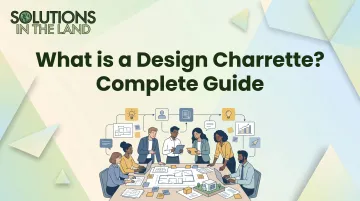
A design charrette is an intensive, collaborative design or planning process where a multidisciplinary group of stakeholders and experts work together — typically over multiple consecutive days — to generate and refine a feasible solution to a complex problem.
Unlike a brainstorming session that stops at ideas, a charrette is a structured process with iterative feedback loops that pushes toward a technically sound, publicly supported plan by the end of the event.
The National Charrette Institute (NCI) defines it as a "structured, values-based process" that is cross-functional, multi-disciplinary, and capable of studying "details and the whole" simultaneously. A process is explicitly not a charrette if it brings stakeholders in only at the end, uses technology solely for presentation, or compresses everything into a single meeting.
The Etymology
The word "charrette" is French for "cart." At the École des Beaux-Arts in Paris in the 19th century, proctors wheeled a cart through the studios to collect students' architectural drawings at deadline. Students would keep sketching even as the cart moved — some reportedly jumped on it to work until the very last moment.
That image — intense, deadline-driven creative effort carried right to the edge — gave rise to the phrase en charrette, meaning working in a focused burst toward an immovable deadline. The term is sometimes Anglicized to "charette" or "charet" in English, and Merriam-Webster includes an entry under "charette."
What a Charrette Is Not
The NCI is direct on this point. A charrette is not:
- A one-day workshop or marathon meeting
- A plan authored by a small group without broader input
- A brainstorming session that stops short of feasibility testing
- A public meeting where participants talk but don't co-create
Calling a shorter event a charrette doesn't just misrepresent the format — it erodes trust and reduces participants' willingness to engage in future processes.
The Three-Phase Structure
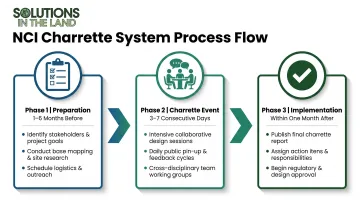
The NCI Charrette System organizes the full process into three phases: Preparation, the Charrette event, and Implementation. The event itself requires at least three feedback loops (the minimum needed to progress from a broad set of concepts to a synthesized, preferred plan). As NCI co-founder Bill Lennertz put it, three loops give teams space to get it wrong twice before landing on the best idea.
Each phase serves a distinct purpose:
- Preparation: Research, stakeholder identification, and framing the problem before the event begins
- Charrette Event: The intensive multi-day session where teams generate, test, and refine solutions through iterative feedback loops
- Implementation: Translating the charrette's preferred plan into actionable next steps with community buy-in already built in
Key Benefits of Running a Design Charrette
Speed Without Sacrificing Quality
Front-loading collaborative input prevents the expensive rework that happens when key voices are excluded early. Construction Industry Institute research analyzing more than $35 billion in project data found that high-quality Front End Planning correlates with approximately 10% lower costs and 7% shorter schedules compared to projects with minimal early planning investment.
That finding applies to capital project delivery broadly, but it reflects the same logic charrettes are built on: decisions made collaboratively at the start cost far less to make than corrections made mid-execution.
Stakeholder Buy-In That Sticks
Because decision-makers are present and actively co-authoring the plan, the resulting output has genuine ownership. Participants advocate for plans they helped create. The NCI notes that this shared ownership "reduces future opposition to projects" — a critical advantage in land use disputes, zoning approvals, and contested community planning processes.
Cross-Disciplinary Insight
Siloed planning processes miss the priorities and reasoning of people outside the core team. Charrettes surface those perspectives in real time:
- Engineers flag constructability problems before designs get locked in
- Community members identify uses and needs that technical teams overlook
- Regulatory experts prevent compliance failures that would require costly redesigns
- Economic consultants stress-test financial assumptions against real market conditions
Plans built this way tend to hold up under pressure. Competing needs get resolved in the room, not on the job site.
The Design Charrette Process: How to Plan and Run One
Phase 1: Pre-Charrette Preparation (1–6 Months Before)
Preparation is where charrettes are won or lost. The NCI describes this phase as being "people-, data-, and place-ready" before the event begins.
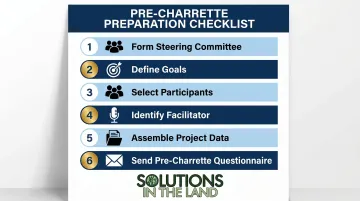
Key preparation steps:
- Form a steering committee at least three months before the event (WBDG guidance)
- Define specific, measurable goals — vague objectives produce vague outcomes
- Select participants — the NCI recommends 25–50 for a large charrette, with breakout groups of 6–8
- Identify a skilled facilitator who can manage group dynamics without directing toward a predetermined answer
- Assemble base project data — site analysis, regulatory constraints, prior studies
- Send a pre-charrette questionnaire to surface key concerns before the room convenes
Phase 2: Conducting the Charrette (3–7 Consecutive Days)
The NCI specifies a four-day minimum for full charrettes, with complex or controversial projects requiring five or more contiguous days. The event typically follows this arc:
- Open with a public or stakeholder session to gather values and establish shared goals
- Break into multidisciplinary sub-groups, each with a designated facilitator
- Work in native design tools — SketchUp, Revit, GIS, hand sketching — so ideas evolve visually
- Run at least three feedback loops, with sub-groups presenting back to the full group for refinement between each iteration
- Use a "parking lot" to capture important but off-topic ideas without derailing the main thread
The facilitator's role is to amplify ideas without steering toward a predetermined outcome. Ground rules — no criticism in early rounds, one primary conversation at a time, consensus-based decisions — should be established at the opening session.
If a charrette begins with a fixed answer, it will fail. Participants sense that quickly, and it poisons the process.
Phase 3: Post-Charrette Follow-Up (Within One Month)
The WBDG recommends preparing a short executive summary within a month of the event to communicate priority goals, followed by a longer report (typically 25–35 pages) documenting specific action items and recommendations. A post-charrette public meeting presents the refined plan back to participants.
Without this phase, even excellent charrette sessions stall. The report and public meeting are what give participants a reason to trust the process — and decision-makers the documentation they need to act on it.
Virtual Charrettes
Remote charrettes can work when structured intentionally. The NCI's High-Touch/High-Tech framework assigns three dedicated roles to keep the session on track:
- Facilitator — manages the agenda and keeps discussion on track
- Recorder — documents ideas as they emerge
- Tech support specialist — troubleshoots tools so the session doesn't lose momentum
Overhead cameras broadcasting live hand-sketching help maintain the visual, dynamic quality of in-person collaboration.
Types of Design Charrettes and How They're Used
Architecture and Urban Planning
The most common form. Multi-day charrettes bring together municipal officials, developers, architects, engineers, and residents to rapidly develop building designs, campus master plans, or neighborhood revitalization strategies.
Nashville's Metropolitan Planning Commission used this approach for the Highland Heights charrette in East Nashville, engaging residents, property owners, business owners, and metro staff through public workshops and a design studio to produce a Small Area Plan with specific land use, building type, and streetscape recommendations.
In the UK, The Prince's Foundation uses a variant called "Enquiry by Design" (EbD) — a process that follows the same iterative, community-facing logic.
UX and Product Design
Shorter sessions — often 90 minutes to a half-day — where designers, developers, and product managers sketch solutions simultaneously. Nielsen Norman Group defines a UX charrette as each person sketching alone for five minutes, followed by a two-minute explanation and one minute of group Q&A per person. The goal isn't a final design — it's rapid idea generation and exposing each team member's different priorities so a lead designer can synthesize them.
Integrated Design for LEED and Green Building
Where UX charrettes compress decisions into hours, green building charrettes tackle longer-horizon choices before they become costly to reverse. Many projects use charrettes early in design to set energy, water, and environmental performance targets before commitments lock in.
LEED v4.1's Integrative Process credit specifically calls for holding a "health charrette" — or integrating health considerations into an existing green charrette — as a method for prioritizing design strategies. This credit supports "high-performance, cost-effective, equitable project outcomes through an early analysis of the interrelationships among systems."
The WBDG cites federal examples including the Greening of the White House, Grand Canyon, and Pentagon projects as early models of this approach. Key goals that teams typically align on during these sessions include:
- Energy and water performance targets
- Site-specific environmental impact thresholds
- System interdependencies (HVAC, envelope, lighting, water)
- Health and equity priorities tied to occupant outcomes
Design Charrettes in Land Use and Agricultural Planning
Charrettes have expanded well beyond buildings into whole-landscape and land use contexts. The Grand Canyon National Park Greening Charrette (April 2004) developed a sustainability plan addressing transportation, facilities design, procurement, and concessions across an entire national park. Federal military installations have used similar approaches for net zero energy planning.
In agricultural and rural contexts, the charrette model suits land use planning particularly well. These projects involve overlapping interests that can't be resolved in separate conversations:
- Ecological — soil health, watershed function, habitat continuity
- Economic — farm viability, market access, land value
- Community — food access, rural identity, succession planning
- Regulatory — zoning, conservation easements, environmental compliance
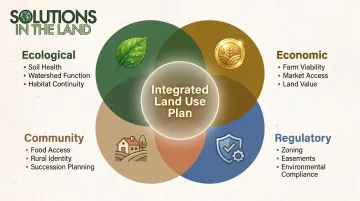
The iterative, multi-stakeholder format ensures a farmer's perspective on soil health and a city planner's perspective on food access are shaped together, not handed off in sequence.
A concrete example: the Miami-Dade County Agriculture & Rural Area Study charrette (December 2002), led by Duany Plater-Zyberk & Company, engaged farmers, residents, and government officials over four days to develop a plan for preserving the Redland's agricultural heritage. The process surfaced a critical data point — farms under 180 acres made up 93% of Dade County farms but controlled only 24% of farmland — which reshaped planning priorities rather than confirming prior assumptions. That's the charrette mechanism working as intended.
For landowners and farmers navigating land transitions — whether converting commodity cropland to regenerative systems, developing multi-use properties, or planning succession — the charrette format aligns diverse stakeholder interests before any land use direction is committed to.
Solutions in the Land, a Kenosha, WI-based regenerative agriculture consultancy, offers Planning Charrettes as part of its service model. Their process brings together agronomic, ecological, economic, and community considerations from the start, so the resulting land use plan reflects the full picture rather than a compromise reached too late.
Common Pitfalls and Best Practices
What Derails Charrettes
| Pitfall | Why It's Damaging |
|---|---|
| Predetermined outcome | Participants sense it immediately; disengagement follows |
| Absent decision-makers | No one can commit in the room; momentum dies |
| Fragmented scheduling | Spreading sessions over weeks breaks the iterative cycle |
| Wrong participants | Observers without authority can't move anything forward |
| No structured follow-up | Good sessions become forgotten conversations |
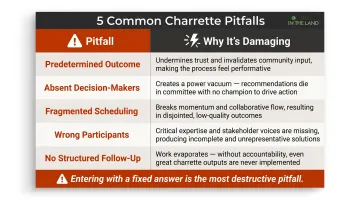
Of all these pitfalls, entering with a fixed answer is the most destructive. The NCI explicitly warns that calling a performative process a charrette damages "participants' trust and willingness to participate in future engagements."
Best Practices That Work
- Set demanding but achievable goals — vague goals produce vague outputs
- Work on or near the project site to keep participants grounded in real conditions
- Build in 24+ hours between feedback loops: the NCI specifies this as the minimum to execute a full review cycle
- Raise and address conflicts during the session, not via email afterward — unresolved tensions don't disappear, they resurface during implementation
- Publish the executive summary within one month of the event to maintain momentum and credibility with participants
Frequently Asked Questions
What does "design charrette" mean?
A design charrette is an intensive, collaborative workshop where a multidisciplinary group of stakeholders works together to develop a feasible design or planning solution. The term comes from the French word for "cart," referencing 19th-century Parisian architecture students who kept sketching as a cart collected their work at deadline.
How long does a charrette usually last?
Charrettes range from a few hours (for focused team design sessions) to four to seven or more consecutive days for full NCI-style community planning charrettes. The right length depends on project complexity, number of stakeholders, and how many feedback cycles the project requires.
How is a charrette different from a workshop?
Workshops are typically one-time events focused on ideas or skills. Charrettes are structured around iterative feedback loops and produce a detailed, feasibility-tested output. Decision-makers must be present so real commitments can be made on the spot, not deferred.
What are the different types of charrettes?
The main types include:
- Architecture and urban planning charrettes — multi-day, community-facing sessions
- Integrated design charrettes — focused on sustainability goals and LEED certification
- UX and product design charrettes — short, team-based sketch sessions
- Land use and agricultural planning charrettes — bringing together landowners, planners, and ecological experts
What is a charrette in architecture?
In architecture, a charrette is an intensive collaborative session where architects, engineers, clients, and often community members work together to rapidly develop and refine design concepts for a building, campus, or district. The term's origins lie specifically in 19th-century architectural education at the École des Beaux-Arts in Paris.
What is a charrette in LEED?
In LEED, a charrette is an early-project session where the full team aligns on energy, water, and environmental performance targets before design decisions are locked in. LEED v4.1 references this under its Integrative Process credit to help teams avoid costly changes and missed certification thresholds.