Introduction
Input costs are climbing faster than most farms can absorb them. ERS projects cash labor expenses will reach $53.9 billion in 2026, up 2.2% year-over-year — and that's before accounting for shifting market demands and growing pressure to adopt organic, regenerative, or diversified systems. Hard work alone doesn't build a financially resilient farm anymore. Strategic planning does.
According to the USDA's 2022 Census of Agriculture, there are over 1 million beginning producers in the U.S. — 30% of all farmers — with an average age of 47. Most are making major financial and lifestyle commitments without a formal plan guiding their decisions.
That gap isn't limited to new entrants. Multigenerational operations rethinking their enterprise mix, landowners weighing whether their acres can generate meaningful income, and established farms looking to transition off commodity crops all share the same need: a business plan that reflects actual conditions, not optimistic assumptions.
This guide covers what a farm business plan is, why it matters, what belongs in it, and how to build one that holds up under real operating conditions.
Key Takeaways
- A farm business plan covers goals, operations, markets, and finances — used internally for decisions and externally for lenders or grant applications.
- A complete plan addresses what you'll grow, who will buy it, what it costs, and what happens when things go wrong.
- Market validation comes before production decisions — know who will buy, at what price, before committing to an enterprise.
- Most farms take several years to reach consistent profitability; your plan must reflect realistic timelines, not best-case assumptions.
- Review and update the plan every 6–12 months, or whenever something significant changes.
What Is a Farm Business Plan?
A farm business plan is a structured document that outlines your farm's mission, production approach, market strategy, financial projections, and risk management — the operational and financial blueprint for the entire business.
It serves two distinct purposes:
- Internal: A decision-support tool that keeps goals visible, spending accountable, and priorities clear through the noise of daily farm operations
- External: A communication document for lenders, USDA program administrators, grant coordinators, or potential partners who need to evaluate the farm's viability before committing resources
Farm business plans vary considerably in scope. A beginning farmer's plan might run 8–10 pages covering the basics. An established operation expanding into value-added products, launching a CSA, or transitioning to a regenerative system will need a more comprehensive document — one that reflects the added complexity each of those decisions brings.
What doesn't change across farm types is the core structure. Every section exists for a reason, and a gap in one area — financial projections, market strategy, risk planning — tends to surface quickly when the plan is reviewed by a lender or program administrator.
What to Know Before You Start Planning
Many people begin writing a farm business plan before honestly confronting what farming actually demands. A plan built on incomplete self-assessment tends to collapse under the weight of first-season reality.
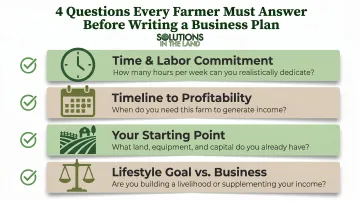
Work through these questions honestly before writing a single section:
- Time and labor commitment: In the early years, most of the work falls on the operator. Hiring help requires cash flow that typically doesn't exist yet. Are you ready for that gap?
- Timeline to profitability: Most farm operations take multiple years before generating consistent net income. ERS forecasts median farm household income at negative levels in both 2025 and 2026 after inflation — many farm households rely heavily on off-farm earnings during the early years.
- Your starting point: Starting from scratch, transitioning an existing operation, or adding a new enterprise to land currently in commodity production each carries a different cost structure and timeline. The plan must reflect which scenario applies.
- Lifestyle goal vs. business: Both are legitimate reasons to farm. But your financial projections, risk tolerance, and decision-making framework need to match whichever lens you're operating under.
A Note on Transition Planning
For farmers considering a move toward organic, regenerative, or diversified systems, the transition itself requires its own planning layer. USDA AMS requires land to undergo a 3-year transition period without prohibited substances before organic certification. During that window, you're incurring transition costs without the price premium organic certification provides.
ERS data shows that organic price premiums have narrowed since 2015 for several key crops, making conservative revenue projections essential during transition.
Map each of these before the first season begins:
- Production changes — new crop mixes, inputs, and practices that align with certification requirements
- Certification timelines — USDA AMS milestones, inspection windows, and documentation obligations
- Market relationships — buyers, pricing agreements, and distribution channels that support transition-period revenue
Why Every Farm Needs a Business Plan
A business plan isn't a box-checking exercise — here's where it makes a real difference:
Access to Capital
Most agricultural lenders — including Farm Credit institutions and USDA FSA programs — require a written business plan as part of the loan application process. The FSA publishes a dedicated Farm Business Plan Worksheet (Form FSA-2037) specifically for this purpose. FSA loan program obligations exceeded $7.5 billion in FY2020, including $3.4 billion directed specifically to beginning farmers. Without a plan, qualifying for that capital becomes much harder.
Pricing Clarity
A plan forces you to run the actual numbers. It will expose quickly whether your expected revenue covers your costs — and at what volume or price point you break even. Many farm ventures that feel viable on paper don't survive a realistic break-even calculation.
Accountability and Goal Tracking
Short-term and long-term goals documented in a plan give you a framework for measuring progress. Without it, small problems accumulate unnoticed until they become serious ones.
Built-In Risk Thinking
Operations that have worked through contingency scenarios — equipment failure, a bad season, a market channel drying up — respond faster and more effectively when those events actually happen. A plan prepares your response before you need it.
Key Components of a Farm Business Plan
Most strong farm business plans share a core set of components. Here's what each one needs to accomplish.
Executive Summary
Written last, read first. The executive summary condenses your mission, key goals, farm structure, financial needs, and expected outcomes into a half-page snapshot. A lender or grant program reviewer will form their initial impression here before reading anything else — make it clear and specific.
Operations Plan
The operations plan covers the mechanics of how the farm actually runs:
- Farm enterprise type (crop, livestock, mixed, value-added)
- Land size, ownership or lease structure
- Production systems and seasonal timelines
- Equipment and infrastructure — owned, leased, or still needed
- Input requirements and sourcing
- Labor needs, including family members and outside hires
For farms pursuing regenerative or whole-system approaches — where soil health, grazing design, and ecological function are part of the production model, not afterthoughts — the operations plan needs to account for how those systems interact. A specialist who understands those interdependencies can identify constraints and design decisions that a standard template won't surface.
Solutions in the Land's whole-system farm planning process works through a six-part framework — guiding principles, regional context, current conditions, opportunities and constraints, recommendations, and revenue generators. It addresses 143 questions per farm, covering:
- Cropping history and land fertility
- Utility easements and watershed position
- Market access and revenue potential
This treats each farm as a unique micro-climate with its own constraints, rather than applying a generic template.
Marketing Plan
A marketing plan answers four questions:
- Who is your customer? (restaurants, co-ops, direct consumers, wholesale buyers)
- What will they pay, and how do they buy?
- What channel gets product to them? (farmers markets, CSA, farm stands, wholesale, online)
- How will you reach them?
Answering these questions before finalizing your enterprise mix matters: market research should drive production decisions, not follow them. U.S. farms sold $9 billion through direct and local channels in 2020, with $2.9 billion of that direct-to-consumer. The opportunity is real — but it's competitive and location-dependent. Know your specific market before committing to an enterprise mix.
Financial Plan
This section typically includes:
- Startup or operating capital needs
- Balance sheet (assets vs. liabilities)
- Monthly cash flow statement
- Income and expense projections for 1–3 years
- Break-even analysis — the volume and price needed to cover all fixed and variable costs
The break-even analysis is the most scrutinized output in any lender review. If you can't show clearly when and how the operation covers its costs, the rest of the financial plan loses credibility. To build that credibility, free enterprise budget templates from AgPlan (University of Minnesota) and SARE's Building a Sustainable Business guide can help structure these calculations accurately.
Risk Management Plan
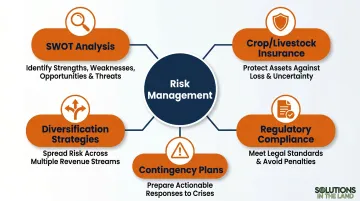
A complete risk management section addresses:
- SWOT analysis — Strengths, Weaknesses, Opportunities, Threats
- Crop or livestock insurance coverage
- Diversification strategies to reduce single-enterprise exposure
- Regulatory compliance requirements
- Contingency plans for equipment failure, severe weather, or a lost market channel
How to Build Your Farm Business Plan: Step by Step
Writing a farm business plan is rarely linear. Expect to move back and forth between sections — especially between the operations and financial components — as you gather real numbers and discover gaps in your assumptions.
The most common pitfalls:
- Deciding what to produce before confirming there's a viable market for it
- Underestimating startup costs (get actual quotes, not rough estimates)
- Building projections on optimistic assumptions rather than realistic ones
- Treating the finished plan as a filing exercise rather than a working document
Avoiding those pitfalls starts with working through each phase deliberately rather than all at once.
Phase 1: Define Your Vision, Goals, and Farm Structure
Write a mission statement that answers: why this farm, why now, and what does success look like in 1–3 years and 3–10 years?
Then document your legal business structure. The four main options each carry different implications:
- Sole proprietorship — simplest setup, full personal liability
- LLC — separates personal and business liability, flexible tax treatment
- Partnership — shared ownership and responsibility, requires a formal agreement
- Corporation — strongest liability protection, more complex compliance requirements
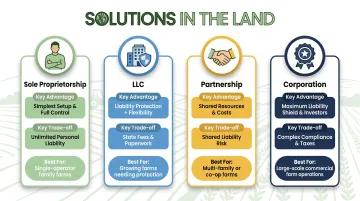
Your structure affects tax treatment and which financing programs you're eligible for, so nail this down early.
Phase 2: Research Your Market and Validate Your Numbers
Identify your target customers and verify — through direct conversations, not assumptions — what they'll pay, how they buy, and what they already have access to. Then get real quotes for inputs, equipment, land costs, and labor.
Once you have those numbers, stress-test your projections against realistic downside scenarios:
- Prices come in 15% lower than expected
- Input costs run 20% higher than quoted
- A key customer or market channel falls through
A plan that only works under best-case assumptions isn't a plan you can rely on.
Phase 3: Write and Assemble the Plan
Work through each component in this order:
- Operations plan
- Marketing plan
- Financial plan and break-even analysis
- Risk management section
- Executive summary (always last)
Use free templates and tools to avoid missing key sections. The USDA Farmers.gov business planning hub, AgPlan, and SARE's Building a Sustainable Business guide are all actively maintained and structured specifically for farm business plans.
Phase 4: Review, Update, and Put the Plan to Work
A plan earns its value through active use. Set a calendar reminder to review it every 6–12 months — or immediately after any major change: a new enterprise, a lease modification, a significant equipment purchase, or a weather event that disrupts the season.
Share the draft with your accountant, attorney, lender, insurance provider, and any agricultural consultants supporting the operation. External eyes catch assumptions you've stopped questioning and gaps you've normalized. Fix those before committing resources, not after.
Frequently Asked Questions
What is the best business structure for a family farm?
The most common options are sole proprietorship (simple to set up, but no liability protection), LLC (popular for liability protection and tax flexibility), and family partnerships or corporations. The right choice depends on farm size, tax situation, and succession goals — consult an attorney or accountant familiar with agricultural operations.
What is the most profitable farm to start?
Profitability depends on local markets, land, and operator skills — no universal ranking applies. At smaller scales, specialty crops, direct-to-consumer models, and value-added products tend to generate stronger margins than commodity grain, though ERS data shows specialty crop farms also carry the highest labor costs as a share of total cash expenses.
What is the easiest farm business to start?
"Easiest" depends on your land, capital, and experience. Small-scale market gardening, pastured poultry, and beekeeping have lower startup costs and faster revenue cycles than row crops or dairy — but each still requires real skill and market preparation to be viable.
Are family farms profitable?
It varies widely. ERS forecasts median farm household income will remain negative through 2026 after inflation, and commodity operations often depend on off-farm income to stay afloat. Diversified farms with direct market relationships, value-added products, or regenerative practices tend to achieve stronger financial resilience.
Do I need a business plan to get a farm loan?
Yes. Most agricultural lenders — including Farm Credit institutions and USDA FSA programs — require a written business plan as part of the application process. The FSA's Form FSA-2037 is specifically designed for this purpose. The plan demonstrates that you understand your operation, your market, and your repayment capacity.
How often should I update my farm business plan?
At minimum every 6–12 months, and immediately after any significant change — a new enterprise, a lease change, major equipment purchase, weather loss, or a shift in your primary market. A plan referenced and updated regularly is far more useful than one filed and forgotten after the loan closes.