Introduction
American farmland is under pressure. US cropland loses an average of 4.63 tons of soil per acre per year, and agricultural runoff is the leading cause of water quality impacts to US rivers and streams, according to the EPA. Meanwhile, fertilizer costs represent 33–45% of operating expenses for corn and wheat farmers — and much of it simply compensates for soil fertility already lost.
Conventional farming has fed hundreds of millions of people. Yet the soil depletion, water contamination, and rising input costs reflected in those numbers point to a system eroding the very foundation it depends on. Sustainable agriculture offers a different model — one built to produce food without consuming the land it grows on.
This guide covers what sustainable agriculture actually means, why it matters for US farmers and landowners, its three core pillars, the most effective practices, how it differs from regenerative agriculture, and how to begin a transition.
TLDR: Key Takeaways
- Sustainable agriculture balances environmental health, farm profitability, and community well-being as one integrated system
- Practices like crop rotation, cover cropping, IPM, and adaptive grazing reduce input costs while building long-term farm resilience
- It applies to farms of all sizes and types across the US
- Sustainable agriculture maintains resources; regenerative agriculture actively restores them
- Transitioning is most effective when it starts with a site assessment and targets the changes with the greatest impact at the lowest upfront cost
What Is Sustainable Agriculture?
The USDA defines sustainable agriculture as farming that protects the environment, aids natural resources, and makes the best use of nonrenewable resources — meeting today's food needs without compromising the ability of future generations to meet theirs.
What that definition means in practice: sustainable agriculture isn't a single technique. It's a framework — a set of principles that can apply to a 40-acre vegetable operation in Wisconsin or a 2,000-acre grain farm in Iowa. The methods change based on soil type, climate, market access, and land history. The goal stays the same: keep the land productive for the long run.
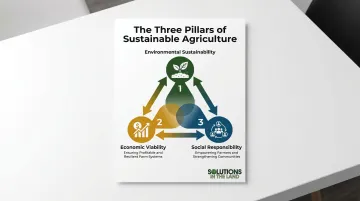
Three priorities define the framework:
- Environmental stewardship — protecting soil, water, and biodiversity
- Economic viability — keeping farms profitable without burning through resources
- Social responsibility — supporting farmworkers, communities, and the next generation of farmers
In practice, these priorities reinforce each other — healthier soil cuts input costs, stronger local markets support farm income, and profitable farms are far more likely to invest in long-term land stewardship. The sections below break down how each of these principles works and what putting them into action actually looks like.
Why Does Sustainable Agriculture Matter?
The Environmental Cost of Industrial Farming
US agriculture accounted for 10.5% of national greenhouse gas emissions in 2022, according to USDA Economic Research Service data. That figure includes nitrous oxide from synthetic fertilizer application and methane from livestock systems — both directly addressable through sustainable practices.
Soil loss compounds the problem. At current erosion rates, US cropland loses nearly 5 tons of topsoil per acre annually. The Rodale Institute notes that about 60 years of topsoil remain at current practices. When soil degrades, yields become harder to maintain without increasing chemical inputs — which accelerates the cycle.
The Economic Case for Change
A University of Colorado study published in Earth's Future found that one-third of fertilizer applied to US corn simply compensates for degraded soil fertility — costing corn farmers over $500 million per year in avoidable spending. When soil health declines, input dependency rises. Sustainable practices that rebuild natural fertility directly reduce that cost.
That cost reduction extends beyond fertilizer inputs. A 2024 USDA ARS analysis of 20 long-term experiments found that crops grown in diverse rotation systems consistently outperform those in monocultures — including under poor weather conditions — lowering production risk across the board.
Climate Resilience
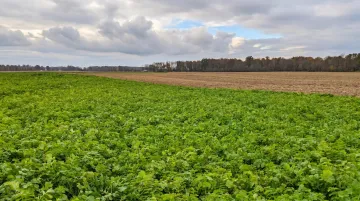
Sustainably managed soils handle weather extremes better. The Rodale Institute's Farming Systems Trial — running since 1981 — found that organically managed systems produced 31% higher corn yields than conventional during drought years. Cover crops improve water infiltration and holding capacity, giving fields a meaningful buffer against both drought and heavy rain events. Diverse cropping systems add another layer of protection by spreading risk across multiple crops and revenue streams — so a single weather event or price drop doesn't sink the whole operation.
The Three Pillars of Sustainable Agriculture
Sustainable agriculture rests on three interconnected pillars. All three must work together; neglecting one undermines the others.
Environmental Sustainability
Environmental sustainability means farming in ways that protect and restore the natural systems the land depends on. The core focus areas:
- Soil health — building organic matter, reducing compaction, supporting microbial life
- Water quality — reducing runoff, managing nutrients, protecting waterways
- Biodiversity — creating habitat, diversifying crops, reducing chemical pressure
- Carbon storage — practices that keep carbon in the soil rather than releasing it
- Reduced chemical inputs — replacing synthetic inputs with biological alternatives where possible
The goal isn't zero productivity. It's maintaining the land's capacity to produce across generations. Cover cropping, reduced tillage, and diversified rotations directly support that capacity.
Economic Sustainability
A farm that can't pay its bills can't be sustainable — regardless of its environmental credentials. Economic sustainability means:
- Reducing long-term input costs through soil health improvements
- Diversifying revenue streams to lower dependence on single commodities
- Connecting to markets that reward quality, sustainability, or differentiation
- Managing transition risk with honest, site-specific planning
Solutions in the Land structures their whole-system farm planning around this principle. Their six-part framework addresses revenue diversification and risk reduction directly, identifying which changes deliver the strongest return with the least disruption to existing operations.
Social Sustainability
Social sustainability addresses the human side of farming. A system that degrades its surrounding community through labor practices, pollution, or inaccessible pricing can't be considered truly sustainable. The core concerns include:
- Fair treatment and wages for farmworkers
- Community access to affordable, nutritious food
- Support structures for beginning and next-generation farmers
- Equitable distribution of agricultural benefits across regions
The USDA estimates 18.8 million people live in low-income, low-food-access areas across the US. Agricultural systems that prioritize local and regional food markets, fair wages, and next-generation farmer support directly address this gap.
Key Sustainable Agriculture Practices and Methods
These methods work best in combination and should be tailored to each farm's soil type, climate, markets, and production history.
Crop Rotation and Diversification
Rotating different crops across seasons and fields prevents nutrient depletion, breaks pest and disease cycles, and improves soil biology. The data supports this — a 2024 USDA ARS study spanning 20 long-term experiments found that crops in diverse rotations consistently outperformed monocultures, including under poor growing conditions.
Intercropping — growing multiple crops simultaneously — adds further benefits. Research shows intercropping increases beneficial biodiversity and can match or exceed monoculture yields while improving soil microbial diversity.
Cover Crops and Reduced Tillage
Cover crops (clover, rye, legumes) planted during off-seasons protect soil from erosion, fix nitrogen naturally, and build organic matter. Legume cover crops alone can supply up to 100 pounds of nitrogen per acre to subsequent crops — reducing fertilizer dependency without sacrificing fertility.
US cover crop adoption reached 17.9 million acres in 2022, up 17% from 2017. That growth reflects farmer recognition of real economic and agronomic returns.
Pair cover crops with reduced tillage and the benefits compound. No-till management decreases CO₂ flux by 14.5% compared to plow tillage while increasing soil organic carbon storage, according to a widely-cited 2020 meta-analysis in the Journal of Environmental Management.
Integrated Pest Management (IPM)
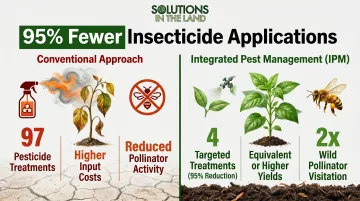
IPM uses biological controls, habitat management, resistant crop varieties, and targeted pesticide use as a last resort. A Purdue University study published in PNAS found that IPM reduced insecticide applications by 95% — from 97 treatments to 4 — while maintaining equivalent or higher crop yields. Wild pollinator visitation nearly doubled on IPM farms.
Beyond yield and ecology, IPM reduces runoff into local waterways and lowers input costs. In farmer surveys, profitability ranks as the top motivator for IPM adoption. That makes it as much a financial strategy as an environmental one.
Agroforestry and Landscape Integration
Agroforestry intentionally integrates trees and shrubs into crop or livestock systems. The benefits run in two directions:
- Ecological: carbon sequestration, biodiversity habitat, erosion control, watershed protection
- Economic: additional income from timber, fruit, or nut crops; improved livestock shelter; long-term asset value
More than 32,700 US farm operations reported agroforestry practices in 2022, a 6% increase from 2017. Adoption is growing, though agroforestry still represents a small fraction of total US farmland.
Livestock and Crop Integration
Strategically reintegrating animals into cropping systems restores a natural fertility cycle that industrial monocultures have largely eliminated. Adaptive multi-paddock (AMP) grazing — where livestock rotate through paddocks on a planned schedule — is one of the most well-documented examples.
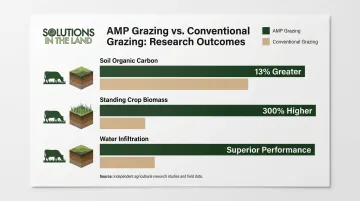
A 2022 study comparing AMP and conventional continuous grazing across ranches in Alabama, Mississippi, Kentucky, and Tennessee found:
- Soil organic carbon 13% greater on AMP ranches (to 1-meter depth)
- Standing crop biomass 300% higher on AMP-managed land
- Better surface water infiltration and less bare ground
Translating this research into farm-specific practice is where consulting expertise matters most — designing grazing plans that account for local soil conditions, forage recovery rates, and production goals.
Water Management and Conservation
Water stewardship protects both farm productivity and the surrounding watershed. Key practices include:
- Efficient irrigation scheduling — matching water application to actual crop needs
- Rainwater harvesting — capturing precipitation for reuse during dry periods
- Riparian buffer strips — planting vegetation along waterways to intercept nutrient runoff before it reaches streams
- Water-appropriate crop selection — matching crops to local rainfall and soil water-holding capacity
Irrigation accounts for the largest share of freshwater consumption in the US. Better water management cuts operating costs and protects the long-term productivity of the land itself.
Sustainable vs. Regenerative Agriculture: Understanding the Spectrum
These terms are often used interchangeably. They're not the same thing.
Sustainable agriculture aims to maintain current resource capacity — farming without further degradation of soil, water, or biodiversity. It's a "do no harm" baseline.
Regenerative agriculture goes further. Coined by Robert Rodale, "regenerative organic" farming doesn't just maintain resources — it actively improves them. The Rodale Institute frames it directly: with roughly 60 years of topsoil remaining at current practices, maintaining the status quo isn't enough. Regenerative systems are designed to build soil organic matter, restore biodiversity, and improve ecosystem function over time.
For most farmers, sustainable practices are the first step — and the most accessible one. Regenerative agriculture is the longer-term destination. Both exist on a continuum, and measurable outcomes matter more than labels.
For landowners and farmers navigating this transition, site-specific guidance matters. Solutions in the Land works with clients at both ends of this spectrum — from initial sustainable practice adoption to full regenerative system design. Managing Partner Ron Doetch's background in organic and restorative agriculture, combined with Allen Williams' expertise in adaptive grazing and soil health, means the planning process is grounded in actual land conditions, market realities, and long-term ecological goals.
How to Start Transitioning Your Farm to Sustainable Agriculture
Transition doesn't happen in a single season. The most successful farm transitions start with an honest assessment of current land health, market access, and production goals — before any practices change.
Start With High-Impact, Lower-Cost Changes
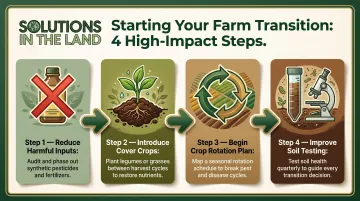
Early wins build momentum and don't require a full operational overhaul:
- Reduce or eliminate the most harmful chemical inputs — identify which inputs can be replaced with biological alternatives
- Introduce cover crops — start with a simple species mix suited to your soil and climate
- Begin a crop rotation plan — even a two-crop rotation improves soil health and breaks pest cycles
- Improve soil testing — baseline data makes every subsequent decision more accurate
Align Practices With Markets
Sustainable agriculture works when practices connect to markets that reward them. A farm that improves its soil health but can't access premium markets for the resulting products may struggle to justify the transition economically. Market alignment should be built into the plan from day one: identifying buyers, pricing structures, and distribution channels that reward quality and sustainability.
Get Site-Specific Support
Generic sustainable farming advice rarely translates cleanly to specific farms. Solutions in the Land's whole-system farm planning process addresses this directly, starting with 143 questions about each farm's history, current conditions, constraints, and opportunities before making any recommendations.
The resulting plan covers environmental enhancement, revenue streams, tenancy, and applicable federal and state programs — and functions as a long-term operating manual for the land.
For landowners and farmers across the US considering a transition, that level of structured, site-specific planning is often what determines whether a transition succeeds or stalls.
Frequently Asked Questions
What are the pillars of sustainable agriculture?
The three pillars are environmental sustainability, economic sustainability, and social sustainability. True sustainable agriculture requires all three to work together — a farm that's ecologically sound but financially unviable, or profitable but harmful to its community, doesn't meet the full standard.
What are the main methods of sustainable agriculture?
Core methods include crop rotation, cover cropping, reduced tillage, integrated pest management, agroforestry, livestock and crop integration, and water conservation practices. No single method works in isolation — the most resilient farms combine several approaches matched to their specific soils, climate, and markets.
What are examples of sustainable agricultural practices?
Common real-world examples include:
- Planting clover between growing seasons to fix nitrogen naturally
- Rotating cattle through paddocks to rebuild soil organic matter
- Installing riparian buffer strips along waterways to reduce runoff
- Replacing synthetic fertilizers with compost or cover crop residue
What is a sustainable agricultural practice?
It's any farming technique that maintains or improves land productivity without depleting natural resources, while also supporting the farm's financial health and the broader community it operates within.
What is the major role of sustainable agriculture?
Sustainable agriculture ensures farming systems can feed current and future generations by protecting the soil, water, and ecosystems that food production depends on — while keeping farms financially viable and rural communities intact.
How can agricultural practices be made more sustainable?
Start by reducing synthetic input dependency, diversifying crop and livestock systems, and improving soil health through biological practices. A whole-farm planning approach — one that accounts for your specific soils, markets, and goals — helps identify which changes to prioritize first and in what order.