For landowners, farmers, and city planners, the question isn't whether to plan — it's whether to plan deliberately or reactively. Without a clear strategy, soil degrades, water quality declines, and the productive capacity that took generations to build quietly disappears.
This guide covers what sustainable land use planning actually means, the principles that make it work, proven strategies across agriculture and conservation, and a practical framework for creating a real plan.
Key Takeaways
- Sustainable land use planning balances economic, environmental, and social needs across every land allocation decision
- Environmental stewardship, economic viability, climate resilience, and watershed-scale thinking form the core principles
- Key strategies span conservation agriculture, adaptive grazing, watershed conservation, and smart urban growth
- Benefits include healthier soil, stronger farm income, improved water quality, and long-term food security
- Effective planning starts with a site-specific assessment; generic plans consistently miss what each parcel actually needs
What Is Sustainable Land Use Planning?
Sustainable land use planning is the strategic process of evaluating and managing land resources to meet present needs without compromising future generations' ability to do the same. Every allocation decision — whether for agriculture, conservation, housing, or industry — integrates environmental, economic, and social considerations from the start.
The FAO defines land-use planning as:
"The systematic assessment of land and water potential, alternatives for land use and economic and social conditions in order to select and adopt the best land-use options."
Its purpose: selecting land uses that meet people's needs while safeguarding resources for the future.
Land Use Planning vs. Land Management
These two concepts are related but distinct:
- Land use planning is the forward-looking process of designating how land is used at a community or landscape scale — setting zones, priorities, and long-term direction
- Land management is the day-to-day practice applied within those uses — grazing rotations, tillage decisions, cover crop selection
Both must work together. A well-designed plan fails without sound management. Sound management without a coherent plan produces fragmented, often contradictory outcomes.
Why It Matters for Farmers and Landowners
Poor land use decisions have compounding consequences:
- For farmers: degraded soil, declining yields, higher input costs, and reduced long-term income
- For landowners: loss of legacy, legal exposure from environmental damage, and diminished land value
- For city planners: sprawl, resource conflicts, infrastructure strain, and climate vulnerability
At Solutions in the Land, one of the most common challenges landowners bring is straightforward: they don't know what to do with their farms. Many want to preserve a farming legacy but have no clear path forward. A deliberate plan doesn't just reduce that uncertainty — it converts it into a strategy with defined goals, timelines, and measurable outcomes.
Core Principles of Sustainable Land Use Planning
Environmental Stewardship
Protecting and restoring natural systems is the foundation of any sustainable plan. Land decisions must account for downstream effects on surrounding ecosystems, not just the parcel being managed. A single drainage decision on one farm can alter water quality across an entire watershed.
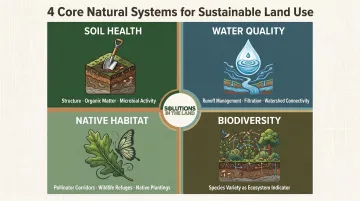
Core natural systems that every plan must address:
- Soil health — structure, organic matter, and microbial activity
- Water quality — runoff, filtration, and watershed connectivity
- Native habitat — pollinator corridors and wildlife refuges
- Biodiversity — species variety as an indicator of ecosystem function
Economic Viability and Market Alignment
Sustainability without profitability isn't sustainable. Plans must connect land decisions to income stability, commodity diversification, and reduced input costs. This means evaluating market access — organic certification, grass-fed channels, direct-to-consumer sales — as an integrated part of land planning, not an afterthought.
That market-first lens is central to Solutions in the Land's approach: revenue generation is a core planning component, not a secondary consideration. The goal is identifying profit opportunities that minimize risk while working with the natural system, not against it.
Climate Resilience
Sustainable land use plans must be designed to withstand drought, flooding, and temperature extremes. This means preserving natural buffers — wetlands, riparian zones, cover crops — and building flexibility into management systems so they can adapt as conditions shift. The data here is clear: during the severe 2012 drought, fields with cover crops saw corn yields increase 9.6% and soybean yields increase 11.6% compared to unprotected fields.
Community Engagement and Social Equity
Effective plans require input from the people most affected — farmers, neighboring landowners, local communities. Land use decisions should reflect shared values, distribute benefits fairly, and avoid externalizing costs onto vulnerable populations. Solutions in the Land's work with partners like the Fondy Food Center reflects this commitment to community-centered food system planning.
Whole-System, Watershed-Scale Thinking
It's also the most frequently overlooked principle. Sustainable land use cannot be planned parcel by parcel in isolation — decisions on one piece of land affect hydrology, soil structure, and biodiversity across an entire watershed.
Solutions in the Land's planning methodology is built around this reality. Their whole-system approach recognizes that "farms are three-dimensional and have rights and responsibilities below the surface and up and down the watershed." Membership in the Huron River Watershed Council puts that landscape-level commitment into practice.
Key Strategies for Sustainable Land Use
Sustainable Agriculture Practices
Conservation tillage, cover cropping, and crop rotation form the foundation of sustainable cropping systems. Their benefits compound over time:
| Practice | Key Benefit | Data Point |
|---|---|---|
| Cover crops | Drought resilience | +9.6% corn yield in 2012 drought |
| Cover crops | Fertilizer savings | $21.90/acre by year five |
| Crop rotation | Yield advantage | +20% vs. monoculture |
| No-till transition | Fuel and labor savings | $23.96/acre |
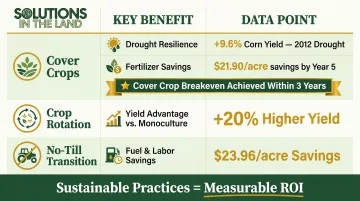
Cover crops typically reach breakeven within three years without incentive payments. With USDA EQIP payments of approximately $50/acre, they can be profitable from year one — since the median seeding cost is just $37/acre.
Agroforestry — integrating trees into agricultural landscapes — adds another layer. Trees stabilize soil, improve water infiltration, sequester carbon, and create diversified income through timber, fruit, or silvopasture. More than 30,000 farm operations across the U.S. now practice some form of agroforestry, and it's especially useful for landowners managing mixed-use properties where single-commodity production carries too much risk.
Adaptive Grazing and Pasture Management
Conventional continuous grazing compacts soil, degrades grasslands, and reduces water infiltration. Adaptive multi-paddock (AMP) grazing reverses this pattern by rotating livestock through designated areas, giving grasslands time to recover.
The results are well-documented: USDA ARS research found that AMP grazing sites stored over 13% more soil carbon and 9% more soil nitrogen than continuously grazed sites. Well-managed grazing builds soil organic matter rather than depleting it — which challenges the assumption that livestock are inherently damaging to land. Solutions in the Land's Allen Williams — a sixth-generation farmer and grazing consultant — has applied these principles across more than 4,000 farms and ranches nationwide, designing AMP systems that restore soil vitality and improve watershed function.
Watershed-Scale Conservation
Wetlands, riparian buffers, and native vegetation corridors do more than protect biodiversity — they perform measurable hydrological work for entire landscapes. USDA NRCS modeling shows that removing geographically isolated wetlands from the landscape increases surface runoff by 9% and reduces groundwater recharge by 14%.
Despite this, the U.S. lost 221,000 acres of wetlands between 2009 and 2019, with loss rates accelerating by more than 50% from the previous reporting period. Protecting these systems serves as flood risk management and water supply management — not only an environmental priority.
Smart Growth and Urban Land Use
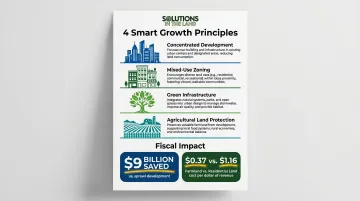
Urban land use decisions don't just affect cities — they directly determine how much pressure falls on surrounding agricultural and natural land. Smart growth principles reduce that pressure:
- Concentrating development in existing communities rather than expanding outward
- Promoting mixed-use zoning to reduce vehicle miles traveled and infrastructure costs
- Incorporating green infrastructure (green roofs, permeable pavement, urban forests)
- Protecting open agricultural land from conversion through zoning and easements
These principles also carry a strong fiscal argument. Smart growth development patterns could save local governments nearly $9 billion compared to sprawl — and the farmland they protect costs municipalities just $0.37 per dollar of revenue to service, versus $1.16 for residential land.
Benefits of Sustainable Land Use Planning
Environmental Benefits
Sustainable land use planning delivers measurable environmental outcomes:
- Improves soil fertility and structure through reduced tillage and increased organic matter
- Restores water quality by keeping sediment, nutrients, and chemicals out of waterways
- Sequesters carbon — cover crop-corn integrated systems are estimated to sequester approximately 5.5 million metric tons of soil organic carbon annually across the U.S.
- Protects biodiversity by preserving and connecting natural habitats at the landscape scale
Economic Benefits
Farmers and landowners see returns across multiple areas — often compounding over time:
- Farmers combining cover crops, no-till, and diversified rotations realize multiple overlapping input reductions that compound over time
- Crop rotation increases gross revenue by an average of 20% compared to monoculture, based on a meta-analysis of 738 field experiments
- Access to premium markets — organic, grass-fed, direct-to-consumer — adds income stability that commodity production alone cannot provide
- Agricultural land preservation reduces municipal service costs, creating community-level fiscal savings
Social and Food Security Benefits
Sustainable land use planning protects productive farmland for future generations — and the benefits extend well beyond the farm gate:
- Preserved farmland near population centers shortens supply chains and supports regional food systems
- Healthy soil and intact wetlands provide clean water and air quality benefits to surrounding communities
- Agriculture and related industries support 11% of total U.S. employment, meaning farmland loss carries direct economic consequences for rural communities
How to Create a Sustainable Land Use Plan
Step 1: Start With a Site-Specific Assessment
No two parcels are alike. Generic plans miss site-specific constraints and opportunities that only emerge through direct evaluation. An effective assessment covers:
- Soil health, fertility levels, and erosion history
- Water drainage patterns, tile systems, and watershed position
- Topography and how it affects water movement and land use potential
- Existing vegetation, natural features, and habitat corridors
- Land use history going back decades — even centuries
- Mineral rights, utility easements, and legal constraints
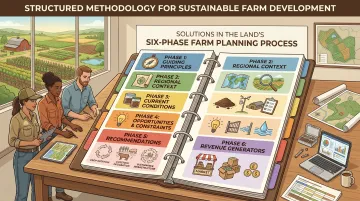
Solutions in the Land's whole-system farm planning process is built around exactly this kind of deep evaluation. Their methodology works through six structured phases: Guiding Principles, Regional Context, Current Conditions, Opportunities & Constraints, Recommendations, and Revenue Generators. Each phase answers specific questions about the farm — 143 in total — producing a complete reference manual for long-term decision-making tailored to that property.
Step 2: Define Measurable Goals Across All Three Pillars
Articulate specific, trackable goals for each dimension:
- Environmental: reduce erosion by X%, improve water retention, restore riparian buffer
- Economic: transition to organic certification, increase per-acre income, reduce input costs by year three
- Social: improve local food access, support supply chain relationships, reduce tax burden on municipality
Set timelines and benchmarks. Without them, "sustainability" remains an aspiration rather than a target.
Step 3: Build a Whole-System Plan
A sustainable plan looks at all land uses together — crops, grazing, conservation areas, water features, access roads — and designs them to support each other. Working with experienced agronomists and land planners at this stage helps landowners avoid costly mistakes and identify opportunities they would otherwise miss.
Solutions in the Land builds exactly this kind of integrated plan — connecting environmental enhancements, revenue streams, and access to relevant funding programs within one coherent strategy tied to each property's specific conditions.
Step 4: Engage Stakeholders and Align With Policy Tools
Once the plan takes shape, aligning it with existing policy tools and neighboring stakeholders significantly strengthens both its funding potential and its long-term durability. Key frameworks include:
- USDA EQIP: financial assistance for conservation practices, including ~$50/acre for cover crops
- USDA CSP: supports ongoing stewardship of working agricultural lands
- ACEP: conservation easements on agricultural land and wetlands
- Municipal comprehensive plans: zoning protections and agricultural preservation designations
- Watershed councils: landscape-level coordination with neighboring landowners
Engaging neighboring landowners and local governments early builds shared commitment, and often surfaces resources and partnerships that wouldn't emerge from single-property planning alone.
Frequently Asked Questions
What does sustainable land use mean?
Sustainable land use means managing land resources in a way that balances economic development, environmental conservation, and social well-being. The goal is to ensure that today's land use doesn't degrade the soil, water, or habitat capacity that future generations will need.
What is a sustainable land use plan?
A sustainable land use plan is a documented strategy that evaluates a land area's resources and designates appropriate uses for different zones or parcels. It outlines the practices needed to achieve long-term productivity, environmental health, and community benefit.
What are the main principles of sustainable land use planning?
The five core principles are environmental stewardship, economic viability, community engagement and equity, climate resilience, and whole-system thinking at the watershed or landscape scale.
What are some examples of sustainable land use?
Concrete examples include agroforestry systems, adaptive rotational grazing, wetland conservation buffers, cover cropping and no-till farming, urban green infrastructure, and conservation easements on agricultural land.
How can we promote sustainable land use?
Sustainable land use is promoted through multiple overlapping strategies:
- Farmer education and technical assistance
- Market incentives for sustainably produced goods
- Government programs like EQIP and conservation easements
- Community-based planning that aligns local goals with environmental stewardship
How does land use affect sustainability?
Land use decisions directly determine whether soil, water, and biodiversity are preserved or degraded. Unsustainable practices — monoculture farming, overgrazing, unplanned development — deplete these resources, while sustainable approaches actively restore them and build long-term resilience.