The response to this crisis isn't simply better chemistry or more precise machinery. It's a fundamentally different relationship with land.
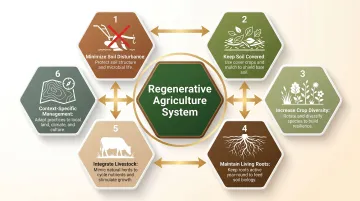
Regenerative agriculture rebuilds what conventional farming depletes — soil biology, water retention, biodiversity, and farm economics. It's not a checklist or a certification. It's a philosophy of active restoration, applied through six interconnected principles that work together as a system.
This guide covers all six, explains the science behind them, and shows how they translate into real outcomes for farmers and landowners.
Key Takeaways
- Regenerative agriculture restores soil biology, water cycles, and farm economics. Unlike sustainable approaches, it actively rebuilds degraded systems rather than just maintaining them.
- Six core principles — from minimizing soil disturbance to integrating livestock — work together as a mutually reinforcing system.
- Combined application multiplies outcomes: no-till alone improves water infiltration by 5.7%; paired with cover crops, that figure jumps to 44.6%.
- Soil organic matter gains, carbon sequestration, reduced input costs, and watershed-scale water quality improvements are all documented outcomes.
- Transition success depends on a site-specific plan: soil type, climate, sequencing, and market access all determine which practices will deliver results.
What Is Regenerative Agriculture?
Regenerative agriculture is a land management philosophy that goes beyond "sustainable." Sustainability aims to maintain current conditions. Regenerative agriculture rebuilds soil biology, ecosystem function, and long-term farm productivity — moving toward restoration rather than holding a steady state.
That restorative ambition is grounded in both modern science and long historical practice. Robert Rodale coined the term "regenerative organic" in the 1980s, defining it as an approach that "at increasing levels of productivity, increases our land and soil biological production base." Indigenous farming communities worldwide had practiced many of these same principles for millennia before that language existed.
How It Differs from Organic Farming
The distinction matters practically:
- Organic farming avoids synthetic pesticides, herbicides, and fertilizers — defined largely by what's excluded
- Regenerative agriculture actively builds soil life, biodiversity, and ecosystem function — defined by what's gained
- A farm can be regenerative without organic certification, and certified organic without being regenerative
- The two approaches are compatible and often complementary, but they're not the same thing
Regenerative agriculture is not a prescriptive formula. Soil type, climate, existing biodiversity, and market access all shape which practices make sense for a given operation — and in what order.
The 6 Principles of Regenerative Agriculture
These principles aren't independent techniques to pick and choose from. Their power comes from synergy — each one amplifies the others. A meta-analysis of 89 studies illustrates this clearly: no-till alone improves water infiltration by just 5.7%, but combined with cover crops, the gain reaches 44.6%.
Minimize Soil Disturbance
Tillage does more damage than it looks. Each pass of a plow:
- Breaks apart fungal networks that transport nutrients between plants and soil
- Releases stored soil organic carbon into the atmosphere
- Disrupts microbial communities responsible for nutrient cycling
- Destroys the macroaggregates that give soil its water-holding structure
No-till and reduced-till farming protect these systems by leaving soil architecture intact. The result is improved water infiltration, better carbon retention, and a more biologically active root zone.
Currently, only 27.5% of U.S. cropland acres use no-till, leaving enormous room for adoption. The biophysical potential for soil carbon sequestration through no-till on U.S. cropland sits at approximately 140 Tg CO₂ per year, with nearly 77% achievable for under $50 per Mg CO₂.
Keep the Soil Covered
Exposed soil erodes, dries out, and sheds the microbial communities that make it productive. Wind, rain, evaporation, and temperature swings all extract value from unprotected ground.
Cover crops, crop residues, and mulches protect the soil surface year-round. The numbers are striking: a 2025 meta-analysis found that cover crops reduce soil organic carbon erosion by an average of 68% on an annual basis while simultaneously increasing topsoil SOC stocks.
Cover crop mixtures — particularly those including legumes — do more than just protect. Compared to bare fallow:
- Bulk soil organic carbon is 16.7% higher in cover-cropped fields
- Cover crop mixtures increase the most stable (mineral-associated) carbon fraction by 25.9%
- Free particulate organic matter SOC content is 73.6% higher in cover-cropped soils
Despite this, cover crops still cover only about 5% of total U.S. cropland. Federal programs like EQIP offer cost-share support to accelerate adoption.
Increase Crop Diversity
Monocultures simplify soil biology. A single crop, season after season, feeds a narrow range of soil microbes and starves everything else.
Diverse rotations reverse this. Research shows that crop rotation increases soil microbial biomass carbon by 13.43% and microbial biomass nitrogen by 15.84% compared to continuous monoculture systems. More microbial diversity means better nutrient cycling, improved pest suppression, and reduced dependence on synthetic inputs.
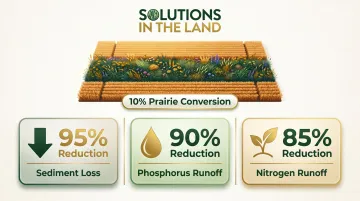
Diversity also works above ground. Native prairie strips are a compelling example: converting just 10% of a crop field to native perennial vegetation reduces sediment loss by 95%, phosphorus runoff by 90%, and nitrogen runoff by 85% — with significant pollinator habitat value confirmed by a decade of Iowa State University research. More than 26,000 acres of prairie strips have now been installed across 14 states.
Maintain Living Roots in the Ground
Roots don't just anchor plants — they actively feed soil life. Through root exudates (sugars, amino acids, and other compounds released into the rhizosphere), roots sustain the fungi and bacteria that drive soil fertility. When fields sit bare between crops, that biological engine goes idle.
Keeping living roots in the ground year-round changes the equation. Perennial cropping systems are especially effective: perennial intermediate wheatgrass delivers 5 to 6 times more total soil organic carbon input than annual winter wheat, with over 95% of that carbon coming from belowground sources. Annual systems, by contrast, derive only 67% of SOC inputs from roots.
For annual cropping systems, cover crops during fallow periods extend living-root benefits across the full calendar year, filling the biological gap between cash crops.
Integrate Livestock
Thoughtfully managed grazing mimics the movement of wild herds that historically shaped North America's most productive grassland soils. When livestock graze cover crops or crop residues with appropriate timing and rest periods, they:
- Recycle nutrients directly back to the soil surface
- Stimulate plant regrowth through grazing pressure
- Increase soil carbon through hoof action and biological inputs
- Add a diversified revenue stream to the operation
The evidence for adaptive multi-paddock (AMP) grazing is concrete: AMP grazing sites contain over 13% more soil carbon and 9% more soil nitrogen than continuously grazed sites, measured to 1-meter depth. This carbon accumulates in the mineral-associated organic matter fraction, the form most resistant to loss.
The key word is intentional. Poorly managed grazing degrades soil and compacts the surface. Livestock integration is regenerative only when timing, stocking density, and rest periods are actively managed — and that's where system design matters most.
Apply Context-Specific Management
No two farms are identical. Soil type, rainfall, existing plant communities, market access, and operator goals all shape which practices deliver results and in what sequence.
This is why regenerative agriculture is a philosophy, not a prescription. The same meta-analysis that documented no-till's 5.7% average infiltration gain also found that in 600–1,000 mm precipitation zones, no-till improves infiltration by 55.6%. Context determines outcome.
For farmers, this means treating each management decision as part of a whole system. Every choice — what to plant, when to graze, how long to rest a paddock — compounds across the operation over time. The farms making the most progress tend to track what's working, adjust annually, and resist applying someone else's system to their own land.
The Real-World Benefits: Environmental and Economic Outcomes
Soil Health and Water Retention
Regenerative practices build soil organic matter over time. Each 1% increase in soil organic matter helps soil hold approximately 20,000 more gallons of water per acre (a benchmark from USDA NRCS, with the actual figure varying by soil texture). The NRCS estimates the total long-term value of a 1% SOM increase at roughly $29 per acre in combined nutrient and water-holding capacity benefits.
Better water retention means more drought resilience, less irrigation dependency, and more stable yields during dry years.
Carbon Sequestration and Climate Resilience
Through photosynthesis and microbial activity, biologically active soils continuously draw atmospheric CO₂ belowground — functioning as active carbon sinks rather than emission sources. Improved water infiltration also reduces surface runoff, cutting flood risk downstream while keeping more moisture available on-farm during dry periods.
Biodiversity Above and Below Ground
Diverse cropping systems and reduced chemical inputs allow ecosystems to recover — both above and below the soil surface:
- Above ground: Beneficial insects and pollinators return as prairie strips and habitat corridors are established. A decade of Iowa State research confirms prairie strips' value as pollinator habitat within row-crop landscapes.
- Below ground: Diverse rotations rebuild microbial communities that provide natural fertility and pest suppression, reducing purchased input dependency over time.
Economic Outcomes for Farmers and Landowners
The financial case for regenerative agriculture builds over time:
- Reduced input costs — lower fertilizer, herbicide, and pesticide expenditures as soil biology improves
- Diversified revenue — livestock integration, specialty crops, and conservation program payments add income streams
- Improved land value — healthier soils represent a long-term asset with compounding returns
- Federal cost-share — EQIP payments for no-till average $53.23/ha, helping offset transition costs
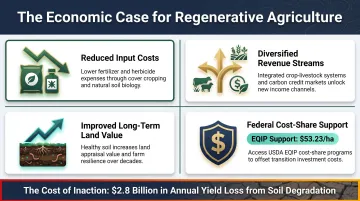
The cost of inaction is also real. Degraded Corn Belt soils currently cost an estimated $2.8 billion in annual yield losses — a baseline that regenerative management can reverse.
Watershed and Community-Scale Benefits
Regenerative farms don't just benefit the fields where practices are applied. Reduced nutrient runoff and sediment loading improve water quality at the watershed scale — effects that ripple downstream to rivers, lakes, and municipal water supplies.
Prairie strips, for example, cut nitrogen runoff by 85% and phosphorus by 90% — individual farm decisions with measurable consequences far beyond the field boundary. Solutions in the Land builds this watershed-scale perspective into every whole-system farm plan, because on-farm choices and landscape outcomes are inseparable.
Putting Regenerative Principles into Practice on Your Farm
Starting Points for Transition
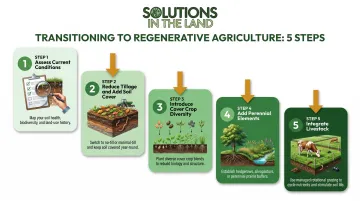
Sequencing matters. Most successful transitions follow a rough progression:
- Assess current conditions — soil health baseline, drainage patterns, existing biodiversity, and production system before making changes
- Reduce tillage and add soil cover — foundational practices that protect existing soil structure and begin building organic matter
- Introduce cover crop diversity — start simple, then add species and mixtures as experience grows
- Add perennial elements — prairie strips, buffer plantings, or perennial crops where site conditions allow
- Integrate livestock — typically a later-stage addition requiring grazing infrastructure and management capacity
Common Barriers — and How to Address Them
Transition is real work. Common challenges include:
- Time horizon — measurable SOC gains typically require 5+ years of consistent practice
- Short-term yield fluctuations — some crops may underperform during the transition period as soil biology rebuilds
- Equipment and infrastructure costs — no-till drills, fencing for livestock rotation, or cover crop seeding equipment
- Learning curve — adaptive management requires ongoing observation, not fixed routines
Site-specific planning reduces most of these risks. Knowing which practices deliver the highest impact for a given soil type, climate, and market means early efforts go where they matter most.
Solutions in the Land's whole-system farm planning process works through 143 questions about each farm — from regional history and current soil conditions to market access, revenue opportunities, and relevant USDA programs. The result is a reference plan built around each farm's specific constraints and opportunities, tailored rather than templated.
Monitoring Progress Over Time
Regenerative agriculture is a direction, not a destination. Tracking progress requires consistent measurement:
- Soil tests — organic matter, biology, structure, and nutrient levels over time
- Cover assessments — percentage of soil covered across seasons
- Biodiversity observations — beneficial insect presence, plant diversity, soil fauna
- Financial benchmarking — input costs, yield stability, revenue per acre
Data guides adaptation. Farms that track outcomes can adjust cover crop mixes, refine grazing rotations, and spot compounding gains that wouldn't be visible without a baseline to compare against.
Frequently Asked Questions
What are the principles of regenerative agriculture?
The six core principles are: minimize soil disturbance, keep soil covered, increase crop diversity, maintain living roots year-round, integrate livestock, and apply context-specific management. They function as an interconnected system — applying them together produces significantly greater outcomes than any single practice alone.
What are the 4 R's of regenerative agriculture?
The 4 R's (Right Source, Right Rate, Right Time, Right Place) are a nutrient management framework that supports regenerative goals by reducing synthetic input dependency. Applied within a regenerative system, they help farmers use fertility inputs more precisely while soil biology rebuilds its own nutrient cycling capacity.
What are the 6 methods of sustainable agriculture?
Sustainable agriculture methods typically include crop rotation, integrated pest management, water conservation, soil management, agroforestry, and livestock management. Regenerative agriculture incorporates all of these but goes further — actively rebuilding degraded soil systems rather than simply maintaining current conditions.
What are the 6 key roles of soil?
Soil performs six critical ecological functions: nutrient cycling, water filtration and retention, carbon storage, support for plant growth, habitat for biodiversity, and regulation of atmospheric gases. Restoring these functions is the practical aim of every core regenerative practice.
How is regenerative agriculture different from organic farming?
Organic certification focuses on avoiding synthetic inputs. Regenerative agriculture focuses on actively building soil biology and ecosystem function. A farm can do one without the other — though the two approaches are often complementary.
How long does it take to see results from regenerative agriculture?
Some improvements, such as reduced compaction and better water infiltration, can appear within one to three seasons. Meaningful soil organic matter gains typically take five to ten years, which is why early site-specific planning helps prioritize wins that keep the transition financially viable.