
Despite their value, cover crops were planted on only 4.7% of total US cropland in 2022 — roughly 18 million of 380 million acres. The gap between what's possible and what's being practiced is enormous.
This guide covers what cover crops are, how they function within a regenerative system, which types serve which goals, how to select and manage them, and what the economics actually look like for US row-crop producers.
Key Takeaways
- Cover crops are non-cash plants grown between main crop cycles to protect and improve soil
- They prevent erosion, fix nitrogen, suppress weeds, and steadily rebuild organic matter
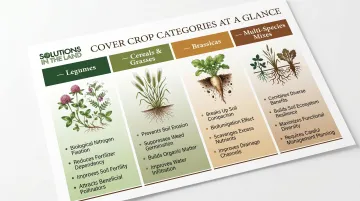
- Legumes, cereals, brassicas, and multi-species mixes each serve different farm goals
- Choose species based on your soil type, climate, equipment, and rotation window
- USDA EQIP payments (up to $76.89/acre in some states) can cover first-year establishment costs
What Are Cover Crops and Why Are They Central to Regenerative Farming?
SARE defines a cover crop as "a plant that is used primarily to slow erosion, improve soil health, enhance water availability, smother weeds, help control pests and diseases, and increase biodiversity." These are plants grown not to sell, but to keep the soil alive and protected between cash crop cycles.
That distinction matters. Conventional agriculture treats the field as a production unit, maximizing output from each season and leaving land bare until the next planting. Regenerative farming treats the field as a living system that needs continuous care.
Bare soil loses structure, bleeds nutrients, and starves the microbial communities that drive long-term fertility.
The Four Pillars of Soil Health
USDA NRCS identifies four principles of a Soil Health Management System:
- Maximize presence of living roots — keep biology active year-round
- Minimize disturbance — reduce tillage and compaction
- Maximize soil cover — protect the surface from erosion and moisture loss
- Maximize biodiversity — support diverse plant and microbial communities
Cover crops directly address three of these four. They work alongside no-till or reduced-tillage systems, adaptive grazing, and crop rotation diversity — not as a standalone fix, but as the practice that keeps soil biology functioning during the months when cash crops aren't in the ground.

The Core Benefits of Cover Crops in a Regenerative System
Soil Health and Erosion Control
Bare soil is vulnerable soil. Wind and rain dislodge particles, carry away topsoil, and compact the surface into a crust that sheds water instead of absorbing it. Cover crop canopy intercepts rainfall and distributes it more gently; root systems anchor soil particles below the surface.
SARE research shows the impact is dramatic:
| Tillage System | Sediment Loss Reduction with Cover Crops |
|---|---|
| Conventional-till | 20.8 tons/acre average reduction |
| Reduced-till | 6.5 tons/acre average reduction |
| No-till | 1.2 tons/acre average reduction |
Non-legume covers (rye, ryegrass, barley) reduced soil loss by 31% to 100% versus bare fields. Brassicas reduced loss by up to 82%.
Cover crops also build soil organic matter over time. Non-legumes increased SOM by 4% to 62% in compiled research; legumes by 8% to 114%. Since soil organic matter is approximately 58% carbon, these gains improve water-holding capacity, nutrient cycling, and drought resilience — compounding across every season.
Nitrogen Fixation and Nutrient Management
Leguminous cover crops form symbiotic relationships with rhizobium bacteria in the soil, pulling atmospheric nitrogen into plant-available forms. The nitrogen contribution is substantial:
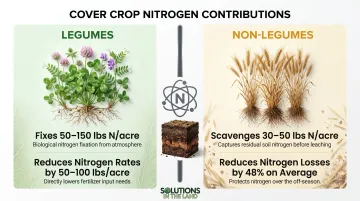
- Legumes (clovers, hairy vetch, field peas): fix 50–150 lbs of nitrogen per acre
- Non-legumes (rye, oats, brassicas): scavenge 30–50 lbs of nitrogen per acre
For corn-soybean rotations — where nitrogen is the largest fertilizer expense — a well-managed legume cover can significantly cut synthetic inputs. Practical Farmers of Iowa estimates legume credits could cut nitrogen rates by 50–100 lbs/acre in extended rotations.
Non-legumes serve a different function: they scavenge excess nutrients left after the main crop, keeping nitrogen in the system rather than letting it leach into waterways. SARE reports cover crops reduce nitrogen losses by an average of 48%, a critical advantage for farmers in the Midwest and Great Lakes region where watershed health is under regulatory scrutiny.
Weed, Pest, and Disease Suppression
Dense cover crop canopy shades out weed seeds during the critical germination window. Terminating the cover leaves a residue mulch that physically blocks emergence.
The numbers depend on biomass — and this is where many farmers underestimate what's needed. University of Wisconsin Extension research shows cereal rye needs approximately 4,500 lbs/acre biomass to reduce waterhemp density by 50%. When terminated at planting, cereal rye reduced early-season weed biomass by 61% compared to no-till without a cover crop.
Brassica species offer a distinct suppression mechanism. Glucosinolates in brassica tissue convert to isothiocyanates when plant cells are disrupted, creating a natural fumigation effect in the soil. Oregon State Extension research confirms brassica covers can manage Verticillium and plant-parasitic nematodes, offering a low-input alternative to synthetic soil fumigants.
Carbon Sequestration and Biodiversity
Living roots feed soil microbes constantly through exudates. Those microbes build stable organic compounds — humus — that store carbon in the soil for decades. Cover crops extend this process through months when cash crops are absent.
The biodiversity benefit is often overlooked. Approximately 44% of cover crop users specifically choose species to support pollinators and beneficial insects, according to the SARE/CTIC National Cover Crop Survey. Cover crops can increase beneficial insect populations by 10 to 100 times compared to bare fields, directly supporting natural pest control heading into the following cash crop season.
Types of Cover Crops: Legumes, Non-Legumes, and Mixes
Legumes
The primary value of legume covers is nitrogen fixation. Key species:
- Red clover and crimson clover — excellent cold tolerance, reliable establishment
- Hairy vetch — high biomass, strong nitrogen contributor, good winter hardiness
- Field peas and cowpeas — fast-establishing, effective in shorter windows
- Alfalfa — deep-rooted, long-term fertility builder
Legumes excel ahead of nitrogen-hungry cash crops like corn. They're generally less effective at scavenging residual nutrients compared to cereals — so they're best deployed strategically in the rotation rather than as the default every year.
Cold tolerance and drainage requirements vary significantly across legume species. Hairy vetch handles colder conditions better than cowpeas, which need a longer, warmer window. Choosing the wrong species for your climate zone costs you the stand — and the season.
Non-Legumes: Cereals, Grasses, and Brassicas
| Category | Common Species | Primary Function |
|---|---|---|
| Grasses/Cereals | Cereal rye, oats, barley, triticale, annual ryegrass | Erosion control, weed suppression, N scavenging |
| Brassicas | Daikon radish, mustard, turnips | Compaction relief, biofumigation, nutrient scavenging |
| Broadleaves | Buckwheat, sunflower | Pollinator support, rapid biomass in short windows |
Cereal rye is the most widely planted winter cover crop in the US — 51% of farmers in the SARE/CTIC survey reported using it in mixes. Its cold tolerance allows establishment even after late corn or soybean harvest in northern climates, making it the logical starting point for Midwest farmers new to cover cropping.
Daikon radish brings a different kind of value: its deep taproot physically fractures compacted subsoil layers, improving drainage and root penetration for the following cash crop. It winterkills in most northern climates, which simplifies termination considerably.
Cover Crop Mixes
Multi-species mixes combine the benefits of legumes and non-legumes simultaneously:
- More total biomass than any single species
- Nitrogen fixation plus nutrient scavenging in one planting
- Broader pollinator support across flowering times
- Better winter survival through species redundancy
- Greater ground coverage from diverse rooting depths
The trade-off is seed cost and management complexity. A hairy vetch/cereal rye blend costs more than straight rye — and a five-species cocktail requires careful attention to seeding rates, termination timing, and species compatibility.
For farmers starting out: begin with a simple two- or three-species mix, build experience for one to two seasons, then add complexity. Attempting a complex cocktail without established systems is one of the most common reasons new cover crop programs fail.
How to Select, Seed, and Manage Cover Crops
Matching Species to Your Farm's Goals
Start with one or two primary goals, not five. The most common beginner mistake is trying to solve every soil problem simultaneously with a single cover crop program.
Goal-to-species decision framework:
| Primary Goal | Recommended Species |
|---|---|
| Nitrogen addition | Hairy vetch, red clover, crimson clover, field peas |
| Erosion control | Cereal rye, winter wheat, annual ryegrass |
| Weed suppression | Cereal rye (high biomass), sorghum-sudangrass |
| Compaction relief | Daikon radish, tillage radish |
| Pollinator support | Crimson clover, buckwheat, sunflower |
After identifying your goal, filter by soil drainage, climate zone, and how the cover crop fits your rotation window. A species that checks every agronomic box but doesn't fit your planting window is still the wrong choice.
Farms with active grazing operations have an additional option: cover crops as dual-purpose forage. Managed grazing integrated with cover crop systems can add direct income while building soil health simultaneously.
This dual-use approach is particularly relevant for operations in transition. Allen Williams, Solutions in the Land's sixth-generation farmer and Grazing and Soil Consultant, works with producers on exactly this kind of whole-farm integration — designing grazing systems that offset cover crop costs through near-term revenue.
Seeding Timing, Rates, and Methods
Three main seeding windows exist:
- Post-harvest seeding — most common, straightforward logistics
- Interseeding into a standing cash crop — extends establishment window, requires equipment compatibility
- Aerial seeding — used ahead of harvest in corn or soybeans, variable success
Earlier establishment consistently produces more biomass and greater nitrogen fixation. Missed seeding windows are one of the top reasons cover crops underperform. A cover crop planted three weeks late in October produces a fraction of the biomass of one planted in mid-September.
Equipment decisions:
- Drill seeding is most precise and requires lower seeding rates
- Broadcast seeding requires 5–20% higher seeding rates to compensate for uneven soil contact
- Aerial seeding is convenient but inconsistent — results depend heavily on rainfall timing after application
Treat cover crop planting as a formal calendar task, not an afterthought. These timing decisions compound across seasons — a point built into Solutions in the Land's whole-farm planning process, which maps the full rotation calendar from the start.
Termination and Transition to Main Crop
Common termination methods and their alignment with regenerative goals:
- Herbicide — most common; effective across species; compatible with no-till systems
- Roller-crimper — mechanically terminates without tillage; ideal for no-till, requires high biomass
- Winterkill — select species that naturally die in cold; simplest management (daikon radish, oats)
- Tillage incorporation — incorporates organic matter as green manure; contradicts no-till goals
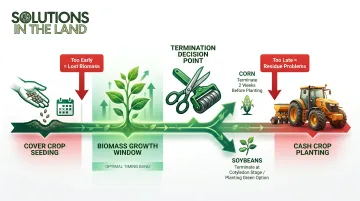
Timing is the most operationally significant decision. Purdue Extension recommends terminating cereal rye approximately two weeks before corn planting — delayed termination causes nitrogen competition that limits corn yield.
For soybeans, the calculus is different. Terminating cereal rye up to the soybean cotyledon stage maintained yield while significantly improving waterhemp suppression. Planting green — seeding soybeans directly into standing cover before termination — captures the most biomass for weed suppression but adds management complexity that requires deliberate planning.
Terminating too early sacrifices biomass and nitrogen credit. Too late creates residue and moisture problems at planting. Target the timing window specific to your cash crop, and build that date backward into your seeding schedule.
Cover Crop Economics: Costs, Returns, and Financial Incentives
What It Actually Costs
SARE's national survey data puts the total per-acre cost range at $15–$78, with a median of approximately $37/acre:
| Cost Component | Per-Acre Range |
|---|---|
| Seed | $10–$50 |
| Seeding | $5–$18 |
| Termination | $0–$10 |
| Total | $15–$78 |
Simple cereal covers (oats or rye, locally sourced) sit at the low end. Complex legume-heavy mixes hit the high end on seed cost alone.
The Long-Term Return
The yield gains from cover cropping are real but slow-building. SARE data shows:
- +3% corn yields and +4.9% soybean yields after five consecutive years of cover cropping
- During the 2012 drought: +9.6% corn and +11.6% soybeans versus non-cover-cropped fields
Iowa State CARD found positive net returns of $8.59/acre for corn and $14.25/acre for soybeans when covers were terminated with herbicide. The drought-year figures make a strong case for treating cover crops as yield insurance — returns are highest exactly when they're most needed.
Fertilizer savings add up quickly. Legume credits of 50–100 lbs of nitrogen per acre translate directly into reduced synthetic fertilizer purchases — at current nitrogen prices, that's roughly $30–$60/acre back in your pocket annually.
USDA Financial Assistance
Federal cost-share can change the economics dramatically, especially in year one:
- EQIP (Environmental Quality Incentives Program) — Wisconsin FY25 rates show a basic Cover Crop (Practice 340) payment of $76.89/acre, which can fully exceed establishment costs for simple cereal covers
- CSP (Conservation Stewardship Program) — Enhancement E340A offers additional payments for cover crops specifically targeting soil erosion reduction
- State-level programs — many states and conservation districts stack additional incentives on top of federal programs
Payment rates vary by state and fiscal year. For farmers weighing whether to start, working with a consultant who can map EQIP and CSP eligibility to your specific operation is often the fastest path to a cash-flow-positive first year. Solutions in the Land's whole-farm planning process addresses 143 questions per farm — including which conservation programs apply — so nothing gets left on the table.
Frequently Asked Questions
What are the best cover crops for regenerative farming?
No single species covers every goal, but the most reliable starting points are cereal rye (cold-climate erosion control and weed suppression), hairy vetch and red clover (nitrogen fixation), daikon radish (compaction relief), and multi-species mixes for holistic soil building. The right answer always depends on your climate, soil type, and what you're trying to fix first.
Do farmers get paid to plant cover crops?
Yes. USDA NRCS EQIP and CSP programs both offer cost-share payments for cover crop establishment, with rates varying by state and practice. Some state programs and conservation districts offer additional incentives. Contact your local NRCS office or a regenerative ag consultant to confirm current rates and eligibility for your operation.
Why do some farmers not plant cover crops?
The most common barriers are upfront seed and equipment costs, uncertainty about termination timing, and difficulty fitting cover crops into an already-complex rotation schedule. These are real challenges, but most come down to planning — not agronomy — and are manageable with the right guidance before the season starts.
How much does regenerative agriculture cost?
Costs vary depending on which practices are adopted and at what scale. Many regenerative practices, including cover cropping, reduce fertilizer and herbicide costs over time. USDA cost-share programs regularly offset transition expenses, making the entry point lower than most producers expect.
What are the 4 R's of regenerative agriculture?
The 4 R's are Right Source, Right Rate, Right Time, and Right Place — a nutrient stewardship framework for optimizing fertilizer use. Cover crops support all four by cycling nitrogen naturally, reducing synthetic input needs, and keeping soil biologically active at the right points in the crop calendar.
What is regenerative land management?
Regenerative land management is a whole-system approach to farming that actively restores soil health, improves water cycles, sequesters carbon, and increases biodiversity — goals that go beyond simply sustaining current conditions. Cover crops are one of the most practical entry points for row-crop producers beginning that shift.