
Introduction
Commodity prices swing without warning. Soil organic matter keeps declining. A single bad season — drought, flooding, pest pressure — can wipe out a year's income when everything rides on one crop. These aren't hypothetical risks; they're the operating reality for most American farmers today.
Integrated farming systems (IFS) address all of these pressures by combining multiple enterprises — crops, livestock, horticulture, composting — into one interdependent operation where the waste from one component becomes the input for another.
The result is a farm built to absorb shocks: diversified income streams, improving soil health, and greater output per acre over time.
This article covers what an integrated farming system actually is, the main types in practice, the measurable benefits, and the best practices that determine whether implementation works or falls apart.
Key Takeaways
- IFS combines crops, livestock, horticulture, and composting so each enterprise feeds the others — reducing waste and external input costs
- Diversified systems match or outperform conventional farms on profitability — a meta-analysis of 119 peer-reviewed studies found higher gross income and net returns across the board
- Key benefits include lower input costs, measurable soil health gains, reduced emissions, and more stable year-round income
- Main IFS types: crop-livestock integration, agroforestry, agri-aquaculture, and crop-horticulture systems
- Expect a four-year transition period before break-even; plan finances accordingly
What Is an Integrated Farming System?
The FAO defines integrated farming as "a circular approach to agriculture: wastes or by-products from a production system are used as inputs within another production system, while improving land use efficiency and productivity." The USDA-ARS adds precision: an integrated agricultural system contains "multiple enterprises that interact in both space and time, leading to a synergistic transfer of resources between those enterprises."
In practice, that means manure from a dairy herd feeds a vermicomposting operation, which produces fertility for vegetable beds, whose crop residue cycles back to the animals. Nothing leaves the farm as waste — every output becomes someone else's input.
How IFS Differs from Conventional Farming
Conventional monocropping maximizes yield from a single commodity. IFS maximizes total system productivity per unit of land and time — a critical distinction for small and marginal landholders who can't compete on commodity volume but can compete on per-acre efficiency and market diversity.
Core Components of an IFS Model
Most IFS configurations include some combination of:
- Crop production — seasonal grains, legumes, and perennial food crops
- Livestock — dairy cattle, goats, or poultry for milk, meat, and eggs
- Horticulture — fruit trees, vegetables, and specialty crops
- Vermicomposting or composting — converting animal and crop waste into soil amendments
- Boundary or border planting — for fodder, carbon sequestration, and additional income
- Aquaculture (optional) — fish ponds whose nutrient-rich water fertilizes adjacent crops
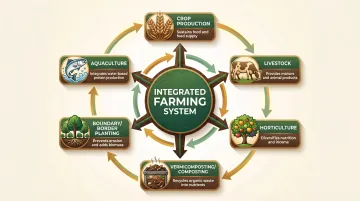
No two IFS models are identical. The right combination depends on land size, soil type, local market demand, available labor, and climate. Getting that fit right is where whole-system planning makes the difference between a model that looks good on paper and one that actually works.
Types of Integrated Farming Systems
Crop-Livestock Integration
The most widely practiced IFS type, crop-livestock integration recycles animal manure back into the cropping system while crops and forages supply feed. A typical configuration combines maize and sunflower production with a dairy and goat component, creating a closed nutrient loop that cuts fertilizer purchases.
SARE-funded research at Kansas State University demonstrated that integrating crops, livestock, and cover crops helped producers offset revenue losses during persistent drought — precisely the kind of risk reduction that single-enterprise farms can't access.
Agroforestry
Trees are integrated with crops and/or livestock through two primary approaches:
- Alley cropping — annual crops grown between rows of maturing trees, generating both short-term crop income and long-term timber, nut, or fruit revenue
- Silvopasture — livestock grazed in forested or tree-integrated pastures, benefiting from shade while the trees benefit from fertilization
USDA documentation confirms agroforestry systems improve water quality, nutrient utilization, carbon storage, and biodiversity — making agroforestry among the most well-documented IFS options for measurable carbon and water outcomes.
Agri-Aquaculture and Crop-Horticulture Systems
In agri-aquaculture, fish pond water fertilizes adjacent crops while crop byproducts provide feed and habitat for fish. Rice-fish systems are a well-documented example that maximize productivity from a single land base.
Crop-horticulture systems take a different approach, layering fruit trees with seasonal vegetables and specialty crops for year-round income. High-value components — herbs, tomatoes, peppers, leafy greens — tend to carry the strongest per-acre returns, particularly through direct market channels.
Adaptive Multi-Paddock (AMP) Grazing
In the US context, AMP grazing combined with cover cropping represents a growing and economically compelling IFS model. Research from Johnson et al. (2022) studying ranch pairs across Mississippi, Alabama, Tennessee, and Kentucky found that AMP systems produced:
- 20.6% increase in soil organic carbon (top 10 cm)
- 46% more standing crop biomass
- 2.38x higher stocking densities without synthetic inputs
- 19.52% reduction in soil CO₂ respiration rates
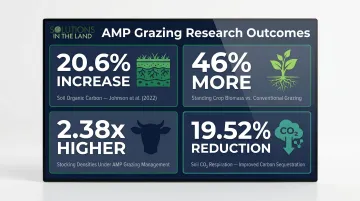
The scale of these gains points to what AMP grazing can accomplish when rotational timing and rest periods are managed deliberately — outcomes that conventional continuous grazing simply doesn't produce.
Key Benefits of Integrated Farming Systems
Economic Resilience and Higher Net Returns
IFS creates multiple simultaneous income streams (crops, livestock products, horticulture, composted amendments for sale), so no single commodity failure can collapse the operation.
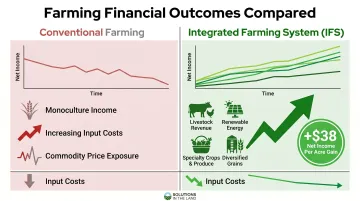
The evidence on profitability is strong. A meta-analysis covering 3,192 effect sizes from 119 peer-reviewed articles found diversified farming systems are at least as profitable as simplified ones, with higher total costs, higher gross income, and higher net returns. The benefit-cost ratio was equivalent , meaning more revenue came in alongside the higher costs, not instead of them.
One Ohio farmer case study cited by Science for Georgia reported a $38 increase in net income per acre after implementing soil health and diversification practices. As input costs decline with improved soil health, that margin continues to expand over time.
Soil Health and Fertility Improvement
Healthy soil is the compounding asset in any IFS model. Nutrient recycling through vermicompost, green manure, and animal waste continuously replenishes soil organic matter — reducing or eliminating dependence on synthetic fertilizers over time.
The Rodale Institute's Farming Systems Trial, now running for over 40 years, consistently shows that integrated and organic systems match or outperform conventional production in yield while building soil carbon and nitrogen. University of Nebraska CropWatch research reports that intensively managed agricultural soils have lost 50–70% of their pre-cultivation carbon — a loss that IFS practices are uniquely positioned to reverse.
Cover crops alone can sequester approximately 0.22 tons of carbon per acre per year. Add AMP grazing and compost cycling, and that rate accelerates substantially — compounding gains that synthetic-input systems simply can't replicate.
Reduced Emissions and Climate Resilience
US agriculture accounts for roughly 10% of total US greenhouse gas emissions (EPA, 2022 inventory data). IFS practices such as cover crops, AMP grazing, silvopasture, and boundary tree planting directly reduce that share by sequestering carbon in soil and biomass.
AMP grazing's 19.52% reduction in soil CO₂ respiration rates is a meaningful indicator: the soil food web under well-managed integrated grazing retains more carbon than it releases. Farms designed around IFS principles can shift from net emitters to net carbon sinks over time.
Food Security and Employment
Climate resilience and food security reinforce each other in a well-designed IFS. A diversified farm household produces year-round outputs across multiple categories:
- Cereals, vegetables, and fruit
- Dairy, eggs, and meat
- Value-added and specialty products
This range reduces reliance on purchased food and insulates the operation from supply chain disruptions.
The employment picture follows the same logic. Multi-enterprise structure spreads labor demand across the year rather than compressing it into planting and harvest windows. International research on IFS models documented 34% more annual employment (774 man-days) compared to conventional systems. US-specific data is limited, but the principle is consistent: more enterprise types means more steady, year-round work on the farm.
Best Practices for Implementing an Integrated Farming System
Start with a Whole-Farm System Plan
The most common implementation mistake is adding enterprises reactively (a few laying hens here, a market garden there) without mapping how they connect. Before purchasing a single animal or planting a single perennial, design the interdependencies: land allocation, enterprise linkages, input-output flows, and market channels.
This is where working with consultants who specialize in whole-system planning pays for itself many times over. Solutions in the Land, a regenerative agriculture consultancy based in Kenosha, WI, has developed a formal six-part planning methodology that answers 143 questions about a farm: from regional context and soil conditions through revenue generators and farm policy.
The resulting Whole-System Farm Plan serves as an operational reference manual for the farm's long-term trajectory, not a short-term checklist.
Their approach treats every farm as a distinct microclimate with unique constraints and opportunities — the mindset an IFS requires.
Phase the Rollout
Start with two or three enterprises that have the strongest existing market connection and land suitability. Add components as cash flow and management capacity allow. Overextending in year one undermines confidence in the whole model before it has a chance to stabilize.
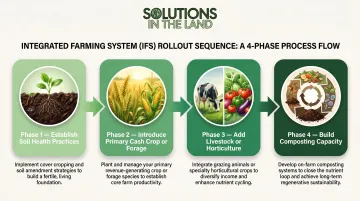
Practical sequencing for a first-phase IFS:
- Establish baseline soil health practices (cover crops, minimal tillage)
- Introduce the primary cash crop or forage system
- Add livestock or horticulture once crop infrastructure is functioning
- Build composting/vermicomposting capacity to close the nutrient loop
Close the Nutrient Loop Deliberately
Composting or vermicomposting shouldn't be an afterthought. Plan it as a formal enterprise component from the start, with dedicated space and infrastructure. Animal and crop waste that leaves the farm or sits unmanaged represents lost fertility and lost income.
Monitor Economics by Enterprise
Track gross return, net return, and benefit-cost ratio for each enterprise individually, not just for the farm as a whole. This tells you which components are carrying the operation and which are dragging it and where recycling efficiencies can improve performance. Enterprise-level tracking is what separates a functioning IFS from a genuinely profitable one.
Prioritize Soil Health as the Non-Negotiable Foundation
Every other IFS component performs better on living, biologically active soil. These are baseline practices, not optional upgrades:
- Cover cropping to protect and feed soil biology between cash crops
- Minimal tillage to preserve soil structure and reduce compaction
- Planned grazing rotations to stimulate root growth and organic matter cycling
- Consistent organic matter inputs to sustain microbial activity year-round
Challenges and Limitations to Consider
IFS is not a shortcut. Understanding its real costs upfront prevents the financial surprises that derail otherwise well-designed transitions.
Upfront Capital and Management Complexity
Multiple enterprises require more infrastructure: livestock housing, composting facilities, fencing for rotational grazing, and irrigation for horticulture. They also demand more management bandwidth. The USDA-ARS framework notes that management requirements increase substantially as a system moves from basic production toward dynamic-integrated models. Farmers often underestimate this learning curve.
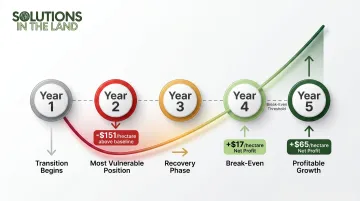
The Four-Year Break-Even Reality
Science for Georgia, citing Bain & Company research, reports that transitioning farms typically break even after approximately four years:
| Year | Financial Position |
|---|---|
| Year 2 | Most vulnerable — costs ~$151/hectare above baseline, minimal revenue gains |
| Year 4 | System begins generating net profit (~$17/hectare) |
| Year 5 | Net profit reaches approximately $65/hectare |
Bridging this period requires a plan. Common funding strategies include:
- Retained earnings set aside before the transition begins
- Operating loans structured around the 4-year timeline
- Phased enterprise additions to spread upfront costs
- USDA transition support programs and cost-share incentives
Land and Scale Considerations
Scale and financial viability go hand in hand. Small-scale IFS configurations are entirely viable — a kitchen garden, poultry flock, and seasonal crops can function on 0.5–1 acre. Meaningful economic returns from multi-enterprise systems, though, typically require at least 1–5 acres, with per-acre income rising as enterprise diversity and market access improve.
USDA ERS data confirms that per-acre income is highest for specialty enterprises such as herbs, mushrooms, and high-value fruits — all well-suited to smaller IFS configurations.
Frequently Asked Questions
What are the components of an integrated farming system?
The core components are crop production (seasonal and perennial), livestock (dairy, poultry, or goats), horticulture (vegetables and fruit trees), composting or vermicomposting, and boundary planting for fodder and carbon sequestration. The specific mix depends on farm size, soil type, climate, and local market access.
What are the different types of integrated farming?
The main types are crop-livestock integration, agri-aquaculture, agroforestry (including silvopasture and alley cropping), crop-horticulture systems, and adaptive multi-paddock grazing. Most real-world IFS models draw from two or more of these categories.
What is the minimum land required for integrated farming?
Small IFS models can function on as little as 0.5–1 acre with poultry, a kitchen garden, and seasonal crops. Meaningful multi-enterprise returns typically require 1–5 acres, though USDA ERS data shows enterprise selection and market channel matter more than raw acreage — specialty crops and direct-market channels generate the strongest per-acre returns at any scale.
What are examples of integrated farming systems?
Three common models include:
- A crop-dairy-poultry-vermicompost system on 1 hectare, where manure feeds composting and compost feeds crops
- A silvopasture system combining cattle grazing with timber and nut trees
- A market garden integrated with laying hens, where birds fertilize beds, consume crop waste, and generate egg revenue
Which vegetables are most profitable for integrated farming systems?
Tomatoes, peppers, leafy greens, and specialty herbs tend to generate the strongest returns — particularly through direct-market and local food system channels. USDA NASS and ERS data identify herbs, mushrooms, and specialty vegetables as the highest revenue per acre for small integrated farms.
How much money can a 40-acre farm make?
Income varies widely based on enterprise mix, market channels, and management intensity. USDA ERS data shows small farms generate anywhere from under $1,000 to over $500,000 in gross revenue — the difference is almost entirely determined by what's grown and how it's sold, not acreage alone.