The stakes are real: the FAO warns that 90% of Earth's topsoil could be at risk by 2050, with an equivalent of one soccer pitch of topsoil eroding every five seconds. For farmers and landowners, that's not a distant statistic — it's a direct threat to land productivity and long-term value.
This guide covers what soil health actually means, the four core principles that govern it, the practices proven to rebuild it, and how to develop a management plan tailored to your land.
Key Takeaways
- Soil health is defined by the soil's capacity to function as a living ecosystem — not just its fertility or chemical properties
- Four core principles guide every decision: minimize disturbance, maximize cover, increase biodiversity, and keep living roots in the ground
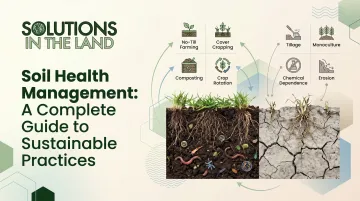
- Key practices include no-till farming, cover cropping, diverse rotations, composting, and adaptive livestock integration
- Regular in-field and lab assessments identify resource concerns and track measurable progress
- A written Soil Health Management Plan translates these principles into site-specific, actionable outcomes
What Is Soil Health and Why Does It Matter?
More Than Fertility
The USDA-NRCS defines soil health as "the continued capacity of soil to function as a vital living ecosystem that sustains plants, animals, and humans." That definition is broader than most farmers first expect.
Soil fertility refers specifically to a soil's capacity to supply nutrients for plant growth. Soil quality describes its chemical and physical properties. Soil health encompasses both — plus ecological functions, climate resilience, water management, and biological diversity. A field can test high in available nitrogen and still have severely degraded health.
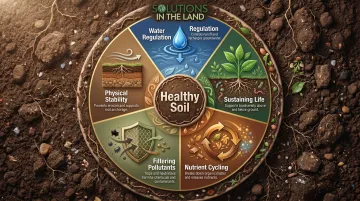
Healthy soil is composed of minerals, organic matter, water, air, and billions of living organisms — bacteria, fungi, earthworms, insects, and protozoa — all functioning as an interconnected system. NRCS identifies five core functions that healthy soil performs:
- Regulating water movement and infiltration
- Sustaining plant and animal life
- Cycling and storing nutrients (carbon, nitrogen, phosphorus)
- Filtering and buffering potential pollutants
- Providing physical stability and structural support
Why Degradation Happens
Conventional practices attack all five of these functions simultaneously. Three patterns drive most of the damage:
- Intensive tillage destroys soil aggregates, exposes organic matter to rapid oxidation, and collapses the fungal networks that hold soil structure together
- Continuous monocrops starve the soil food web of biological diversity
- Over-applied synthetic inputs disrupt microbial communities that would otherwise handle much of the nutrient cycling on their own
The scale of that damage is significant. According to FAO, approximately 1.7 billion people now live in areas where crop yields are falling due to human-induced land degradation. Reversing just 10% of that degradation could restore enough production to feed an additional 154 million people annually.
That global picture translates directly to individual farm economics. Degraded soil demands more inputs, more labor, and more management — while producing less with each passing season.
The Four Core Principles of Soil Health Management
NRCS organizes all soil health decision-making around four interconnected principles. Applying them together — rather than cherry-picking one or two — produces the most lasting improvements. The first two protect the soil habitat; the second two fuel the biological communities living within it.
Minimize Soil Disturbance
Disturbance comes in three forms:
- Physical (tillage): breaks apart aggregates, kills beneficial fungi, exposes organic matter to decomposition, and compacts subsoil layers over time
- Chemical (excessive fertilizers and pesticides): disrupts microbial communities and alters soil chemistry
- Biological (overgrazing, non-diverse cropping): reduces the plant diversity that feeds the soil food web
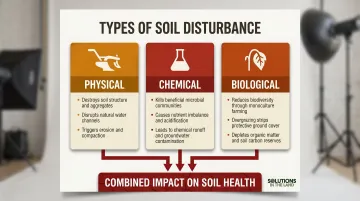
Physical tillage causes the most immediate structural damage and is typically the first target for reduction.
Reducing disturbance allows natural soil structure to rebuild. Macropores created by roots and earthworms reestablish, improving water infiltration. Micropores return, improving water retention. Mycorrhizal networks (which can extend root reach by a factor of 100 or more) regenerate when tillage stops disrupting them.
Maximize Soil Cover
Bare soil is vulnerable soil. Raindrops hit exposed surfaces with enough force to break apart aggregates, seal the soil surface, and trigger runoff. Bare soil also loses moisture rapidly through evaporation and swings dramatically in temperature — conditions that stress soil organisms and suppress microbial activity.
Keeping the surface covered (with living plants, crop residues, or mulch) addresses all of these problems at once. The target is high coverage at all times, with residue management calibrated to balance decomposition rates against ground cover needs. That means managing harvest residue intentionally and getting cover crops in the ground before bare-soil windows open.
Increase Plant Biodiversity
Different plant species release different root exudates (carbon-rich compounds) that feed specific microbial communities. A field growing the same crop every year feeds a narrow slice of the soil food web. A field rotating through small grains, legumes, brassicas, and cover crop mixes feeds a much wider community, building the biological diversity that makes soil resilient.
Research published in Nature Communications found that crop rotation significantly increases bacterial Shannon diversity and species richness compared to continuous cropping systems — providing large-scale evidence that rotation delivers measurable biological benefits, not just agronomic ones. Diverse plant communities also reduce pest and disease pressure, which lowers the chemical inputs needed to manage them.
Maintain Continuous Living Roots
The rhizosphere (the zone immediately surrounding plant roots) is the most biologically active part of the soil. Roots feed microbes through exudates, create biopores as they grow and die, and physically improve soil structure. When fields sit bare after harvest, that biological engine shuts down.
Cover crops are the primary tool for keeping roots active during off-season periods. In Midwest climates, winter-hardy species can maintain root activity well into fall and resume it early in spring:
- Cereal rye: cold-tolerant, establishes quickly, reliable ground cover
- Hairy vetch: nitrogen-fixing legume, pairs well with cereal rye
- Austrian winter pea: another nitrogen fixer suited to Midwest winters
Together, these species bridge the biological gap that bare fields leave open between cash crops.
Sustainable Soil Management Practices That Build Healthy Soil
The four principles are the framework. These practices are how you apply them.
Reduced Tillage and No-Till Farming
No-till and reduced tillage preserve soil aggregate structure, protect organic matter from rapid oxidation, reduce fuel consumption, and improve water infiltration. The economic case strengthens over time — peer-reviewed analysis confirms that continuous no-till adoption reduces overall input costs and improves profitability across multi-year timeframes.
The transition period requires attention. Weed pressure often increases in early no-till years, and residue management becomes more critical when it can no longer be incorporated. Most operations see meaningful structural improvements within three to five years of consistent practice.
Conservation tillage now covers the majority of major U.S. crop acres — 76% of corn acres and 68% of wheat acres according to USDA ERS data — but adoption varies significantly by region and operation type.
Cover Cropping
Cover crops do several jobs simultaneously:
- Keep living roots in the ground between cash crops
- Add organic matter as they decompose
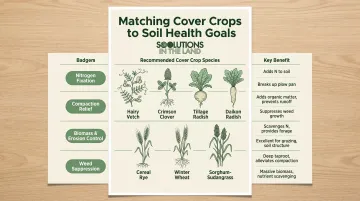
- Fix nitrogen (legume species like hairy vetch can contribute 72–183 lbs of N per acre, depending on species and termination timing)
- Suppress weeds and break pest cycles
- Reduce erosion and runoff
Species selection should match specific goals. Deep-taprooted species like tillage radish address compaction. Legumes like crimson clover or hairy vetch fix nitrogen. Small grains like cereal rye produce large amounts of biomass for erosion control. Multi-species mixes address more goals simultaneously than single-species plantings.
Despite strong evidence of benefit, cover crops were planted on only 4.7% of total U.S. cropland in 2022 nationally — though among full-time commercial farms, adoption rates run 52–57%. The gap between early adopters and the national average reflects economic and logistical barriers more than lack of awareness.
Diverse Crop Rotations
Extended rotations incorporating small grains, legumes, perennials, and cover crops build soil biodiversity, reduce pathogen and pest accumulation, and cycle a broader range of nutrients through the system. Each additional crop provides a different rooting depth, residue chemistry, and microbial food source.
One important nuance: not all rotation changes automatically build organic matter. University of Illinois research found that fast-decomposing soybean residues can reduce soil organic carbon compared to continuous corn in some systems — meaning the mechanism of rotation matters as much as the diversity itself.
Composting and Organic Matter Management
Compost is a direct tool for rebuilding soil organic matter, improving aggregate stability, and reintroducing diverse microbial populations. It differs from green manures (incorporated fresh plant material) and crop residue management (leaving surface residue in place) in the degree of biological processing that has already occurred.
Higher organic matter levels do improve water-holding capacity, though the relationship is texture-dependent. The commonly cited figure — that each 1% increase in SOM holds 20,000 additional gallons of water per acre — applies most directly to coarser-textured soils; the actual effect varies significantly with texture and should be applied with that context.
Adaptive Livestock Integration
Integrating livestock into crop systems through carefully designed prescribed grazing accelerates soil biological activity via manure inputs, stimulates root growth through controlled grazing pressure, and improves soil aeration and aggregate stability.
The key word is adaptive. Planned rest periods, rotational paddocks, and stocking rates calibrated to forage recovery distinguish this approach from overgrazing, which compacts soil and degrades structure.
Peer-reviewed research documents that adaptive multi-paddock (AMP) grazing increases soil organic carbon stocks compared to continuously grazed pastures. Allen Williams, Solutions in the Land's Grazing & Soil Consultant and a sixth-generation farmer, applies this framework directly with landowners and farmers — designing site-specific grazing systems that restore soil vitality while improving farm profitability.
Building a Soil Health Management Plan
A Soil Health Management Plan (SHMP) is a written framework that identifies current soil conditions, specific resource concerns, and a sequenced set of practices to address them, tailored to a specific soil type, climate, production system, and set of goals.
Assessing Soil Health: Where to Start
Effective planning begins with two levels of assessment:
In-field assessment:
- Slake test for aggregate stability (how well aggregates hold together when wet)
- Visual evaluation of soil surface coverage and crusting
- Infiltration rate observation after rainfall
- Penetrometer readings to identify compaction depth and severity
Laboratory assessment:
- Soil organic carbon and carbon mineralization potential
- Microbial activity and bioavailable nitrogen
- Aggregate stability under controlled conditions
Standard nutrient tests — nitrogen, phosphorus, potassium — are necessary but don't capture soil health. A field can show adequate NPK levels while having severely compromised biological function and structure.
What to Include in a Soil Health Management Plan
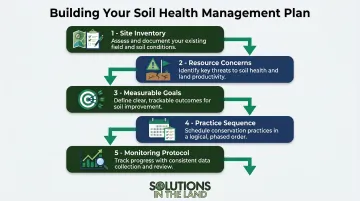
An effective SHMP covers:
- Site inventory — soil types, slope, drainage, existing management history
- Resource concerns — compaction zones, organic matter depletion, erosion risk, aggregate instability
- Measurable goals — specific targets with timeframes (increasing organic matter by a defined percentage over five years, for example)
- Practice sequence — which practices to implement first, in what order, and on what timeline
- Monitoring protocol — how progress will be tracked, what indicators will be measured, and how often the plan will be reviewed and adjusted
Working with Experts
Farmers and landowners can take meaningful first steps independently: reducing tillage, adding a cover crop, starting composting. A comprehensive, site-specific SHMP benefits from expert input, particularly for operations with complex soils, production goals, or transition challenges.
Solutions in the Land offers whole-system farm planning and regenerative agriculture consulting, helping landowners and farmers turn soil health principles into site-specific, actionable plans. Their process accounts for regional context, soil history, revenue streams, and long-term goals — treating each farm as the distinct system it is.
NRCS also offers several resources for plan development and funding:
- Technical Service Providers (TSPs): Certified professionals who assist with SHMP development
- EQIP (Environmental Quality Incentives Program): Cost-share funding for approved conservation practices
- CSP (Conservation Stewardship Program): Annual performance-based payments, with a minimum of $4,000 per year for qualifying operations
Contact your local NRCS service center for current payment schedules and eligibility.
On the emerging opportunity in carbon markets: farms that build soil organic matter through these practices may have access to carbon credit programs. This market is still evolving, and producers should approach it with informed caution — verifying program terms, additionality requirements, and payment reliability before committing acreage.
Frequently Asked Questions
What is a soil management plan?
A soil management plan is a written document that identifies current soil conditions and resource concerns on a piece of land, then outlines tailored practices and goals to restore or maintain soil health over time. It functions as an ongoing operational framework, revisited and adjusted as conditions evolve.
What should be included in a management plan?
An effective plan includes a site inventory, identified resource concerns, and measurable soil health goals with clear timelines. It also specifies conservation practices in sequenced order and a monitoring protocol to track results and adjust as conditions change.
What are the best management practices for soil health?
The most evidence-backed practices are reduced or no-till farming, cover cropping, diverse crop rotations, composting, and prescribed livestock integration. A well-designed system combines several of these practices, because no single approach delivers the full range of biological, chemical, and physical benefits on its own.
What are sustainable soil management techniques?
Sustainable soil management is grounded in four core principles: minimizing disturbance, maintaining soil cover, increasing plant biodiversity, and keeping living roots in the ground year-round. Practical methods include no-till, cover crops, extended rotations, and rotational grazing.
How do I improve soil health quickly?
The fastest early gains typically come from stopping bare-soil periods, reducing tillage, and adding organic matter through compost or cover crops. Properly managed livestock integration can also accelerate soil biological activity. Long-term structural improvement takes years, but the biological response to reduced disturbance can begin within the first season.
What is soil fertility and nutrient management?
Soil fertility refers specifically to the soil's capacity to supply nutrients for plant growth. Nutrient management is the practice of optimizing inputs — timing, source, rate, and placement — to match crop needs. Both fall within the broader scope of soil health, which also includes biological function, water regulation, and long-term ecosystem resilience — factors that fertility metrics alone don't capture.