The problem is that pricing varies dramatically. A simple rural site might clear for under $2,000. A complex industrial parcel with contamination history can push past $6,000. Without understanding what drives that range, buyers routinely underestimate costs or choose the wrong consultant.
This guide breaks down 2026 pricing tiers, the factors that move quotes up or down, what the fee actually includes, and how to build an accurate budget for your specific situation.
Key Takeaways
- Phase 1 ESA costs range from $1,500 for simple rural sites to $6,000+ for complex industrial or multi-parcel properties
- Biggest cost drivers: property size, prior land use, location, turnaround time, and consultant qualifications
- Lenders typically require a Phase 1 ESA before approving a loan — buyers usually foot the bill, though it's negotiable
- Cheap reports risk lender rejection and can strip your CERCLA liability protections, so consultant quality matters as much as cost
How Much Does a Phase 1 ESA Cost in 2026?
No fixed price exists for a Phase 1 ESA. Any quote you receive without providing a specific property address should be treated as a rough estimate at best. Costs are shaped by site-specific factors, and two properties on the same street can carry very different research burdens.
Buyers most commonly run into trouble by assuming the lowest quote is sufficient, forgetting to budget for expedited fees, or not realizing that services like Phase 2 investigations aren't included in the base price.
Typical Cost Ranges
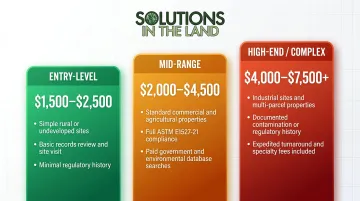
| Tier | Property Type | 2026 Cost Range |
|---|---|---|
| Entry-level | Simple, undeveloped, or lightly used rural/small commercial sites | $1,500 – $2,500 |
| Mid-range | Standard commercial, retail, agricultural with moderate site history | $2,000 – $4,500 |
| High-end | Industrial, multi-parcel, known contamination history, tight deadlines | $4,000 – $7,500+ |
According to Phase1Finder's 2026 pricing guide, entry-level reports cover basic records review, a site visit, and standard turnaround — but exclude rushed delivery, complex historical research, and remote location travel. Mid-range reports include full ASTM E1527-21 compliance, paid database searches, and a complete written report by a qualified environmental professional. The high-end tier reflects extensive historical records work, multiple site structures, expedited fees, or significant travel costs.
CORE Environmental cautions that firms offering Phase 1 reports under $2,000 typically sacrifice depth, accuracy, and compliance. If your lender or transaction requires ASTM E1527-21 compliance, a cut-rate report may not satisfy due diligence requirements.
Agricultural properties — particularly those with pesticide storage, fuel tanks, or industrial-adjacent history — land in the mid-to-high range. The additional historical research required for chemical handling areas and above/underground storage tanks (ASTs/USTs) pushes costs above baseline pricing.
Key Factors That Affect Phase 1 ESA Cost
Pricing is shaped by a combination of property characteristics, logistical demands, and the level of professional expertise required.
Property Location and Urban Density
Urban and historically developed areas carry higher research burdens. Decades of land-use records, neighboring site contamination risks, and complex regulatory databases all increase the time a consultant spends on your project.
State-level pricing reflects this clearly:
- New York: typically $2,500 – $5,000
- California: $2,000 – $4,500
- Texas: $1,500 – $3,500
Rural properties may have simpler records but can trigger travel surcharges for remote locations — costs that consultants quote per-project and don't always disclose in initial estimates.
Property Size and Site Complexity
Larger parcels mean longer site inspections and more records to pull. Size alone doesn't determine complexity. A small gas station can cost more to assess than a 200-acre undeveloped field — storage tanks, chemical handling areas, and manufacturing buildings each add inspection scope and report complexity that acreage doesn't capture.
Prior Land Use and Site History
Properties with a history of industrial operations, agricultural chemical storage, or commercial activity require deeper historical research. Common triggers that push costs above baseline include:
- Former farmland with pesticide or fertilizer storage areas
- Properties adjacent to industrial sites or fuel terminals
- Sites with documented fuel tank installations or chemical handling
- Commercial properties requiring multi-decade aerial photo reviews
Turnaround Time
Standard turnaround runs 2–4 weeks and is built into the base price. When transaction timelines compress that window, rush fees apply:
- Expedited service (1–2 weeks): typically a 20–50% surcharge
- Very fast turnaround (5 business days or fewer): often a flat $500–$1,000 premium
The simplest way to avoid rush fees is to commission the Phase 1 ESA as early in the transaction as possible.
Consultant Qualifications and Insurance
Under ASTM E1527-21 and 40 CFR Part 312, a qualified Environmental Professional (EP) must conduct or oversee the assessment and sign the final report with a statement of qualifications. The EP must also carry professional liability insurance, and the firm must use paid environmental database vendors (such as EDR or GeoSearch) for regulatory records searches.
These requirements aren't optional extras — they're what makes the report legally defensible and lender-acceptable. A report prepared outside these standards will be rejected by lenders and carries no standing in environmental liability disputes.
What's Included in a Phase 1 ESA — and What Isn't
The Four Standard Components
A compliant Phase 1 ESA under ASTM E1527-21 always includes:
- Records review — federal, state, tribal, and local environmental databases; Sanborn fire insurance maps; aerial photographs; tax maps; property and building records
- Historical source review — aerial photo sequences going back decades, city directories, prior land records to identify past uses
- Physical site inspection — visual documentation of chemical drums, storage tanks, soil staining, stressed vegetation, odors, or unidentified liquids; visual inspection of adjoining properties also included
- Written report — evaluates all collected data and identifies any Recognized Environmental Conditions (RECs), Historical RECs (HRECs), and Controlled RECs (CRECs)
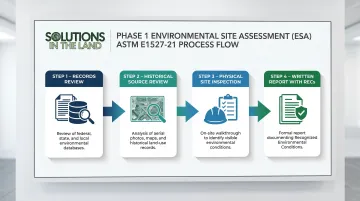
No physical sampling occurs during a Phase 1 ESA.
What's NOT Included
Many buyers are surprised to find these services are not covered — each carries its own quote and timeline:
- Soil or groundwater sampling (Phase 2 ESA)
- Asbestos inspection and testing
- Lead-based paint assessment
- Mold assessment
- Radon testing
- Wetlands delineation
- PFAS and emerging contaminant screening
- Ecological or endangered species evaluation
Before signing any agreement, confirm in writing which of these are included — bundled quotes frequently obscure where the base scope ends and add-on fees begin.
Phase 2 ESA Costs When RECs Are Identified
If the Phase 1 report flags RECs, physical sampling through a Phase 2 ESA is almost always the next step. Costs vary significantly based on site complexity:
| Phase 2 Scope | Typical Cost |
|---|---|
| Limited (targeted sampling) | $5,000 – $15,000 |
| Moderate (standard sampling program) | $15,000 – $35,000 |
| Complex/large industrial | $35,000 – $100,000+ |
Cheap vs. Quality Phase 1 ESAs: What You Need to Know
The gap between a compliant Phase 1 ESA and a cheap one isn't just about report quality — it's about legal exposure. For agricultural landowners and land buyers, the consequences of a deficient report can be severe.
Red Flags to Watch For
Common indicators of a low-quality report:
- Assessor doesn't meet the ASTM Environmental Professional definition under 40 CFR Part 312
- Missing or incomplete environmental database searches (firm skipped paid data vendors)
- No aerial photo review, Sanborn maps, or city directory research
- No analysis of adjoining property risks
- No EP qualification statement or signature
- Data gaps not identified or documented
- Quote provided without requesting a specific property address
Aegis Environmental warns that low-cost providers offering reports around $1,400 risk missing significant contamination — including old landfills that may not surface in incomplete database searches.
The CERCLA Liability Issue
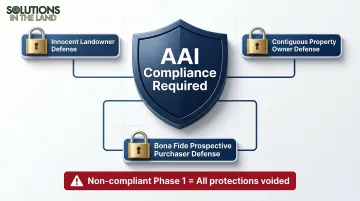
Under CERCLA Section 107(b), buyers can access three liability protections, but all three require completion of All Appropriate Inquiries (AAI) per 40 CFR Part 312:
- Innocent Landowner Defense
- Contiguous Property Owner Defense
- Bona Fide Prospective Purchaser Defense
A Phase 1 ESA that doesn't meet ASTM E1527-21 standards fails to satisfy AAI. That voids all three protections. CERCLA cleanup liability is joint and several with no statutory cap, and remediation costs on a contaminated site routinely reach millions of dollars.
For agricultural landowners taking on property with unknown prior uses, that exposure is real and personal. A qualified Environmental Professional isn't an upgrade — it's the baseline for protecting your investment.
How to Estimate the Right Budget for Your Phase 1 ESA
Accurate budgeting means looking beyond the base quote. The full cost of a Phase 1 process depends on your property specifics, your transaction timeline, and what your lender requires.
Questions to Answer Before Requesting Quotes
- What is the property's prior use — agricultural, industrial, commercial, or undeveloped?
- How large is the site, and how many structures are on it?
- Does the closing have a firm deadline that might require expedited delivery?
- Which lender program applies — USDA FSA, SBA, HUD, or conventional?
Lender requirements vary significantly:
- USDA FSA: Requires a Phase 1 when the FSA-851 screening form indicates possible contamination (proximity to landfills within 0.5 miles, historical gas station or industrial use, etc.). The loan applicant pays.
- SBA 7(a) and 504: Mandatory Phase 1 for high-risk NAICS codes, including gasoline stations (NAICS 457) and certain food manufacturing operations. Must comply with ASTM E1527-21.
- HUD: Required for multifamily or non-residential acquisition and development; the assessment must be completed before loan commitment.
Understanding lender scope requirements before you hire an environmental consultant can prevent costly add-ons. For farmers pursuing regenerative or organic transitions, Solutions in the Land's whole-farm planning process covers property history, subsurface constraints (mineral mining history, utility easements, drainage tiles), and adjacent land uses — context that naturally complements a Phase 1's historical research and can sharpen scope definition from the start.
Hidden Costs to Budget For
| Cost Item | Typical Range |
|---|---|
| Rush fee (expedited turnaround) | $500 – $1,000 flat, or 20–50% surcharge |
| Remote property travel surcharge | Quoted per project |
| Asbestos inspection (if required by lender) | $250 – $850 |
| Phase 2 ESA (if RECs identified) | $5,000 – $100,000+ |
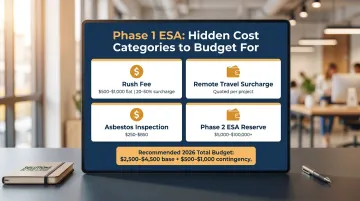
Recommended budget for most agricultural or commercial transactions in 2026:
- Phase 1 ESA: $2,500 – $4,500
- Rush fees or add-ons (contingency): $500 – $1,000
- Reserve for properties with chemical storage, fuel tanks, or industrial adjacency: $10,000 – $20,000
Frequently Asked Questions
What does a Phase 1 environmental assessment include?
A Phase 1 ESA covers four components: environmental database and records review, historical land-use research using aerial photos and fire insurance maps, a physical site inspection, and a written report identifying any Recognized Environmental Conditions. No soil or water sampling is involved — that's Phase 2 territory.
Who pays for a Phase 1 Environmental Site Assessment?
Payment is negotiated between buyer and seller. Buyers most commonly pay — when a lender requires it as a condition of financing, this is nearly always the case. Sellers sometimes commission one to smooth a transaction or strengthen their negotiating position.
How long does a Phase 1 ESA take to complete?
Standard turnaround is 2–4 weeks for straightforward properties. Expedited options exist (typically 1–2 weeks) at added cost. Properties with dense historical land use or complex site histories may take longer regardless of the timeline requested.
How long is a Phase 1 ESA valid?
Key components — interviews, government records searches, site inspection — must be conducted or updated within 180 days before property acquisition. The broader historical review must fall within one year. Transaction delays that push past those windows can require costly updates or a new assessment.
What happens if a Phase 1 ESA identifies contamination?
The Phase 1 report identifies potential risks (RECs) but doesn't confirm actual contamination. A Phase 2 ESA with physical sampling is typically the next step. Results then shape negotiation, drive remediation planning, or support a decision to withdraw from the transaction altogether.
Is a Phase 1 ESA required for agricultural or farmland purchases?
There's no universal legal mandate, though most lenders — including USDA FSA and SBA lenders — require one before approving agricultural land loans. Farmland with prior chemical storage, fuel tanks, or proximity to industrial operations is especially likely to trigger the requirement.