For buyers, sellers, and landowners, the first question is almost always: what will this cost?
The honest answer is that Phase 2 ESA pricing varies dramatically — from roughly $4,000 for simple, targeted investigations to well over $100,000 for complex, multi-contaminant sites. That range isn't vague; it reflects genuine differences in what each investigation requires. Understanding what drives those numbers up or down is how you budget accurately and avoid financial surprises.
This article breaks down typical price tiers, the key factors that move costs, what a quote actually covers, and how to approach the budgeting process strategically.
Key Takeaways
- Phase 2 ESA costs typically run $5,000–$15,000 for standard commercial properties; complex or heavily contaminated sites can exceed $100,000
- The biggest cost drivers are contamination type, number of sample locations, site accessibility, and geographic location
- Sampling and lab fees alone represent 40–50% of total project cost
- A thorough Phase 1 ESA is the single best tool for controlling Phase 2 costs by defining exactly what to investigate
- Skipping a warranted Phase 2 ESA can expose buyers to significantly higher remediation and legal costs down the road
How Much Does a Phase 2 ESA Cost?
There's no fixed price for a Phase 2 ESA. Unlike Phase 1 assessments, which follow a relatively standardized records-review process, Phase 2 scope is driven by what the Phase 1 found — and every site is different.
Two budgeting mistakes derail most Phase 2 projects before fieldwork even begins:
- Accepting a low quote without understanding what's actually included
- Commissioning a Phase 2 with a vague scope because the Phase 1 wasn't thorough enough to define what needs testing
Typical Cost Ranges by Tier
| Tier | Typical Range | What It Usually Covers |
|---|---|---|
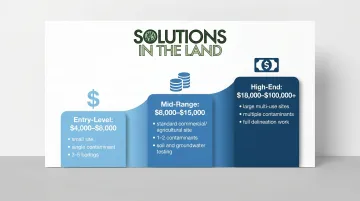
| Entry-Level | $4,000–$8,000 | Small site, single suspected contaminant, 3–5 soil borings, basic lab panel, standard report |
| Mid-Range | $8,000–$15,000 | Standard commercial or agricultural property, 1–2 contaminants, soil and/or groundwater sampling, full report |
| High-End | $18,000–$100,000+ | Large or multi-use sites, multiple contaminants, contamination delineation, monitoring well installation, multiple site visits |
According to multiple environmental consulting firms, including LoanGuys.com and Aegis Environmental, most standard commercial investigations fall between $6,000 and $25,000. The $100,000+ range applies to sites with severe contamination requiring extensive delineation work.
RRMSC published a detailed cost estimate for a Phase 2 ESA at a former dry cleaner investigating PCE (a chlorinated solvent). That single-contaminant investigation on a standard commercial lot came to $22,946 once groundwater sampling and full reporting were factored in.
What's Included vs. What's Not
Most base quotes include:
- Work plan development and site investigation planning
- On-site field supervision and sample collection
- Soil borings or groundwater sampling for the specified scope
- Standard laboratory analysis for defined contaminants
- Final written Phase 2 ESA report with findings and recommendations
Most base quotes exclude:
- Remediation or cleanup (covered under Phase 3)
- Legal fees
- No Further Remediation (NFR) letter applications and state filing fees
- Expedited laboratory turnaround surcharges
- Additional sampling rounds if contamination requires further delineation
- Vapor intrusion testing (often quoted separately)
Key Factors That Affect the Cost of a Phase 2 ESA
Pricing depends on contamination type, property size, site conditions, location, and the number of visits required. Understanding each factor helps you evaluate quotes accurately and spot where costs are likely to grow.
Type and Scope of Contamination
What the consultant tests for determines which lab panels are needed — and lab costs vary enormously by contaminant type.
Per the California State Water Resources Control Board's 2023 Cost Guidelines, per-sample laboratory costs include:
| Contaminant | Test Method | Cost per Sample |
|---|---|---|
| TPH-Gasoline | EPA 8015 | $97 |
| TPH-Diesel | EPA 8015 | $114 |
| Volatile Organic Compounds (VOCs) | EPA 8260 | $266 |
| Semi-Volatile Organic Compounds (SVOCs) | EPA 8270 | $486 |
| CAM 17 Metals Suite | CAM 17 | $309 |
Testing for chlorinated solvents (like those found at dry cleaners) costs 2–5x more per sample than a basic petroleum screen. Multiply that across 10–20 sample locations, and lab costs alone can range from under $1,000 to over $10,000 — which is why they represent 40–50% of total project cost.
Agricultural properties introduce additional costs that often catch landowners off guard. Former farmland may require pesticide and herbicide testing suites that fall outside standard commercial analytical panels — costs that consultants frequently omit from initial quotes.
Property Size and Number of Sample Locations
Once contamination type is established, property size drives the next major cost variable. Each boring or monitoring well adds drilling time, equipment charges, and lab fees for every sample collected. The California Water Board publishes benchmark unit costs of $32/ft for soil borings and $60/ft for 2-inch monitoring wells. Total drilling services for a standard project typically run $2,000–$5,000, but that climbs fast when contamination needs to be delineated across a larger area.
Site Accessibility and Conditions
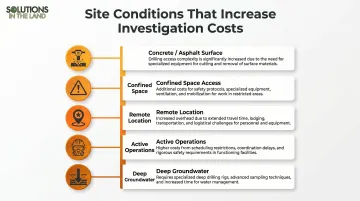
Difficult site conditions directly increase labor costs:
- Drilling through concrete or asphalt (plus surface restoration)
- Confined space access requiring specialized safety equipment
- Remote locations requiring additional mobilization time
- Active operations that restrict when and where work can occur
- Depth to groundwater — a 40-foot well costs substantially more than a 10-foot boring
Mobilization for drilling equipment runs approximately $177/hour with a 4-hour maximum per California Water Board benchmarks, meaning remote sites can add $700 or more per mobilization event.
Geographic Location and Consultant Proximity
Local consultants with established regional lab relationships typically offer more competitive pricing than firms traveling from outside the area. The farther the equipment and crew need to travel, the higher the mobilization costs — and this compounds if multiple site visits are required.
Number of Site Visits and Follow-Up Requirements
Some Phase 2 investigations require return trips that aren't captured in initial quotes:
- Installing and sampling monitoring wells over quarterly intervals
- "Chasing" a contamination plume until its full extent is mapped
- Satisfying state regulatory requirements for additional data before a case can be closed
Each return visit adds mobilization, sampling, and lab costs. Before signing a contract, ask your consultant how they handle scope expansion — and whether follow-up visits are billed at a fixed rate or on a time-and-materials basis.
What Does a Phase 2 ESA Cost Cover?
Understanding how costs are distributed helps you compare quotes accurately and spot what might be missing.
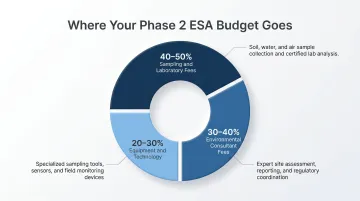
Sampling and Laboratory Fees (40–50% of Total Cost)
Lab and sampling fees represent the largest share of most Phase 2 budgets. This covers soil borings, groundwater sampling, soil vapor testing where applicable, and all associated lab analysis. When a transaction deadline is approaching, expedited turnaround carries an additional surcharge above standard rates.
Environmental Consultant Fees (30–40% of Total Cost)
Consultant fees cover:
- Plan and coordinate the site investigation with regulatory requirements
- Supervise drilling and sampling operations on-site
- Interpret data against applicable screening levels
- Prepare the final Phase 2 ESA report
Rates vary by firm size, credentials, and regional market. Larger national firms often carry higher overhead than regional specialists.
Equipment and Technology (20–30% of Total Cost)
Specialized equipment costs include:
- Drilling rigs for soil borings and monitoring well installation
- Ground-penetrating radar for locating underground storage tanks
- Electromagnetic surveys for subsurface mapping
- Mobile field testing devices (like photoionization detectors for real-time VOC screening)
More complex sites require more advanced equipment. Proposals sometimes itemize these costs separately, so confirm upfront whether equipment is bundled into the total or billed as a separate line item.
Report Preparation and Regulatory Filing
The final Phase 2 ESA report is included in most quotes. What's typically not included: state agency filing fees, government notifications, NFR letter applications, or legal fees if an attorney is involved in interpreting findings or managing liability.
How to Budget Smarter for Your Phase 2 ESA
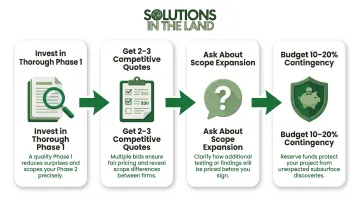
The most effective cost control measure happens before Phase 2 begins: invest in a thorough Phase 1 ESA. A well-documented Phase 1 defines exactly what to test for and where. That precision lets consultants propose targeted scopes instead of broad, expensive investigations across the entire property. A cheap or vague Phase 1 consistently inflates Phase 2 proposals.
Get at least 2–3 competitive quotes. Everything a consultant needs to price a Phase 2 is in the Phase 1 report, so any qualified firm can provide an estimate. Request itemized scopes of work, not just total numbers — the line items reveal what's actually included.
Ask explicitly about potential cost expansion. Before signing, get answers to:
- Are additional sampling rounds included if contamination is found?
- What happens if delineation requires more borings than currently scoped?
- Are expedited lab fees included or billed separately?
- If monitoring wells are installed, are quarterly sampling costs included?
Budget a 10–20% contingency. Multiple industry sources recommend this as a minimum. Phase 2 investigations can uncover conditions that require additional work — having contingency built in avoids mid-project surprises.
For landowners and agricultural investors evaluating farm properties, environmental due diligence rarely exists in isolation from agronomic questions. Solutions in the Land works with landowners and farmers to understand how a property's history — commodity crop production, fuel storage, prior land uses — shapes both what an assessment needs to investigate and how the land can be managed once cleared.
Their whole-system farm planning work, which includes environmental site assessments, addresses both questions in parallel: is the site clean, and what can it productively become?
Frequently Asked Questions
How much does a Phase 1 and Phase 2 environmental site assessment cost?
Phase 1 ESAs typically range from $2,000 to $6,000 for standard commercial properties. Phase 2 ESAs run from roughly $5,000 to $100,000+ depending on scope and contamination complexity. They are separate engagements with separate costs — Phase 1 is always completed first, and Phase 2 is only commissioned if the Phase 1 identifies Recognized Environmental Conditions.
Who pays for a Phase 2 environmental site assessment?
In most transactions, the buyer pays as part of pre-purchase due diligence, though sellers sometimes cover the cost to prevent deal delays. Lenders may require a Phase 2 as a financing condition and specify approved vendors. When contamination liability is disputed, the responsible party — typically a prior owner or operator — may be required to fund it.
What is included in a Phase 2 environmental site assessment?
A Phase 2 ESA covers site investigation planning, physical soil and/or groundwater sampling, laboratory analysis of collected samples, and a final written report summarizing findings, risk levels, and recommended next steps. Remediation, regulatory filings, and legal fees are separate.
What is the difference between environmental site assessment Phase 1, 2, and 3?
Phase 1 is a non-intrusive records review and site inspection that identifies potential risks without physical testing. Phase 2 involves actual soil, groundwater, or vapor sampling to confirm or rule out contamination. Phase 3 is the remediation phase — where confirmed contamination is cleaned up based on a site-specific plan.
How long does a Phase 2 ESA take to complete?
Straightforward investigations typically complete in 2–4 weeks from site visit to final report. Complex investigations involving monitoring wells, multiple sampling events, or contamination delineation can extend to several months.
Can you negotiate the cost of a Phase 2 environmental site assessment?
Yes. Shopping multiple consultants, narrowing scope based on Phase 1 findings, avoiding unnecessary add-ons, and selecting firms with established local lab relationships all reduce costs. A precise, well-documented Phase 1 report does the most to control costs — it gives consultants less room to propose broad, open-ended investigations.
Conclusion
Phase 2 ESA costs range from under $5,000 for simple, targeted investigations to well over $100,000 for complex, multi-contaminant sites. The spread is driven by scope — which is determined almost entirely by what the Phase 1 ESA finds.
Investing adequately in a Phase 2 assessment when one is warranted protects buyers from substantially larger costs down the line. Under EPA's All Appropriate Inquiries framework, conducting proper environmental due diligence is also what qualifies buyers for CERCLA liability protections as innocent landowners or bona fide prospective purchasers. That protection has real financial value — often far exceeding the cost of the assessment itself.
Budget for the actual risk profile of the property, use your Phase 1 to define the scope precisely, get multiple quotes, and keep a contingency fund in reserve. Done right, a Phase 2 ESA gives you the information to negotiate, remediate, or walk away — before you're legally and financially committed to the outcome.