
Introduction
A family farm carries more than balance sheets and equipment inventories. It holds generations of land knowledge, ecological relationships built over decades, and an identity that can't be appraised or transferred on paper. When it comes time to pass that on, the financial and personal stakes hit differently than any other business transition.
Yet only 34% of U.S. family businesses have a robust, documented, and communicated succession plan, according to PwC's U.S. Family Business Survey. For farming families, the stakes of that gap are higher than most — a missed transition doesn't just affect a business, it can end a multigenerational relationship with the land.
If you want the land and the operation to outlast you, this guide covers what succession planning actually involves, why family farms face unique challenges, how to build a plan step by step, and the mistakes that derail even well-intentioned families.
Key Takeaways
- Family business succession planning is the structured process of transferring leadership and ownership to the next generation or designated successors.
- Without a formal plan, farms risk forced land sales, operational disruption, major tax exposure, and lasting family conflict.
- A complete plan addresses successor development, legal and financial structuring, estate planning, and clear transition timelines.
- Agricultural succession goes beyond ownership transfer — stewardship values, conservation agreements, and soil health practices must carry forward too.
- Starting 5–10 years before an anticipated exit gives families the most flexibility and the best outcomes.
What Is Family Business Succession Planning?
Family business succession planning is the deliberate process of identifying, preparing, and transferring leadership and ownership of a family-owned business to the next generation or chosen successors. Done well, it preserves the business's financial health, operational continuity, and long-term legacy.
As Iowa State University's Center for Agricultural Law and Taxation defines it: "Succession planning is preparing to transfer an operating farm, ranch or other business to successors, many times family members."
What the Process Actually Covers
Succession planning goes well beyond signing over ownership. A complete plan addresses:
- Preparing the successor to manage operations, relationships, and decisions before any formal transfer occurs
- Updating entity structures, wills, trusts, and ownership agreements to reflect the new arrangement
- Minimizing transfer costs through gifting strategies, trust vehicles, and exclusion planning
- Capturing institutional knowledge so it doesn't leave with the retiring generation
- Building shared understanding among all family members, not just the direct successor
How It Differs from Selling a Business
When a business sells to a third party, the transaction is primarily financial. Family succession is different. It requires balancing business logic with family dynamics, emotional readiness, and legacy goals that often can't be quantified. That complexity is why most advisors recommend starting the process 5 to 10 years before the intended transition — not months.
Why Family Farms Need a Succession Plan
The numbers on farm succession reveal a quiet crisis. According to USDA data, the average farm producer in the U.S. is 58.1 years old, and 1.29 million producers are 65 or older. For most farming families, succession isn't a distant concern — it's an active one.
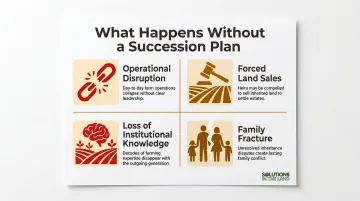
What Happens Without a Plan
The consequences of an unplanned transition are specific and serious:
- Operational disruption — planting and harvest cycles don't pause for estate proceedings; a sudden leadership gap can damage buyer and supplier relationships built over decades
- Forced land sales — estate and inheritance tax obligations, or unresolved ownership disputes, can force heirs to sell farmland under time pressure and at below-market value
- Loss of institutional knowledge — soil management practices, grazing rotations, conservation agreements, and crop systems that exist only in a farmer's memory can disappear in a single generation
- Family fracture — without a clear, documented plan, disputes over land ownership and inheritance can permanently divide families and end farming operations that survived economic downturns and droughts
The Tax Reality
Estate tax exposure is real but often overstated. In 2020, only 0.16% of farm estates owed federal estate tax, and the federal basic exclusion amount has risen to $13.99 million per decedent in 2025. However, rising land values complicate the picture — U.S. cropland now averages $5,830 per acre nationally, with some Midwest farmland running significantly higher. Larger operations can cross exposure thresholds quickly, and state-level estate taxes (Illinois carries a $4 million exclusion, for example) create additional complexity that a federal-only analysis misses.
The earlier a family starts the process, the more tools are available — from graduated ownership transfers to conservation easements that reduce taxable estate value. The next step is understanding what a succession plan actually needs to cover.
How to Create a Family Business Succession Plan
Effective succession planning unfolds in a structured sequence that addresses both the business and personal dimensions of the transition. The process works best when started well before the owner intends to exit — most extension services and advisors recommend beginning at least 5–10 years ahead.
Step 1: Assess Your Business and Personal Goals
Before any transition can be planned, you need an honest baseline.
On the business side, this means evaluating financial health, operational strengths, market position, outstanding liabilities, and land and equipment values. A SWOT analysis helps surface both the assets worth protecting and the vulnerabilities that need addressing before transfer.
On the personal side, the current owner needs to clarify:
- Anticipated retirement timeline and income needs post-exit
- Non-negotiable legacy priorities (keeping the land in the family, maintaining farming practices, etc.)
- Risk tolerance around tax exposure and liquidity
- Whether a full exit, gradual transition, or retained advisory role best fits their goals
These two assessments, taken together, define what a successful transition actually looks like — and that definition drives every subsequent decision.
Step 2: Identify and Develop Your Successor
Successor selection is where many farm families make their first mistake: defaulting to birth order or family expectation rather than capability and genuine interest.
The right successor is identified based on:
- Demonstrated interest in farming as a career, not an obligation
- Current skills and willingness to develop the ones they lack
- Alignment with the operation's values and long-term direction
- Capacity to manage both the agronomic and business dimensions of the farm
Once identified, successor development is a multi-year investment. Effective approaches include:
- Mentorship with the current owner through shared decision-making
- Formal agricultural education or business training
- Outside work experience at other farms or agribusinesses
- A gradual increase in operational responsibility with real accountability
The goal is to hand over a business to someone who has already been running it in practice — not someone learning on the job after the keys change hands.
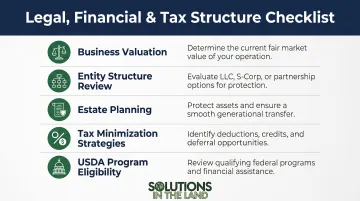
Step 3: Address Legal, Financial, and Tax Structures
This step requires qualified legal and financial advisors. The core work includes:
- Business valuation — establishing fair market value of the farm, including land, equipment, water rights, crop systems, and any conservation easements
- Entity structure review — determining whether the current business structure (sole proprietorship, LLC, family partnership, S-corp) is appropriate for the transition
- Estate planning — updating or creating wills, revocable trusts, and irrevocable trusts that govern asset transfer
- Tax minimization strategies — tools like intentionally defective grantor trusts (IDGTs) can shift future land appreciation outside the taxable estate while the grantor pays income tax on trust earnings; annual gift tax exclusions ($18,000 per donee in 2024) allow incremental, tax-efficient transfers over time
- USDA program eligibility — successors may qualify for Beginning Farmer and Rancher Loans through USDA FSA if they've operated for fewer than 10 years and meet ownership thresholds; these programs can facilitate buy-ins and enable on-farm tenure without requiring outside financing
Start this process early. Legal and tax structures take time to set up correctly, and errors made under deadline pressure tend to be expensive to unwind.
Step 4: Document Operations and Create a Transition Timeline
Operational documentation is the most underestimated step in farm succession, and one of the few genuinely specific to agricultural businesses.
What needs to be captured before a transition:
- Day-to-day management processes and seasonal schedules
- Soil health protocols and fertility management history
- Grazing rotations and adaptive pasture management plans
- Crop rotation sequences and market relationships
- Supplier and buyer contracts, along with relationship context
- Conservation agreements, easement obligations, and land use restrictions
- Water rights documentation and infrastructure records
For farms operating under regenerative or sustainable systems, this documentation is especially critical. These practices are often undocumented — living in the current operator's memory rather than any written record. When that knowledge isn't transferred, recovering lost soil health and ecological productivity can take years.
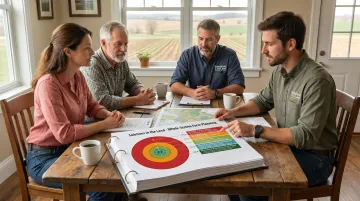
Solutions in the Land's whole-system farm planning process was built specifically for this kind of documentation work. Their methodology walks farms through 143 questions — covering regional context, soil conditions, conservation obligations, revenue streams, and policy programs — and produces what the company calls "a solid reference manual to make good decisions." The process explicitly accounts for "the burden to future generations and the legacy of the work," which makes it directly relevant for families building the operational documentation layer of a succession plan.
The transition timeline should assign specific milestones and responsibilities — who takes over which decisions, when, and with what support — rather than leaving the handover as an informal, undefined process.
Step 5: Implement, Communicate, and Monitor
The final phase is where planning becomes action — and where family dynamics most often surface.
Key implementation steps:
- Share the plan transparently with all family members, not just the successor — surprises create resentment
- Execute legal agreements with the guidance of your advisors, including ownership transfers, buy-sell agreements, and trust instruments
- Assign clear roles and timelines so everyone knows who is responsible for what during the transition period
- Establish a review cadence — business conditions change, family circumstances change, and tax laws change; a plan that isn't revisited becomes outdated quickly
Key Factors That Affect Farm Succession Planning
Family Dynamics and Communication
Unresolved family tensions don't disappear when a succession plan is written — they tend to surface in disputes over perceived fairness, excluded family members, or conflicting visions for the land's future. Structured family conversations, facilitated by a neutral third party when needed, reduce this risk significantly. The goal isn't consensus on everything. It's shared understanding of the plan and the reasoning behind it.
Timing and Successor Readiness
Successor readiness — not the owner's retirement date — should drive the transition timeline. A successor who takes over before they're operationally and emotionally prepared will make avoidable mistakes during the highest-stakes period of the farm's transition. Missouri Extension's guidance outlines five distinct phases of management transition, from minority to majority ownership — a useful framework for staging responsibility increases over time.
Land and Asset Valuation
| Asset Class | 2025 U.S. Average ($/acre) | 1-Year Change |
|---|---|---|
| Farm real estate | $4,350 | +4.3% |
| Cropland | $5,830 | +4.7% |
| Pasture | $1,920 | +4.9% |
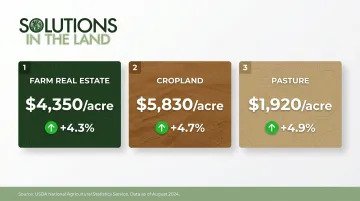
Source: USDA NASS Land Values 2025 Summary
Rising land values complicate equitable treatment of multiple heirs and make liquidity planning more difficult. Conservation easements, water rights, and encumbered acreage add additional appraisal complexity that standard business valuation methods aren't designed to handle.
Preservation of Farming Philosophy
For regenerative and sustainable operations, succession planning has a dimension that generic business guides miss entirely: the successor must also carry the land stewardship philosophy that defines the operation's ecological and economic value.
A successor who understands soil health principles, adaptive grazing systems, and conservation commitments will maintain or improve the farm's long-term productivity. One who doesn't may inadvertently undo decades of ecological work within a few seasons.
Solutions in the Land's whole-system farm planning work includes successor readiness assessments — evaluating whether potential successors share the farming philosophy and identifying where additional development is needed before the handover.
Legal and Regulatory Environment
Farm succession is shaped by overlapping legal frameworks that vary by state:
- State-specific inheritance and estate tax laws
- USDA loan eligibility rules for beginning farmers
- Conservation easement obligations and restrictions
- Agricultural zoning and land use designations
- Heirs' property title issues, which USDA FSA's Heirs' Property Relending Program can help resolve
All of these require qualified legal counsel with agricultural experience — general estate attorneys often miss the farm-specific nuances.
Common Mistakes in Family Business Succession
Most farm families don't fail at succession because they made one bad decision. They fail because of patterns — avoidable ones. These three show up most often:
- Starting too late, when a health crisis or retirement deadline removes all flexibility
- Defaulting to birth order instead of evaluating who is actually prepared and committed
- Treating the handover as a transaction rather than a multi-year process
Waiting Too Long to Start
Many farm families treat succession planning as something to address when pressure forces the issue — a health scare, a looming retirement, or a family dispute. By that point, options narrow and costs rise. Succession is a phased, multi-year process, not a decision made in a single conversation. Starting early is what keeps choices open.
Assuming the Oldest Child Is the Natural Successor
Defaulting to birth order or family expectation rather than capability produces mismatched leadership that damages both the business and the family. The right successor is the person most prepared and most committed. Reaching that conclusion honestly requires open conversation and sometimes the willingness to consider non-family candidates — which is harder than it sounds but often necessary.
Treating Succession as a Single Event
Succession is not a document signed on one day. It's an ongoing process of preparation, gradual transition, and relationship management that unfolds over years.
Families that treat it as a transaction — hand over the keys, sign the papers, done — encounter the highest rates of conflict and operational disruption. The farms that transition successfully are the ones where the next generation has been running the operation in practice long before the formal handover.
Frequently Asked Questions
What is family business succession planning?
It is the structured process of transferring leadership and ownership of a family business to the next generation or chosen successors. The process encompasses financial, legal, and operational planning to ensure business continuity and preserve the family's legacy.
How do you plan succession in a family business?
Assess the business and owner goals, identify and develop successors, address legal and tax structures, document operations, and implement a clear transition timeline. Most advisors recommend starting the process 5–10 years before the intended exit.
What are the 5 D's of succession planning?
The 5 D's are five unplanned events that can force a business transition: Death, Disability, Divorce, Disagreement, and Distress (financial hardship). A formal succession plan prepares the business to survive any of these events without operational crisis.
What are the 4 C's of family business?
The 4 C's are four interconnected dimensions of family business: Continuity (multigenerational preservation), Culture (shared values and identity), Capital (financial assets), and Communication (open dialogue among family and business stakeholders).
When should you start succession planning for a family business?
Start at least 5–10 years before the planned exit. Early planning lets successors build real leadership experience — not just theoretical knowledge — while giving the business time to adjust financially and operationally without a hard deadline forcing rushed decisions.
What happens to a family farm if there is no succession plan?
Without a plan, family farms are exposed to forced land sales to cover estate taxes, sudden leadership gaps, loss of generational farming knowledge, and family conflict over ownership. Any one of these outcomes can permanently end a multigenerational farming legacy.