A Phase I Environmental Site Assessment (ESA) is a professional, non-invasive investigation into a property's environmental history. Its purpose: identify whether current or past activities on or near the site have introduced contamination that could threaten your health, your crops, or your legal standing as the new owner. Required for most commercial and agricultural real estate transactions, Phase I ESAs follow the ASTM E1527-21 standard and the EPA's All Appropriate Inquiries (AAI) rule at 40 CFR Part 312.
This guide covers why a Phase I ESA is required, what the process involves, what findings like RECs mean for your transaction, and what to do once you have your report in hand.
Key Takeaways
- A Phase I ESA involves records review, site inspection, and interviews — no soil or water sampling
- Required by most lenders, including USDA Farm Service Agency and SBA loan programs, before financing is approved
- Conducted by a qualified Environmental Professional (EP); typically completed in 10–20 business days
- Core findings are classified as RECs — if any are identified, a Phase II ESA with physical sampling is usually recommended
- A clean report gives farmland buyers and landowners confidence, negotiating leverage, and a clearer path for long-term land planning
Why Landowners and Farmers Need a Phase I ESA
The CERCLA Liability Problem
Under the Comprehensive Environmental Response, Compensation, and Liability Act (CERCLA), a property buyer can be held strictly liable for cleaning up contamination — even contamination that predates their ownership by decades. This isn't a technicality easily argued away; liability attaches under CERCLA Section 107(a) simply by virtue of owning the property.
The remedy is completing a Phase I ESA before closing. A properly conducted assessment, compliant with ASTM E1527-21, establishes the "Innocent Landowner Defense" under CERCLA Section 107(b)(3). Without it, you inherit whatever environmental history came with the deed.
As of February 14, 2024, only the E1527-21 standard satisfies the EPA's AAI rule — the prior E1527-13 standard is no longer acceptable for CERCLA liability protection.
Lender Requirements for Agricultural Transactions
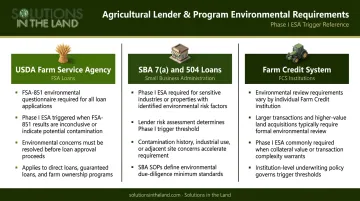
Most agricultural lenders require environmental due diligence before approving financing:
| Lender/Program | Requirement |
|---|---|
| USDA Farm Service Agency | Form FSA-851 environmental screening required for all direct farm loans; Phase I ESA triggered when screening is inconclusive |
| SBA 7(a) and 504 Loans | Phase I ESA required for environmentally sensitive industries or properties with identified risk factors |
| Farm Credit System | Policies vary by institution; most require environmental review for larger transactions |
Skip the assessment, and you don't avoid the requirement — you lose the financing.
Unique Risks for Agricultural Land Buyers
Farmland carries specific contamination risks that aren't always visible at the surface:
- Underground storage tanks (USTs) for farm fuel — the EPA reports approximately 62,000 releases still awaiting cleanup nationally as of 2025
- Historical pesticide or chemical storage in farm outbuildings
- Adjacent land uses such as former gas stations, dry cleaners, or industrial facilities
- Former orchard applications of lead arsenate pesticides on land that looks clean today
For farmers pursuing organic certification, this matters beyond the legal question. USDA NOP regulations require that no prohibited substances be applied to land for three years prior to harvest. A Phase I ESA documents that history, supporting your organic transition plan and giving certifying agents the documentation they need.
The Investment Protection Angle
That same documentation has direct financial value — and not just for organic certification. A Phase I ESA costs a fraction of what contamination remediation runs, and it gives buyers real data to:
- Negotiate a price reduction based on environmental risk
- Request remediation as a condition of sale
- Walk away from a problematic property before closing
For existing landowners, a Phase I ESA is also valuable when refinancing, changing land use, or applying for agricultural conservation programs — it documents environmental stewardship as part of your property record.
What Does a Phase I ESA Include?
A Phase I ESA covers four core components: records review, site reconnaissance, interviews, and a written report. All assessments must follow ASTM E1527-21 and be conducted by a qualified Environmental Professional (EP). Under 40 CFR Section 312.10, an EP qualifies through one of four pathways:
| Pathway | Credentials | Experience Required |
|---|---|---|
| 1 | Licensed Professional Engineer (PE) or Geologist (PG) | 3 years relevant experience |
| 2 | Federal/state/tribal environmental license or certification | 3 years relevant experience |
| 3 | Baccalaureate degree in engineering or science | 5 years relevant experience |
| 4 | No specific degree | 10 years relevant experience |
Records Review
The EP examines historical sources to reconstruct what happened on and around the property:
- Sanborn fire insurance maps and historical aerial photographs
- Topographic maps and city directories
- Federal and state regulatory databases covering Superfund (NPL) sites, RCRA facilities, UST and LUST registries, brownfield listings, and environmental liens
- Activity and Use Limitations (AULs) recorded against the property
This step often surfaces findings that weren't disclosed during negotiations — a farm property that once sat adjacent to a fuel depot, or a parcel with a decades-old UST registration no one mentioned at the table.
Site Reconnaissance
The EP visits the property and adjacent lots, looking and listening for indicators of contamination:
- Stained or discolored soil
- Corroded storage containers or tank remnants
- Oily sheens or unusual odors
- Areas of vegetation die-back or stressed plant growth
- Evidence of dumping or chemical storage
This is a visual-only inspection — no samples are collected. The EP photographs findings and takes detailed field notes that become part of the final report.
Interviews
Written records don't capture everything. The EP interviews people with direct knowledge of the property's history, including:
- Current and former owners and tenants
- Local government officials and utility providers
- Neighbors with long-term familiarity with the site
This surfaces undocumented uses — for instance, a prior owner who stored petroleum products in a barn that was never formally reported.
Report Preparation
All findings are compiled into a written report covering:
- Site history and physical description
- Sources consulted and any data gaps
- Identified Recognized Environmental Conditions (RECs)
- Recommendations for further action
A properly prepared Phase I ESA report is legally defensible and shareable with lenders, insurers, and other parties. Most reports are delivered within 5–7 business days of the site visit.
How Long Does a Phase I ESA Take and What Does It Cost?
Typical Timeline
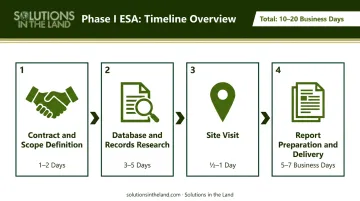
A standard Phase I ESA runs 10–20 business days from engagement to final report delivery:
- Contract and scope definition — 1–2 days
- Database and records research — 3–5 days
- Site visit — typically a half to full day on-site
- Report preparation and delivery — 5–7 business days
Property size, complexity of site history, government records turnaround times, and interview scheduling all affect the timeline. Large agricultural parcels with multiple prior owners can run longer.
Cost Factors
No federal agency publishes a standardized cost range for Phase I ESAs. Industry sources in 2024–2025 cite general ranges starting around $1,800 to $5,000 for standard commercial assessments, with large rural and agricultural parcels often commanding higher fees due to expanded site reconnaissance scope.
Key variables that affect your cost:
- Property acreage — more land means more ground to cover
- Historical complexity — multiple prior owners or diverse prior uses require more research
- Geographic location — travel requirements and regional labor rates vary
- Turnaround time — expedited reports cost more
- Number of adjoining properties requiring review
Validity Period
Understanding the validity window matters for budgeting — an expired report means paying to refresh components, which adds cost and delays closing.
A Phase I ESA is generally usable for up to one year after completion. However, interviews, site reconnaissance, regulatory database searches, and environmental lien review must all be no more than 180 days old at the time of acquisition.
If your transaction stretches past that window, those components require updating before the report supports CERCLA liability protection. Build your ESA order date around your anticipated closing date, not your contract date.
What Are Recognized Environmental Conditions (RECs)?
RECs are the core output of every Phase I ESA. ASTM E1527-21 defines three classifications:
| Type | What It Means |
|---|---|
| REC | Known or suspected presence of hazardous substances or petroleum products due to a current or past release |
| CREC (Controlled REC) | Past contamination addressed by regulators, but with residual contamination remaining under land use restrictions |
| HREC (Historical REC) | A past release fully remediated to unrestricted use standards — no controls remain |
Common REC Triggers on Agricultural Properties
- Farm fuel USTs — the EPA confirmed 4,307 new releases from underground storage tanks in FY2025 alone, with a national backlog of roughly 62,000 sites still awaiting cleanup
- Pesticide mixing areas or chemical storage buildings from prior farm operations
- Adjacent gas stations, dry cleaners, or industrial facilities identified during records review
- Historical pesticide applications on former orchards or properties near manufacturing sites
What a REC Means for Your Transaction
A REC is not a verdict — it's a finding that warrants further investigation. When the Phase I ESA identifies a REC, buyers have several options:
- Negotiate a price reduction to account for the risk
- Require the seller to conduct Phase II testing before closing
- Attach remediation as a condition of sale
- Walk away — with documented justification in hand
Lenders may independently require resolution of RECs before financing moves forward. Understanding which REC type applies — and whether controls remain on the land — directly shapes what the property can support agriculturally and what lease terms or land use restrictions will follow.
What a Phase I ESA Does NOT Cover — and When You Need a Phase II
A Phase I ESA is entirely non-invasive. No soil borings, no groundwater samples, no lab analysis. It can identify the risk of contamination based on history and observation, but it cannot confirm or quantify what's actually in the ground.
The following are explicitly excluded from a standard Phase I ESA under ASTM E1527-21:
- Asbestos-containing materials (ACM) surveys
- Lead-based paint inspections
- Mold assessments
- Radon testing
- Wetlands delineations
- Endangered species evaluations
These can be contracted as supplemental services and may be especially relevant for older farm structures or properties near wetlands or waterways. For farmland owners weighing conservation transitions or property acquisitions, understanding which supplemental assessments apply to your site is a worthwhile early step in due diligence.
When a Phase II ESA Is Needed
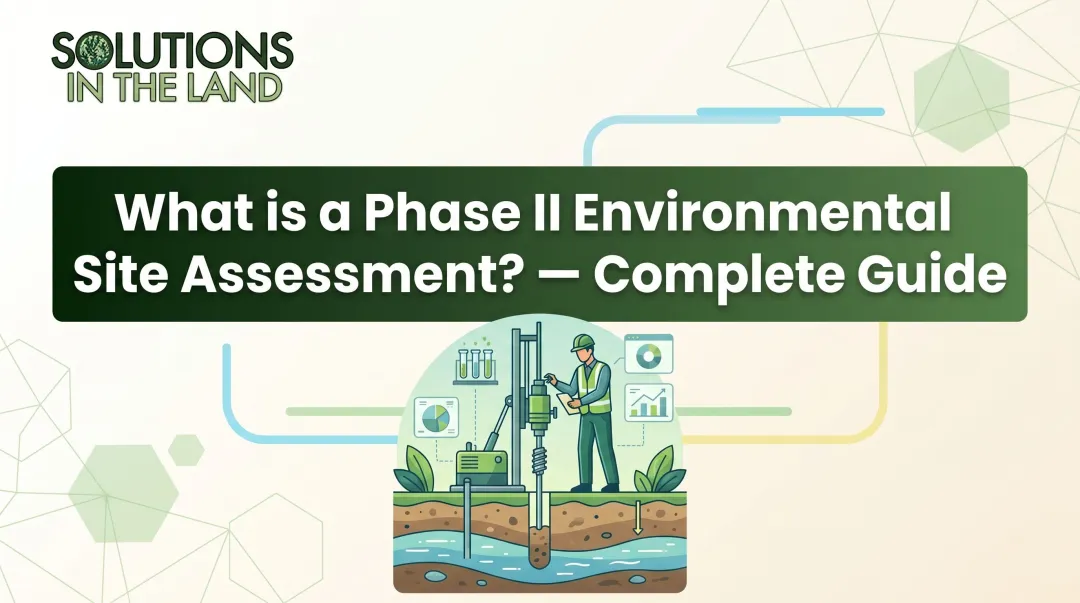
If the Phase I report identifies RECs, the EP will typically recommend a Phase II ESA: an invasive investigation involving soil borings, groundwater sampling, and laboratory analysis to confirm or rule out contamination and determine its extent.
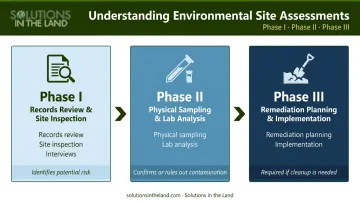
Each phase serves a distinct purpose:
- Phase I — Records review, site inspection, interviews; identifies potential risk
- Phase II — Physical sampling and lab analysis; confirms or rules out contamination
- Phase III — Remediation planning and implementation if cleanup is required
What Happens After a Phase I ESA: Planning Your Next Steps
If No RECs Are Found
A clean Phase I ESA report is the green light most transactions need. For landowners and farmers, it's also the moment to shift focus from environmental due diligence to productive land use planning.
Solutions in the Land works with landowners after acquisition to develop whole-system farm plans tailored to the site's specific conditions, history, and market opportunities. This includes organic transition planning, soil health assessment, crop system design, and regenerative agriculture consulting that translates a clear environmental record into a productive long-term strategy for the land.
The Phase I ESA documentation can also support organic certification applications, NRCS conservation program eligibility, and future loan applications.
If RECs Are Found
RECs require a decision, not panic. Practical next steps:
- Negotiate — use the REC finding as documented justification for a price reduction
- Request Phase II testing — determine whether the REC represents actual contamination or residual risk
- Require remediation commitments — make cleanup a condition of closing
- Walk away — a REC on a property intended for organic use may be disqualifying if residual contamination falls under use restrictions incompatible with food production
Understanding what a specific REC means for organic certification eligibility or regenerative agriculture viability requires both an environmental consultant for the contamination side and a land use advisor for the agricultural planning side.
Retain Your Report
The Phase I ESA reflects conditions at a specific point in time and is valid for up to one year (with 180-day component requirements). Retain it as part of your permanent property documentation. It supports:
- Future refinancing and loan applications
- Organic certification processes
- Conservation program applications (including NRCS)
- Any future transactions involving the land
Frequently Asked Questions
What is included in a Phase I Environmental Site Assessment?
A Phase I ESA covers three core components: a records review of historical documents and regulatory databases, a visual on-site inspection (site reconnaissance), and interviews with knowledgeable parties. All findings are compiled into a written report that identifies any RECs and recommends Phase II investigation where warranted.
How long does a Phase I Environmental Site Assessment take?
Most Phase I ESAs take 10–20 business days from engagement to final report delivery. Timeline varies based on property size, the complexity of historical research required, and the availability of interview contacts and government records.
How much does a Phase I Environmental Site Assessment cost?
Standard assessments typically range from $1,800 to $5,000, based on industry sources for 2024–2025. Agricultural parcels with large acreage, complex site histories, or expedited turnaround requirements generally fall at the higher end.
What is the difference between Phase 1 and Phase 2 environmental site assessments?
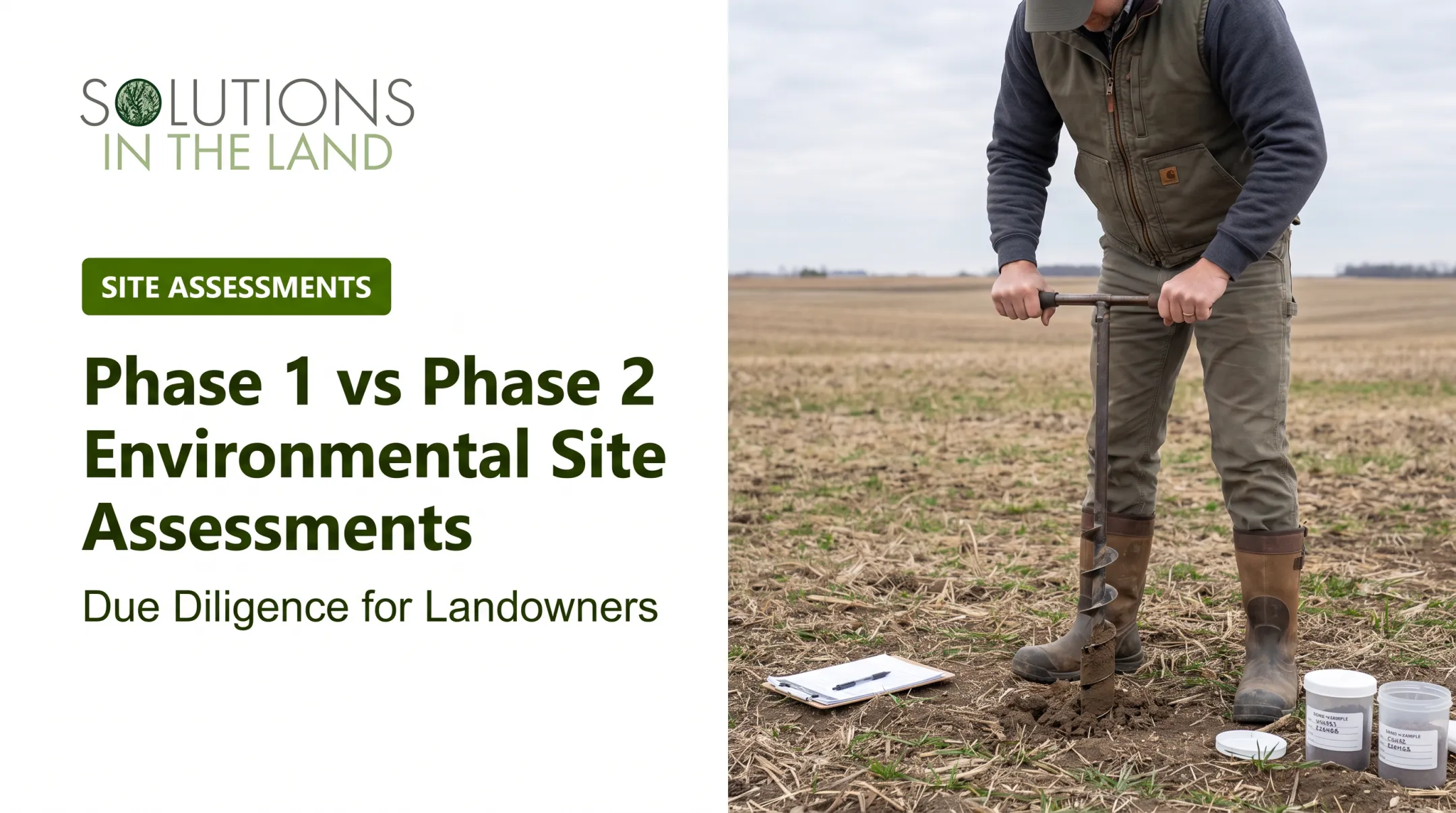
A Phase I ESA is a non-invasive review of records, visual site conditions, and interviews to identify potential contamination risk. A Phase II ESA involves physical sampling — soil borings, groundwater testing, and lab analysis — conducted when RECs identified in the Phase I require confirmation.
What are the main steps of a Phase I Environmental Site Assessment?
A Phase I ESA identifies existing or historical contamination risks before a property transaction, protecting buyers from inheriting legal liability under CERCLA. The four steps are:
- Records review of historical documents and regulatory databases
- Site reconnaissance (visual on-site inspection)
- Interviews with knowledgeable parties
- Written report preparation
What is a brownfield site assessment?
A brownfield is a previously developed property where past industrial or commercial use may have left contamination. A Phase I ESA is typically the first step in evaluating a brownfield for redevelopment — including conversion to agricultural or community food production use.