Introduction
Modern farmers are being pulled in several directions at once: rebuild degraded soils, find new revenue, and adapt to weather that behaves less predictably every season — on the same land, with the same resources. Conventional approaches tend to tackle these problems one at a time. Alley cropping is built to handle them together.
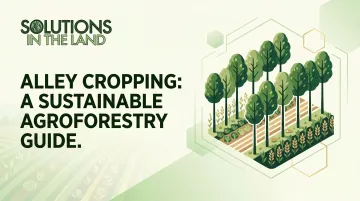
As an agroforestry practice, alley cropping integrates rows of trees or shrubs into working crop fields, creating productive "alleys" where annual or perennial crops continue to grow.
The arrangement generates near-term income from alley crops while building long-term value from timber, nuts, or fruit — and restoring soil health in the process.
This guide is written for landowners, farmers, and agricultural stakeholders who are exploring how trees might fit into their existing operations, or who are considering a broader transition toward regenerative farming. What follows is a practical breakdown of how alley cropping works, what it takes to establish, and whether it's the right fit for your land.
Key Takeaways
- Alley cropping plants tree rows at wide intervals, with crops grown in the spaces between them
- It reduces nitrogen leaching by up to 83% and supports biodiversity, erosion control, and microclimate stability
- Long-term income comes from trees (timber, nuts, fruit); alley crops cover revenue during establishment
- Alley widths typically range from 60 to 120 feet; east-west row orientation maximizes crop sunlight
- USDA EQIP and CSP funding (NRCS Code 311) can help offset startup costs
What Is Alley Cropping and How Does It Work
The USDA National Agroforestry Center defines alley cropping as "the planting of rows of trees and/or shrubs to create alleys within which agricultural or horticultural crops are produced." In tropical agriculture, the same system is often called hedgerow intercropping. In Europe, the term "silvoarable" is used. The mechanics are the same regardless of the label.
What distinguishes alley cropping from monoculture is how trees actively reshape the productive dynamics of the entire field over time — not as a static addition, but as a living system that compounds in value as it matures.
How the System Functions
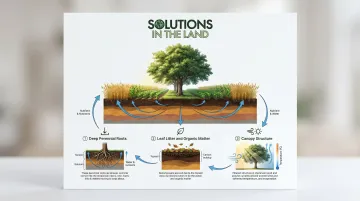
As trees and shrubs mature, they alter how light, water, and nutrients move through the field:
- Deep perennial roots access subsoil moisture and nutrients that annual crops never reach — and recycle them back into the system
- Leaf litter and organic matter continuously build soil carbon within the alleys
- Canopy structure moderates wind, temperature, and evaporation across the crop zone
These functional benefits accumulate over years, which is why alley cropping is a long-term commitment rather than a seasonal fix. Systems can range from simple — a single grain crop rotated between walnut rows — to complex, multi-layered designs producing timber, nuts, fruit, and specialty crops simultaneously.
The 2022 Census of Agriculture recorded 3,915 farms reporting alley cropping in the United States, making it a growing but still niche practice within the broader agroforestry category.
The Environmental and Economic Benefits of Alley Cropping
Soil Health, Erosion Control, and Water Quality
Alley cropping's environmental benefits are well-documented and span multiple dimensions:
Soil fertility:
- Tree leaf litter and root turnover continuously add organic matter to alley soils
- Nitrogen-fixing species (black locust, alder in temperate zones) improve fertility
- Deep tree roots capture leached nutrients before they exit the root zone — a function researchers call the "safety net" effect
Erosion and water quality: Tree rows intercept rainfall, slow surface runoff, and stabilize soils through perennial root networks. Research by Wolz et al. at the University of Illinois found that converting a corn-soybean rotation to alley cropping reduced total unintended nitrogen losses by 83% over four years — from 240 kg N/ha in the monoculture to just 41 kg N/ha in the alley cropping system.
Microclimate: A 2022 review in Agricultural and Forest Meteorology found that every field-scale study examining wind speed in alley cropping systems reported a reduction compared to monoculture. Half of air temperature studies documented daytime cooling in the alleys. While soil moisture effects vary by site and species, reduced wind exposure and cooler soil temperatures consistently reduce crop stress during hot, dry periods.
Biodiversity and Farm Income
Biodiversity and pollination: Tree and shrub rows provide habitat, food sources, and movement corridors for pollinators, beneficial insects, and wildlife. The NRCS explicitly recognizes this, listing "enhancing wildlife and beneficial insect habitat" as a stated purpose of alley cropping (Code 311). Beyond wildlife support, research shows that tree rows also act as pesticide filters — concentrations drop measurably at sampling points adjacent to tree rows compared to open field sites.
Diversified income:
- Annual crops (grains, vegetables, forages) generate revenue from year one
- Tree crops (timber, nuts, fruit) build into income streams over time that monocultures can't replicate
- Combined system resilience reduces exposure to single-commodity price swings
A nine-year Chinese study of apple-based alley cropping found Land Equivalent Ratios (LER) consistently above 1.0 — the combined system produced more total output per unit of land than either crop grown alone, even though annual crop yields ran 13–18% lower in the alleys. For landowners planning a transition, that margin is where whole-system design decisions have the most leverage.
Best Trees and Crops for an Alley Cropping System
High-Value Tree Options
| Tree Species | Primary Products | Key Considerations |
|---|---|---|
| Black walnut | Timber, nuts | Light shade, deep roots; allelopathic (juglone) — incompatible with some crops |
| Chestnut | Nuts | Blight-resistant; pairs well with winter wheat or hay |
| Pecan | Nuts, timber | Deeper shade than walnut; no allelochemicals; excellent safety-net roots |
| Apple | Fruit | Faster returns; well-studied in LER research |
| Elderberry | Fruit, medicinal | Medium-term returns; strong pollinator habitat value |
| Hazelnut | Nuts | Shrub-scale; earlier production than timber species |
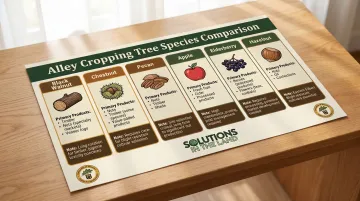
The University of Missouri Center for Agroforestry notes that most current research centers on pecan, chestnut, and eastern black walnut for temperate US alley cropping applications.
Alley Crop Options
Suitable alley crops vary by market and light conditions:
- Cereal grains (wheat, oats, corn) — suited to wide alleys with full-sun species
- Forages and legumes — compatible with moderate canopy shade
- Vegetables and specialty greens — work well in medium alleys early in tree establishment
- Medicinal herbs and flowers — often shade-tolerant; strong specialty market potential
Selecting Compatible Pairings
The wrong tree-crop pairing can create damaging competition. Key decision factors:
- Water needs: Match tree and crop moisture requirements to your rainfall pattern
- Shade tolerance: As canopy density increases, alley crops must tolerate lower light levels
- Root dynamics: Deep-rooted trees (walnut, pecan) cause less shallow-zone competition
- Allelopathy: Black walnut produces juglone, which suppresses many vegetable crops nearby
- Equipment clearance: Tree canopy spread at maturity must accommodate your machinery
A qualified agroforestry specialist can assess your soil profile, canopy timeline, equipment constraints, and target markets to identify pairings that actually perform — not just ones that look good on paper.
How to Design and Space Your Alley Cropping System
Row Orientation and Spacing
Orientation: East-west row orientation is generally recommended for temperate systems — it maximizes sunlight exposure for alley crops throughout the day. If erosion is a concern on sloped land, rows oriented along the contour take priority. For wind erosion, rows perpendicular to prevailing wind provide the best protection.
Alley width: This is one of the most consequential design decisions you'll make.
| Alley Width | Alley Crop Lifespan | Best Suited For |
|---|---|---|
| 60 feet | 5–10 years (before canopy closure) | Moderate shade-tolerant crops; smaller equipment |
| 80 feet | Up to 20 years of row crop production | Standard row crop equipment; most temperate systems |
| 100–120 feet | Extended full-sun production window | Full-sun annual crops; large equipment; tall timber species |
NRCS guidance recommends designing alley widths as multiples of your widest equipment, with approximately 4 feet of buffer on each side of the tree row to prevent machinery damage.
Within-Row Tree Spacing and Long-Term Planning
Within-row spacing (the distance between individual trees in the same row) should reflect the mature canopy size of your chosen species and your thinning strategy over time. Tighter spacing encourages straight stem development for timber; wider spacing suits grafted nut stock.
Alley cropping systems are dynamic. As trees mature over 10–20 years, conditions in the alleys shift considerably. Your crop mix needs to shift with them:
- Light levels drop as canopy closes, limiting full-sun annual production
- Soil moisture dynamics change as root systems compete and complement each other
- Nutrient cycling shifts as leaf litter and root turnover accumulate over time
- Crop selection transitions from full-sun annuals in early years toward shade-tolerant forages or herbs
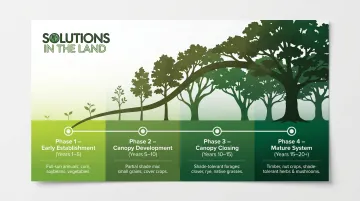
Mapping this evolution before you put a single tree in the ground is where structured farm planning earns its value. Solutions in the Land specializes in exactly this kind of multi-decade land transition planning, helping landowners think through crop sequencing, revenue projections, and system adjustments before they become reactive problems.
Equipment compatibility is critical and often overlooked. Tractors, harvesters, and sprayers must fit within alleys at every stage of tree growth, not just at planting. Designing for mature canopy spread, not seedling size, prevents operational headaches a decade down the road.
How to Establish an Alley Cropping System
Three Common Pathways
- Convert an existing orchard — integrate agronomic or forage crops between existing tree rows, thinning as needed to create workable alleys
- Establish tree rows on cropped or fallow land — plant tree rows first, then begin alley crops between them from the start
- Integrate perennial or specialty crops between tall annual crops — for example, establishing medicinal herbs or Christmas trees between corn rows as a transitional strategy
Financial Planning and USDA Programs
Because trees take years to reach productive maturity, alley crops carry the financial weight of the operation in the early phase. Plan your financial model around this timeline: establishment costs include tree seedlings, protective fencing, labor, and weed management — all before tree crops produce meaningful revenue.
Federal programs can help offset these startup costs:
- EQIP (Environmental Quality Incentives Program): Alley cropping qualifies under NRCS Conservation Practice Code 311, which covers financial and technical assistance for establishment
- CSP (Conservation Stewardship Program): Also covers agroforestry practices including alley cropping
- SARE grants: The Sustainable Agriculture Research and Education program has funded alley cropping research projects; check their database for relevant funding opportunities
Solutions in the Land's whole-system farm plans explicitly identify appropriate local, state, and federal resources — including grant programs — as part of the recommendations phase.
Early Establishment Practices
- Cover crop alleys before the tree canopy closes to build soil organic matter and suppress weeds
- Mulch around tree seedlings to retain moisture, moderate soil temperature, and reduce weed competition in the critical first two years
- Minimize tillage near tree rows to protect developing root systems
- Plan integrated pest management from the outset — alley systems introduce new pest and beneficial insect dynamics that monocultures don't
Common Challenges and How to Address Them
Management Complexity
Alley cropping demands broader knowledge than monoculture farming: you're managing tree biology, crop agronomy, and their interactions at once. As the system matures, those interactions become more nuanced: changing light conditions require crop shifts; root competition intensifies; tree pruning decisions affect both timber value and crop yields.
This complexity is best navigated with experienced support. Solutions in the Land's whole-system farm planning process is designed for this kind of layered decision-making, helping landowners and farmers structure choices around the full range of variables that shape a farm's long-term revenue and resilience.
Capital Requirements and Land Access
Upfront costs are real: tree seedlings, protective infrastructure, fencing, and labor all occur years before tree crops generate income. Compounding this, alley cropping rewards long-term land tenure. Farmers with short lease terms or uncertain land access may not recoup their investment before the lease expires.
Strategies to address this:
- Negotiate long-term agricultural leases (15–25 years) that protect establishment investment
- Explore land-sharing agreements that align tree crop revenue with landowner interests
- Pursue EQIP and CSP cost-share programs to reduce establishment burden
Tree-Crop Competition
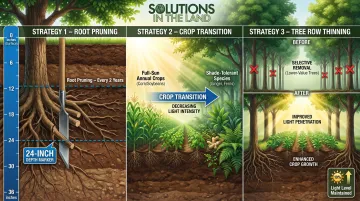
As trees grow, competition for light, water, and nutrients in the alleys intensifies. Management tools:
- Root pruning: Use a ripper or chisel plow to sever lateral roots up to 24 inches deep at the outer canopy edge. NRCS recommends a 2-year interval before ripping the opposite side of the same tree row
- Shift alley crop selection toward shade-tolerant species as the canopy closes in
- Remove lower-value trees from rows over time to maintain alley light levels and improve timber quality on remaining stems
Frequently Asked Questions
What is meant by alley cropping?
Alley cropping is an agroforestry practice where rows of trees or shrubs are planted at wide enough intervals to create alleys in which agricultural or horticultural crops are grown. It allows multiple crops — annual and perennial — to coexist and complement each other on the same land.
What are the benefits of alley cropping?
Alley cropping delivers benefits across both ecology and economics:
- Improves soil health and reduces nitrogen leaching
- Controls erosion and protects water quality
- Moderates microclimate and supports pollinator habitat
- Diversifies income streams for greater market and climate resilience
How does alley cropping affect yield?
Studies consistently show Land Equivalent Ratios above 1.0, meaning overall farm output increases when measured across the whole system. Individual annual crop yields may dip modestly (13–18%) near tree rows due to shade and root competition, but tree crop income compensates over time.
What are the best trees for alley cropping?
Black walnut, chestnut, pecan, apple, elderberry, and hazelnut are among the most commonly used. The best choice depends on your climate, USDA hardiness zone, market access, and compatibility with your chosen alley crops.
What is the spacing for alley cropping?
Alley widths typically range from 60 to 120 feet between tree rows. Sixty-foot alleys support row crop production for 5–10 years before canopy closure; 80-foot alleys extend that window to 20 years. Within-row tree spacing depends on the mature canopy size of the chosen species.
What is the difference between alley cropping and silvopasture?
Alley cropping integrates trees with cultivated crops grown in the alleys. Silvopasture integrates trees with grazing livestock and forage grasses. Both are recognized USDA agroforestry practices, but silvopasture is designed around rotational grazing rather than agronomic or horticultural crop production.