Introduction
Most farmers spend serious time thinking about seed selection, equipment maintenance, and weather patterns. The soil itself — the actual foundation of every crop decision — often gets less attention than it deserves.
That's a costly oversight. According to the FAO, approximately 1.7 billion people live in areas where crop yields are falling due to land degradation — with agricultural productivity running 10% lower than it would be without human interference.
The problem isn't abstract. USDA Economic Research Service data shows that farmers reported at least one soil-related resource concern on 49% of fields growing soybeans, wheat, cotton, and oats.
The scale is significant, but none of it is permanent. Soil fertility management gives farmers and landowners a practical toolkit for diagnosing what's wrong, fixing it systematically, and building lasting productivity into the land.
This guide walks through what soil fertility means, how to spot decline before it costs you yield, and the improvement strategies that deliver measurable, lasting results.
Key Takeaways
- Soil fertility management is the ongoing cycle of testing, amending, and adjusting soil conditions to sustain crop production
- Fertile soil depends on the right pH, adequate organic matter, active biology, and balanced nutrients working together
- Soil testing every 3–5 years is the minimum foundation of any fertility plan
- Core improvement strategies: correct pH, build organic matter, balance N-P-K against crop needs, and protect soil biology
- The 4 R's (Right Source, Right Rate, Right Time, Right Place) provide a practical check for any nutrient application decision
What Is Soil Fertility Management?
Soil fertility is the soil's capacity to supply essential nutrients in the right quantities and in forms that plant roots can actually absorb. The FAO identifies at least 16 elements plants need to complete their life cycle — from the macronutrients (nitrogen, phosphorus, potassium, calcium, magnesium, sulfur) to micronutrients like zinc, boron, and iron.
This is distinct from the broader concept of "soil health," which encompasses the soil's function as a living ecosystem. Fertility is specifically about nutrient availability and the chemical and physical conditions that govern it.
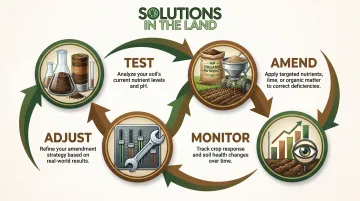
Management means it's never a one-time fix. Every crop cycle removes nutrients from the soil. Natural processes add some back, but rarely enough to replace what production takes out. The management cycle looks like this:
- Test — establish baseline nutrient levels, pH, and organic matter
- Amend — correct deficiencies and imbalances based on test results
- Monitor — track crop response and soil changes over time
- Adjust — recalibrate inputs as conditions and crop needs evolve
Skipping any step in that cycle has consequences on two fronts. Poor fertility management directly reduces yield potential and pushes farmers into reactive spending on inputs that may not address the actual problem. The environmental costs — nutrient runoff, soil erosion, water quality degradation — extend well beyond the farm boundary.
What Makes Soil Fertile: Key Properties to Understand
Soil pH: The Master Variable
pH controls whether nutrients are chemically available to plant roots — regardless of how much fertilizer sits in the soil. Most crops perform best in the 6.0–7.0 range. Outside that window, nutrients become locked up or, at very low pH, elements like aluminum and manganese reach toxic concentrations.
Phosphorus uptake, for example, is optimal between pH 6.0 and 7.0. Drop below 6.0 and phosphorus reacts with other soil compounds and becomes unavailable — meaning phosphorus fertilizer applications go to waste without first addressing pH.
Organic Matter: The Engine of Fertility
Organic matter (OM) does more work per percentage point than almost any other soil property:
- Nutrient retention — holds and slowly releases nitrogen, phosphorus, and other nutrients
- Water storage — each 1% increase in OM helps soil hold approximately 20,000 additional gallons of water per acre (USDA NRCS)
- Soil structure — improves aggregation, reduces compaction risk, and supports infiltration
- Microbial habitat — feeds the biological community that drives nutrient cycling
Cation Exchange Capacity (CEC)
CEC measures how well soil holds onto positively charged nutrient ions — calcium, magnesium, potassium, ammonium — rather than losing them to leaching. Sandy soils may have CEC values of 3–5 meq/100g; dark loams typically range 15–25; organic soils can reach 50–100. Higher CEC means more nutrient-holding capacity and generally more forgiving soil to manage.
Soil Biology
Bacteria, fungi, earthworms, and other soil organisms drive nutrient mineralization — converting organic nitrogen, phosphorus, and other elements into plant-available forms. Each organism class plays a distinct role:
- Mycorrhizal fungi — extend root surface area by orders of magnitude, improving phosphorus and nitrogen uptake
- Bacteria and decomposers — break down organic residues and release plant-available nutrients
- Earthworms and macrofauna — improve soil structure and accelerate organic matter incorporation
This is why chemical inputs alone rarely achieve their full potential: without active biology, the cycling that makes nutrients available is incomplete.
Liebig's Law of the Minimum
Yield is limited by the scarcest required nutrient, not the most abundant one — the same principle that governs soil biology. A field loaded with nitrogen but deficient in zinc will still underperform. Physical constraints follow the same logic: severe compaction can make a chemically fertile soil functionally infertile, regardless of what the lab report says.
Warning Signs of Declining Soil Fertility
Fertility problems rarely announce themselves clearly. Most visible symptoms get misdiagnosed as pest or disease issues when the actual cause is a nutrient deficiency or pH problem.
Visual field indicators:
- Yellowing or pale plant color (nitrogen, iron, or sulfur deficiency)
- Stunted or uneven growth across a field
- Poor stand establishment despite good seed quality
- Increased weed pressure in areas where crops are struggling
- Disappointing yields despite adequate rainfall
Structural warning signs:
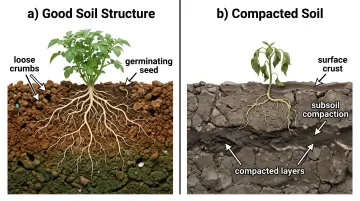
- Compaction and slow water infiltration after rain
- Surface crusting and standing water
- Visible erosion on slopes or field edges
- Poor root development when pulled at mid-season
Compaction alone can reduce yields by up to 50% in severe cases, according to USDA ARS research — with typical losses of 10–20% in unfavorable years, even at moderate compaction levels.
That kind of loss is preventable — but only if problems are caught early. Without regular soil testing, most fertility decline goes undetected until yield losses are already significant. USDA NRCS recommends testing every 3–5 years as a minimum. Fields receiving manure applications or undergoing significant pH shifts may need more frequent monitoring.
Proven Strategies to Improve Soil Fertility
Start with Soil Testing
Soil testing is the only way to move from guessing to knowing. Two main approaches:
- Composite sampling — multiple cores mixed to create one sample representing the field; gives a useful overview for relatively uniform fields
- Grid sampling — divides the field into small zones, each sampled independently; reveals spatial variability and enables precision variable-rate applications
A complete soil test measures pH, organic matter, CEC, macronutrient levels (N, P, K, calcium, magnesium, sulfur), and often selected micronutrients. Results drive every subsequent decision — they should not be used to confirm what you planned to apply anyway.
Correct pH First
Agricultural lime raises pH in acidic soils by adding calcium carbonate or dolomitic lime (which also supplies magnesium). Application rates are determined by soil test and soil buffering capacity — typically 1–2 tons per acre for general corrections, though this varies widely.
One practical constraint: lime takes six months to one year to significantly shift soil pH. Apply it at least six months before planting acid-sensitive crops. For alkaline soils, sulfur amendments can lower pH, though the process is slower and more difficult to manage.
For acidic fields, correcting pH alone often improves nutrient availability enough to meaningfully reduce fertilizer requirements — before a single additional input is applied.
Build Organic Matter
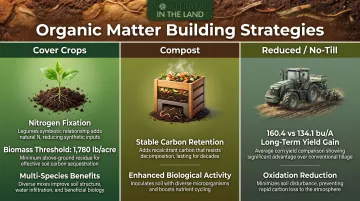
Organic matter increases gradually; it's a multi-year investment. Three proven approaches:
- Cover crops — legumes fix nitrogen; grasses add biomass. WSU research found that consistent OM increases require cover crop biomass exceeding 1,780 lb/acre. Multi-species mixes typically outperform monocultures for both biomass and biological diversity
- Compost — adds stable organic carbon and biological activity simultaneously
- Reduced or no-till — tillage oxidizes organic matter rapidly. MSU's 30-year Kellogg Biological Station study found no-till corn averaged 160.4 bu/A versus 134.1 bu/A for conventional tillage over 2005–2023, though the yield advantage took 8–16 years to fully materialize
Manage Macronutrients Precisely
Phosphorus and potassium management should account for crop removal rates, not just current soil levels. Over-application builds excess that creates runoff risk without yield benefit.
Nitrogen demands the closest attention. Losses through leaching, volatilization, and denitrification can reach 70% of applied nitrogen — meaning less than a third may actually reach the crop.
Split applications — a portion at planting, the remainder at key growth stages — improve efficiency substantially. Modeled results show split N application with rate adjustments can increase profit by 14.6–19.5% compared to single pre-season applications.
Support Soil Biology
Biological activity amplifies every other fertility investment:
- Use rhizobium inoculants on legumes to maximize nitrogen fixation
- Minimize broad-spectrum soil fumigants and fungicides where possible
- Diversify crop rotations to feed a broader range of soil organisms
- Reduce tillage passes to protect mycorrhizal fungal networks that extend root reach
Adaptive Grazing for Pasture and Mixed-Use Land
Soil biology principles don't stop at the crop field. On grasslands and mixed-use farms, planned rotational or adaptive multi-paddock grazing builds fertility from the ground up — moving livestock through paddocks on a schedule that stimulates root exudates, adds organic matter through manure and plant residue, and drives biological activity without heavy synthetic inputs.
Allen Williams, Grazing & Soil Consultant at Solutions in the Land and a sixth-generation farmer, has worked with this system across thousands of operations. Properly designed grazing systems can restore soil structure, increase organic matter, and improve water infiltration — often while supporting more livestock on the same acreage through more uniform pasture utilization.
The 4 R's of Nutrient Management: A Framework for Responsible Fertility
The 4R Nutrient Stewardship framework — developed by the International Plant Nutrition Institute, International Fertilizer Association, and Fertilizer Canada — gives farmers and landowners a consistent structure for making smarter nutrient decisions. Each "R" addresses a different point of failure in common fertility programs.
| R | Principle | Example |
|---|---|---|
| Right Source | Match nutrient form to crop and soil need | Organic nitrogen releases slowly; synthetic urea is fast but volatile — choose based on timing and crop stage |
| Right Rate | Apply what the crop needs, based on soil test data | Soil test–based rates, not default regional averages |
| Right Time | Apply when the crop can use it | Split nitrogen applications rather than a single pre-season dose |
| Right Place | Get nutrients where roots can reach them | Band phosphorus near the root zone rather than broadcasting on high-pH soils |
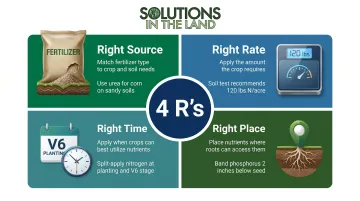
The 4 R's apply across both organic and conventional systems. Use them as a quick audit: if your current approach can't answer all four questions clearly, that gap is costing you in inputs, yield, or both.
Building Long-Term Soil Fertility: The Whole-System Approach
Piecemeal fertility management — liming one year, adding compost the next, addressing compaction only when it becomes obvious — produces inconsistent and often temporary results. Each element of fertility (pH, organic matter, biology, water management, crop design) affects the others. Fixing one while neglecting the rest limits what any single intervention can accomplish.
The farms that build lasting fertility treat it as a multi-year investment in the land's productive capacity. MSU's long-term research showed that no-till systems maintained higher soil moisture during the 2012 drought, supporting better soybean yields than tilled plots — a direct dividend of years of prior soil health investment. The FAO estimates that reversing just 10% of human-induced degradation on existing croplands could restore enough production to feed 154 million additional people annually.
A whole-system plan integrates:
- Regular soil testing to track progress and guide adjustments
- Organic matter building through cover crops, compost, and reduced tillage
- Nutrient management tied to crop removal and soil test data
- Biological support through diverse rotations and reduced soil disturbance
- Water management to prevent erosion and improve infiltration
- Crop or grazing system design that aligns with market opportunities
Solutions in the Land's whole-system farm planning approach was built for exactly this kind of integrated thinking. Their process covers six planning phases and 143 site-specific questions, connecting soil fertility with water, biology, revenue, and land stewardship as one coherent strategy.
Managing Partner and Agronomist Ron Doetch brings decades of expertise in organic, sustainable, and restorative agriculture. Allen Williams contributes deep grazing and soil health consulting experience across thousands of operations throughout the US. For landowners and farmers ready to move beyond incremental fixes, that combination of site-specific planning and hands-on agronomic knowledge translates directly into measurable, lasting results.
Frequently Asked Questions
What is soil fertility management?
Soil fertility management is the ongoing process of assessing, maintaining, and improving the soil's ability to supply nutrients and support healthy crop or pasture growth. It covers both chemical dimensions (pH, nutrient levels, CEC) and biological ones (microbial activity, organic matter cycling).
Why is it important to manage soil fertility?
Poor soil fertility directly limits yields . Per Liebig's Law of the Minimum, a crop performs only as well as its most limiting nutrient allows. Left unmanaged, fertility decline drives up input costs, accelerates erosion, contributes to water quality problems, and reduces the land's long-term productive capacity.
What are some strategies to improve soil fertility?
The most effective strategies: regular soil testing, correcting pH with agricultural lime, building organic matter through cover crops and compost, applying macronutrients relative to crop removal rates, and supporting soil biology through reduced tillage and diverse rotations.
What are the 4 R's of nutrient management?
Right Source, Right Rate, Right Time, and Right Place. Together, they ensure nutrients are applied in a form, quantity, timing, and location that maximizes plant uptake and limits waste, cost, and environmental risk.
Which fertilizer is called the king of fertilizer?
Nitrogen. It's the nutrient most frequently limiting plant growth, required in the largest quantities by most field crops, and the primary driver of vegetative development and yield. It also carries the highest input cost and loss risk when managed poorly.
What is poor man's fertilizer?
Snow. As snowfall deposits atmospheric nitrogen onto the soil surface, it releases that nitrogen gradually as it melts , delivering an estimated 2 to 12 pounds of nitrogen per acre annually through natural atmospheric deposition. It's a modest but genuinely free nitrogen input.