
That distinction matters more than ever. Cattle producers across the United States are managing depleted soils, forage that swings from drought stress to overgrowth, and input costs that keep climbing. Add drought risk, scrutiny over methane emissions, and constant pressure to improve margins, and it's clear why so many producers are asking whether a different management approach could help.
This guide covers what regenerative cattle farming actually means, how adaptive grazing works day to day, how to select cattle and forage for your specific land, what the research says about benefits and limits, and how to take a first, measurable step toward evaluating the approach on your own operation.
Key Takeaways
- Intentional grazing improves soil function, forage recovery, and water cycling without a fixed formula.
- Local forage supply drives stocking and rotation; no universal acres-per-cow figure fits every farm.
- Profit depends on forage, herd performance, infrastructure, and market access together.
- Treat regenerative claims as testable; back decisions with site monitoring and credible research.
What Is Regenerative Cattle Farming?
Regenerative cattle farming is a whole-system approach to managing grazing land. The goal: restore or improve the ecological function of the land while running a cattle operation that pays the bills. That means healthy animals, functioning soil, and a workable balance sheet: all three, not just one.
The word "regenerative" gets used loosely. There's no single "regenerative cow" breed, and no guaranteed environmental outcome stamped with the term.
Regenerative vs. Product Labels
Grass-fed, grass-finished, organic, natural, and regenerative are not interchangeable terms:
- Grass-fed means forage-only feeding after weaning, with no grain and no feedlot confinement, per USDA guidance.
- Grass-finished is a different claim: an animal marketed this way could still have received grain earlier in life.
- Organic is a federally regulated certification with its own set of rules.
- Natural refers to minimal processing, not farm management practices at all.
- Regenerative is treated by USDA as a separate environmental claim that requires its own substantiation, not a defined production method.
The USDA Economic Research Service's 2025 Organic Situation Report confirms that regenerative agriculture falls outside USDA's organic program entirely. Private regenerative labels vary widely, and no single certification governs the term. That's precisely why we tell clients not to buy a label; buy a management practice you can verify.
The Natural Grazing Model
Much of the thinking behind regenerative grazing traces back to how wild herbivores once moved across landscapes: graze an area hard, deposit manure and urine, disturb old plant material underfoot, then move on and let the ground recover before returning.
Cattle can mimic that pattern under a manager's direction, but only when the system is deliberately designed, not left to chance.
How Does Regenerative Cattle Farming Work?
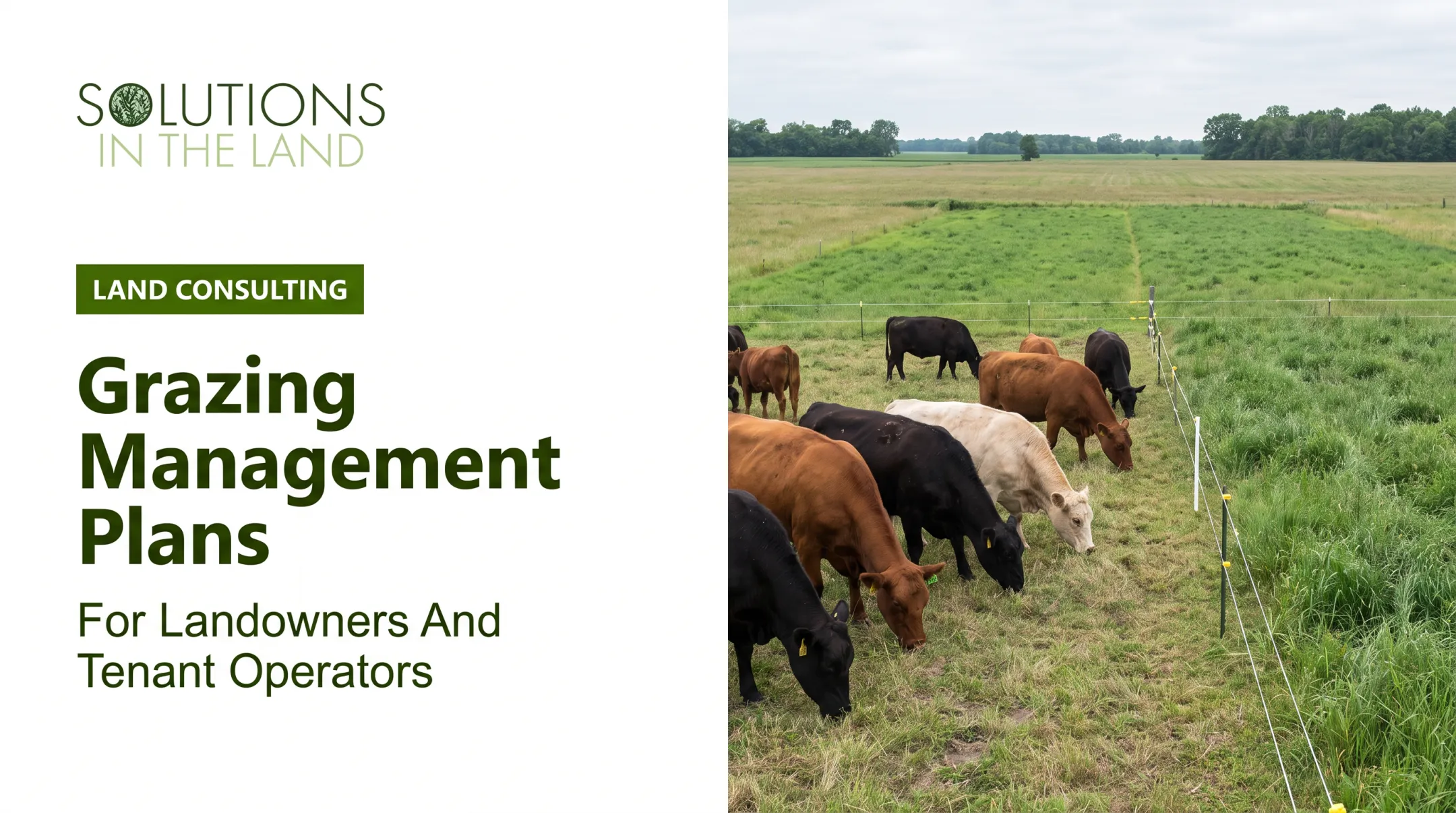
At the center of most regenerative systems sits adaptive multi-paddock grazing: cattle are concentrated in a right-sized area for a planned period, then moved to allow the previous paddock time to recover before cattle return.
Adaptive Multi-Paddock Grazing
There's no fixed calendar here. Managers continuously adjust based on:
- Stock density and grazing duration
- Recovery time between grazing events
- Forage maturity and growth stage
- Weather, terrain, and water access
- Herd body condition
Virginia Cooperative Extension's rotational grazing guidance describes moves as frequent as every one to three days with rest periods of 30 days or more (useful as an illustration, not a nationwide rule). The right numbers depend entirely on your rainfall, soil, and forage species.

Cattle themselves function as a management tool in this system: they harvest forage, trample some plant residue back into ground cover, and cycle nutrients through manure. That said, cattle aren't universally beneficial in every context. Stocking pressure and rest timing determine whether the outcome helps or hurts the land.
Getting those timing calls right depends on a few practical tools.
Tools for Managing the Rotation
Most operations lean on:
- Temporary electric fencing for flexible paddock sizing
- Reliable, well-distributed water infrastructure
- Grazing charts or software to track recovery periods
- Regular pasture walks and direct observation
What to Monitor
Track these indicators over a full season, not just a single grazing pass:
- Forage recovery and plant diversity
- Bare ground percentage and soil cover
- Water infiltration or runoff signs
- Animal body condition, weight gain, and reproductive rates
- Supplemental feed, labor hours, and infrastructure costs
For example, a 40-acre pasture split into four paddocks might run cattle through each section for three to five days, then rest each paddock 25 to 35 days depending on rainfall and growth.
The evidence on outcomes is genuinely mixed. USDA ARS research comparing five paired grazing sites in the southeastern United States found more than 13% greater soil carbon and 9% greater soil nitrogen under adaptive multi-paddock grazing versus continuous grazing. But a separate Northern Great Plains study of nine paired ranches found nearly identical water infiltration rates between the two systems. Results are site-specific, so monitoring your own ground beats assuming a universal benefit.
Choosing Cattle, Forage, and Stocking Rates for a Regenerative System
Cattle selection should follow the land, not the other way around. That means matching genetics to your climate, terrain, forage base, water access, and disease pressure, and to your own ability to move and observe the herd regularly.
Useful selection traits include:
- Moderate mature size relative to your forage supply
- Strong forage conversion efficiency
- Annual rebreeding and calving timed to forage availability
- Structural soundness, docility, and longevity
- Milk production appropriate to available grass, not maximized regardless of cost
Forage Capacity Drives Stocking Rate, Not Acreage
Acres-per-cow is one of the most misapplied numbers in cattle farming. Carrying capacity actually depends on:
- Soil type and rainfall patterns
- Forage species and season
- Grazing management history
- Drought conditions
- Available supplemental feed
North Dakota State University Extension's carrying-capacity method calculates demand in animal-unit-months by multiplying herd size, animal-unit equivalents, and grazing months, then compares that figure against actual usable forage on the ground. A reference animal unit assumes a 1,000-pound cow with a calf, which is a baseline for calculation, not a description of your herd.
Regional forage examples (adapt to your own soil test and local extension guidance, not copy directly):
| Region | Common forage options |
|---|---|
| Kentucky / cool-season pasture | Stockpiled tall fescue, red and ladino white clover |
| Southeast / Alabama | Bermudagrass, bahiagrass, ryegrass |
| Eastern Nebraska | Switchgrass, big bluestem, indiangrass |
| Northern Plains / Montana | Intermediate and pubescent wheatgrass |
Forage capacity and cattle genetics have to work together. Avoid selecting cattle solely for maximum size or output. Larger cows carry higher maintenance requirements and feed costs, and can erode reproductive performance or resilience during a tough year.
Compare individual animal performance against herd averages and pasture condition using your own records. That data should drive retention, culling, and breeding decisions, not genetics catalogs alone.

Benefits, Limitations, and Profitability
Potential Ecological Benefits to Measure
- Improved ground cover and root systems
- Faster forage recovery between grazing events
- Reduced erosion and better water infiltration
- Stronger nutrient cycling and habitat value
Potential Business Benefits
- More grazing days and reduced reliance on stored or purchased feed
- Better forage utilization per acre
- Lower exposure to input-cost swings
- Access to differentiated markets willing to pay for verified practices
Costs and Risks to Plan For
- Fencing and water infrastructure investment
- Added labor and planning time during the learning curve
- Livestock handling demands from more frequent moves
- Drought exposure and delayed financial returns
Is Regenerative Farming Profitable?
It depends entirely on the operation.
USDA's Economic Research Service surveyed cow-calf producers in 2018 and found average total feed costs of $366 per head under continuous grazing versus $402 per head under intensive rotational grazing. The same survey found no statistically significant difference in supplemental feed costs between groups.
Track your own net margin. A rotational system does not automatically lower costs.
The Climate Picture, Honestly
Cattle produce methane, measured in one USDA study at roughly 0.27 to 0.34 kilograms per cow per day depending on season. Soil-carbon outcomes from grazing vary by site, climate, and measurement window.
No current research supports a blanket claim that regenerative grazing offsets cattle emissions across the board. Evaluate specific claims against university, USDA, or peer-reviewed sources rather than marketing copy.
That same scrutiny applies when a buyer offers a regenerative premium. Before chasing the market, ask whether they require documentation, third-party certification, or measured ecological outcomes, and whether the premium actually covers your added costs.
How to Begin a Regenerative Cattle Farming Plan
Start with a baseline, not a wholesale system change. Assess your land, soils, forage, water, fencing, herd performance, labor, finances, and both your ecological and business goals before committing to anything.
A practical first-year sequence:
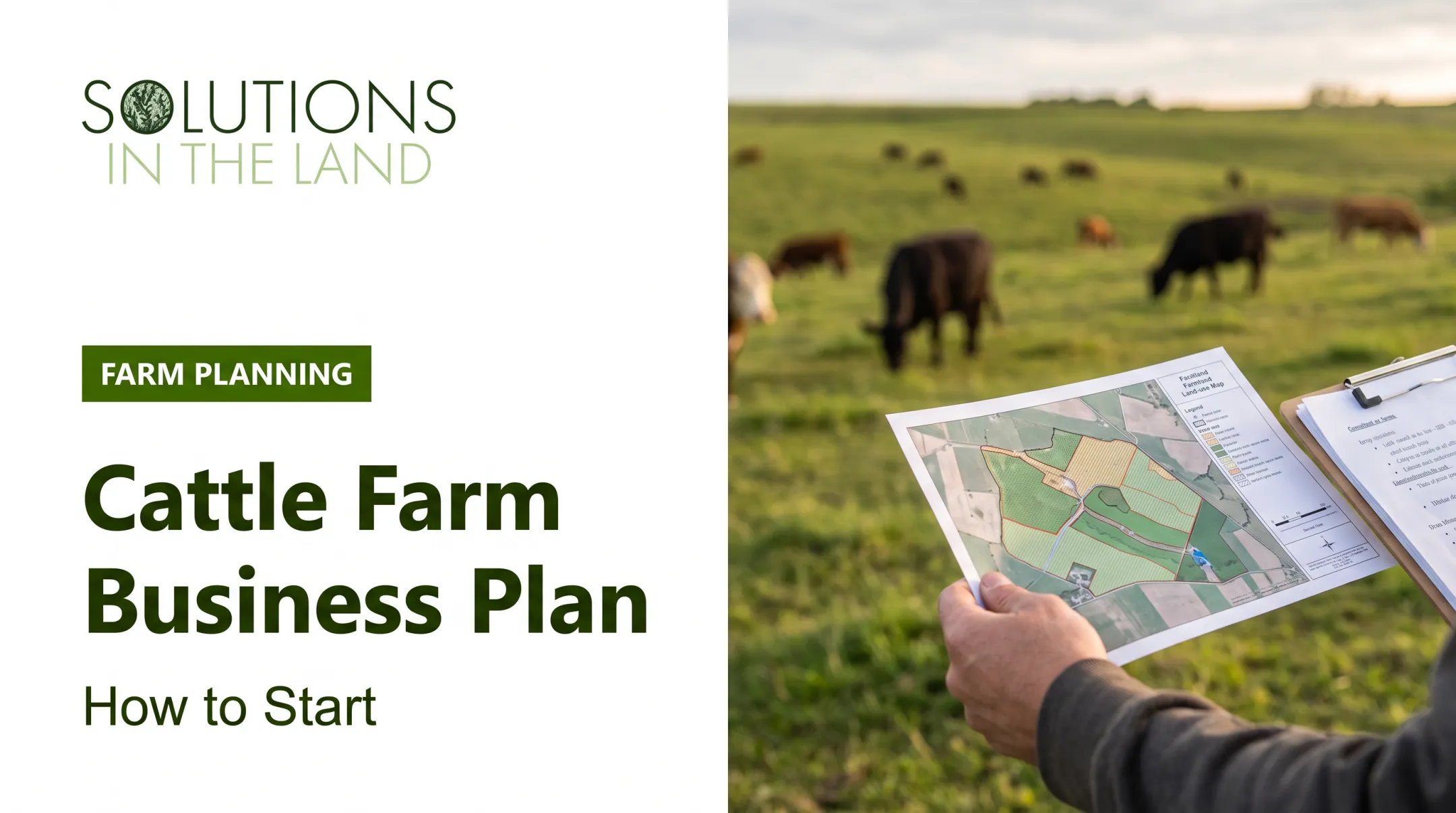
- Map existing resources — paddocks, water, fencing, forage species
- Estimate current forage supply and compare it to herd demand
- Design a movement and recovery schedule suited to your rainfall and soil
- Budget infrastructure and labor costs realistically
- Set monitoring metrics before you start, not after
- Review results at season's end before expanding further

Build a drought contingency plan with clear trigger points. Set a predetermined precipitation threshold by a given date that prompts destocking, a rotation change, or a feed purchase. Deciding this in advance removes guesswork when conditions turn dry.
Baseline mapping, forage balance, and drought triggers are the kind of work Solutions in the Land was built around. Our Whole-System Farm Plans catalog a farm's history, resources, opportunities, and constraints through more than 140 questions on soil, water, markets, and lease structure.
Allen Williams, our Grazing and Soil Consultant and a sixth-generation farmer, has advised adaptive grazing systems on more than 4,000 operations, from a few acres to over a million. That breadth keeps recommendations tied to what has worked on comparable ground.
For landowners weighing a transition lease to support a tenant moving toward regenerative practices, our farm lease consulting sits at the intersection of conservation outcomes and lease economics.
Before investing, answer these questions:
- What is the current limiting factor on this land?
- What change is financially feasible this year?
- How will you measure success?
- Which market will actually support this product?
- What outside expertise do you need to fill gaps?
Frequently Asked Questions
Is regenerative farming profitable?
Profitability depends on site conditions, grazing design, animal performance, labor, and market access. Evaluate net margin using your own enterprise budget rather than assuming a label guarantees a better return.
How many acres per cow for regenerative farming?
There's no universal figure — carrying capacity shifts with forage production, climate, soil, season, and management. Run a site-specific forage assessment rather than relying on a rule of thumb.
What are some examples of regenerative agriculture practices?
Common practices include adaptive grazing, planned pasture recovery, maintaining living roots and soil cover, encouraging forage diversity, and protecting waterways. All must be adapted to your specific farm.
What are the five pillars of regenerative agriculture?
Frameworks differ by organization. NRCS lists four soil health principles (living roots, minimal disturbance, soil cover, biodiversity), while other groups add livestock integration or context as additional pillars.
What crops are best for regenerative farming?
The best forage or cover-crop mix depends on your region, soil, rainfall, and livestock needs. Locally adapted perennial grasses and legumes, chosen with extension guidance, generally outperform a generic national mix.
What is a regenerative cattle farm?
A regenerative cattle farm intentionally manages grazing, forage, soil, water, and animals together to improve land function while producing cattle in a financially viable way.