
Introduction
A farm is never just one thing. It's a family legacy, a working business, a land asset, and often the primary source of retirement income for the generation that built it.
Naming heirs in a will covers only a fraction of that reality.
Farm succession planning addresses who will operate the farm and when management authority shifts. Estate planning is the legal and financial framework covering incapacity, death, asset distribution, and tax coordination. Neither one works well alone.
With the average U.S. farm producer now 58.1 years old, and 38% of producers at least 65, successor readiness is just as urgent as document preparation.
This guide covers aligning family goals, building successor readiness, organizing farm records, choosing ownership structures, and working with qualified advisors.
Legal and tax decisions always require a licensed attorney and tax professional familiar with your state's laws.
Key Takeaways
- Succession planning decides who runs the farm; estate planning decides asset control in incapacity and after death
- Equal inheritance isn't always workable when only some heirs farm
- Current records, honest valuations, and open family communication anchor a durable plan
- Start before a crisis forces the issue; revisit after major family, financial, or legal changes
Why Farm Succession and Estate Planning Belong Together
A handshake agreement about who takes over the farm means little if the underlying legal documents say something else. The will, trust, deed, beneficiary designations, and any operating agreement all need to match that succession conversation. When they don't, the plan can unravel the moment it's tested.
Planning these pieces separately creates predictable problems:
- Probate delays that stall farm operations during a critical season
- Unclear decision-making authority if an owner becomes incapacitated
- Forced asset sales to cover taxes, debt, or buyouts
- Disputes among heirs over value, control, or fairness
- Fragmented land ownership across multiple co-owners
- Insufficient retirement income for the generation stepping back
In a 2023 survey of 403 U.S. producers, 55% reported having a written succession plan while 45% did not, a gap that showed little relationship to the operator's age. That's a sample finding, not a national rate, but it reflects a common reality: plenty of experienced farmers still haven't put intentions on paper.

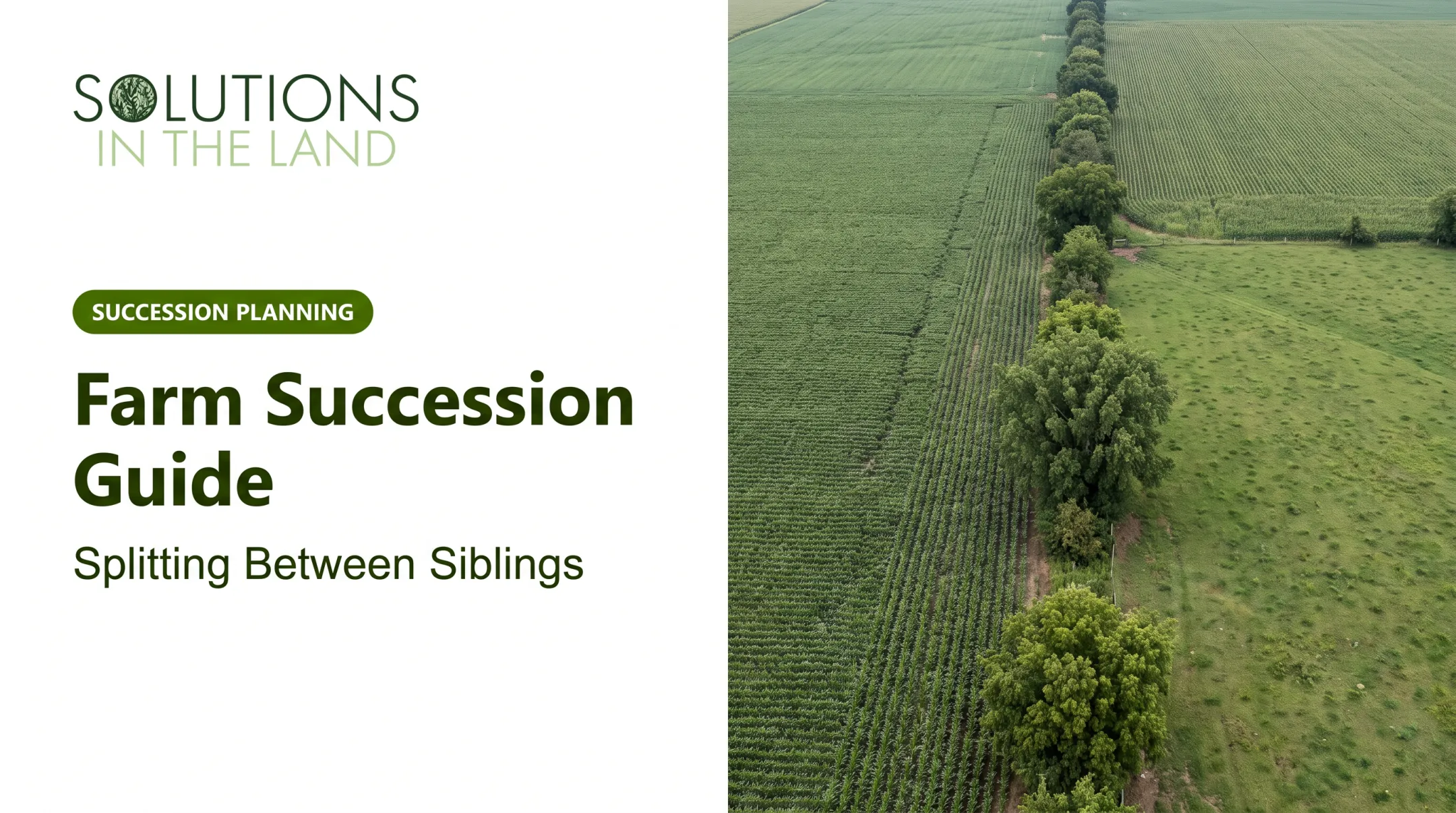
Missing paperwork creates a concrete fragmentation risk. Iowa State's Center for Agricultural Law and Taxation notes that any co-owner of inherited farmland, regardless of how small their share, can petition a court to partition the property.
Three siblings inheriting 300 acres together doesn't guarantee three siblings who want to keep farming it together. Some states favor dividing land in kind rather than forcing a sale, but a contested partition action is exactly the outcome coordinated planning is designed to prevent.
How to Build a Coordinated Farm Succession and Estate Plan
Start With Goals, Not Documents
Before any attorney drafts anything, the family needs clarity on priorities. Common goals include:
- Keeping land in the family for generations
- Preserving the operating business
- Funding a comfortable retirement
- Supporting conservation commitments
- Providing for a surviving spouse
Most families balance several of these at once. Naming those priorities out loud changes which tools make sense later.
Inventory Everything
A complete asset and obligation inventory should include:
- Farmland, buildings, and residences
- Leases, livestock, equipment, and crop inventory
- Water or mineral interests, where applicable
- Conservation agreements and easements
- Loans, guarantees, and insurance policies
- Investment and business interests
Identify the People Involved
Map everyone who has a stake or a formal role:
- Current owners and prospective operators
- Non-farming heirs and spouses
- Employees, lenders, trustees, and executors
- Anyone who might act under a financial or healthcare power of attorney
Gaps here surface fast during an actual incapacity.
Bring in Qualified Professionals
Attorneys, accountants, financial planners, insurance advisors, and agricultural consultants each evaluate different pieces: wills, trusts, entity structures, buy-sell provisions, installment arrangements, gifting strategies, and insurance-funded liquidity.
Entity selection, asset titling, and tax treatment all depend on state law and individual circumstances. No single structure is universally correct.

Convert the Plan Into a Written Roadmap
Turn decisions into a document the family can actually follow:
- Responsibilities and decision-making authority
- Training milestones and transfer dates or conditions
- Valuation methods and payment terms
- Retirement income provisions
- A schedule for reviewing the plan as circumstances change
Common Farm Succession and Estate Planning Strategies
Families rarely choose just one tool. Most coordinated plans layer several strategies together.
Gradual transfer versus transfer at death
A gradual handoff spreads ownership and management over years. That gives the successor time to build skills and keeps the retiring generation involved with ongoing income.
A transfer at death is simpler to set up. It leaves less room for the successor to prove readiness and can create a harder financial cliff for everyone involved.
| Strategy | Primary purpose | Advisor to consult |
|---|---|---|
| LLC, partnership, or corporation | Keeps land or business assets unified while transferring ownership interests over time | Attorney, tax advisor |
| Wills and revocable trusts | Directs distribution; trusts can avoid probate and name a successor trustee for incapacity | Estate attorney |
| Buy-sell agreements | Structures how a departing owner's interest is purchased, with defined price and terms | Attorney, financial advisor |
| Installment sales | Spreads a purchase price over time via down payment plus periodic payments | Tax advisor, attorney |
| Life insurance | Provides liquidity for taxes, debt, or buyouts without an immediate land sale | Insurance advisor |
Entity structures that keep land whole
An LLC or similar entity can hold land as a single unit while family members own transferable interests. The operating agreement should spell out voting rights, transfer restrictions, and how interests get valued.
Wills and revocable trusts
Trusts and wills serve different practical functions. A will directs distribution at death but doesn't avoid probate on its own.
A revocable trust can keep the owner in control during life, name a successor trustee for incapacity, and bypass probate for assets properly titled in the trust's name.
Buy-sells, installment sales, and life insurance
Buy-sell agreements, right-of-first-refusal provisions, and installment sales matter most when multiple heirs are involved and a successor must purchase interests rather than simply inherit them.
Life insurance can fund those buyouts, or cover taxes and debt, without forcing an immediate sale of productive land. None of these tools guarantees a particular tax outcome, and all of them require professional guidance to structure correctly.

Preparing the Family and Successor for the Transition
Documents alone don't make a transition work. The people involved need a shared understanding of what's coming.
A useful first family meeting covers:
- The owner's goals for retirement, income, and legacy
- The successor's genuine interest, skills, and capacity
- What non-farming heirs expect, financially and emotionally
- Compensation, housing, and debt arrangements for the successor
- Who holds management authority, and when that changes
- What happens if the successor decides to leave the operation
Management succession and ownership succession often move on different timelines. A successor might take on staged responsibilities, financial reporting duties, and performance milestones for years before any ownership actually transfers. Written job expectations and regular check-ins make that staged approach concrete instead of vague.
Not every farm has an obvious family successor, and that's not a failure of planning. Alternatives include:
- A trusted employee or beginning farmer
- A professional manager
- A lease arrangement or partnership
- A conservation-focused transition
- An outright sale
Each can preserve the owner's retirement needs and land-use goals without requiring a family member to take over.
When family members disagree, neutral facilitation or mediation can move the conversation forward. Some states offer agricultural mediation programs specifically for succession disputes, often at low or no cost.
Fair, in this context, rarely means identical. A farming heir may receive land and equipment while a non-farming sibling receives cash, insurance proceeds, or other assets. That split can be entirely equitable even when it isn't equal on paper.
Why Farm Records Matter for Estate Planning and Farm Management
Every strategy above depends on accurate information. Advisors can't structure a buy-sell agreement or value an LLC interest without knowing what the farm actually owns, owes, and produces.
A working records checklist includes:
- Deeds, titles, and entity formation documents
- Wills, trusts, and beneficiary designations
- Loan agreements, leases, and insurance policies
- Tax returns and financial statements
- Production and equipment records, including livestock inventories
- Conservation obligations, employee information, and vendor contracts
At Solutions in the Land, that inventory work is part of a Current Conditions assessment. We catalog mineral rights, utility easements, tile drainage, soil fertility, and related operating details.
The same record set informs a lease or conservation plan—and gives an estate attorney or financial advisor a transfer structure that matches reality.
Complete records support clearer decisions on:
- Realistic asset distribution among heirs and successors
- Successor financing terms and retirement income projections
- Tax planning and adequate insurance coverage
- Whether keeping the operation intact is actually feasible
Store files in a secure, organized system with access permissions, backups, and update dates. Make sure at least one other trusted person knows where to find them during an illness or after a death.
Implementation, Review, and Whole-System Farm Planning
A plan sitting in a drawer doesn't help anyone. Implementation means actually executing documents, updating titles and beneficiary designations, forming entities or finalizing agreements, communicating decisions to the family, training successors, and tracking milestones over time.
Review the plan whenever there's a major change:
- Births, deaths, marriages, or divorces in the family
- A disability or shift in retirement timing
- Land purchases, sales, or new debt
- Changes to the business structure
- Major tax-law changes
- A successor's change of plans
Many agricultural extension programs suggest a full review every three to five years at minimum, with earlier check-ins as soon as life changes occur. Waiting for a crisis to prompt a review defeats the purpose of planning at all.
Succession and estate planning also don't sit apart from the rest of the operation. They connect directly to market strategy, soil and watershed goals, conservation commitments, infrastructure needs, labor, and long-term profitability. That is where whole-system farm planning fits.
At Solutions in the Land, we work with landowners and farm families on site-specific operations, market-based production decisions, land stewardship priorities, and measurable transition-readiness goals. We don't draft legal or tax documents—those decisions belong with your attorney and tax advisor. What we can do is help you see the full picture of the operation before those documents get written.
Three decisions to make first:
- Gather your records
- Schedule the family conversation
- Assemble your advisory team
Frequently Asked Questions
What are common methods for farm succession planning?
Common methods include gradual transfers, entities like LLCs, trusts, buy-sell agreements, and installment sales. Each method needs matching wills, trusts, deeds, and beneficiary designations to take effect as intended.
What steps go into estate planning for farmland?
Start by setting goals, inventorying assets and records, and naming decision-makers and heirs. Then choose strategies with professional input, execute the documents, put the plan in motion, and review it as circumstances change.
Why do farm records matter for estate planning?
Records establish ownership, value, debt, income, and operating knowledge. Without them, advisors and successors can't make informed decisions about transfers, financing, or valuation.
How can farm families treat farming and non-farming heirs fairly?
Fairness usually means different assets for different heirs, not identical shares. A farming heir might receive land while a non-farming heir receives cash, insurance proceeds, or a structured buyout.
When should we review a farm succession and estate plan?
Review the plan every three to five years at minimum, and sooner after major family, financial, operational, or legal changes. Work with qualified professionals familiar with your state's requirements.