
Miss those windows, and your liability protection under CERCLA may not hold up.
This matters for more than legal technicalities. Buyers rely on an ESA to price risk. Lenders rely on it to underwrite a loan. Landowners and farm operators rely on it to know what they're actually buying, refinancing, or leasing. An outdated report might miss a new spill, a demolished tank, or a changed neighboring use, none of which show up if nobody's looked at the site recently.
Below, we'll walk through the exact timing rules, when an update or new assessment is needed, what triggers a Phase 1 ESA in the first place, and how it differs from a Phase 2. Always confirm current EPA and ASTM requirements with a qualified Environmental Professional before relying on any timeline.
Key Takeaways
- A Phase 1 ESA's critical components (interviews, records review, site inspection) are valid for 180 days before acquisition.
- The full assessment cannot be older than one year for federal AAI purposes.
- Lenders, insurers, and grant programs often set stricter timelines than the federal baseline.
- The report flags potential concerns; it does not confirm contamination through lab sampling.
What Does a Phase 1 Environmental Site Assessment Do?
A Phase 1 ESA is a non-invasive investigation into a property's current and historical uses. It's typically conducted under ASTM E1527-21, the standard the EPA recognizes for satisfying All Appropriate Inquiries under CERCLA.
For rural or forestland property, ASTM offers a parallel standard, E2247-23, designed for rural and forestland sites.
The assessment exists to help buyers, lenders, landowners, and developers evaluate potential environmental liability before a transaction closes, not after.
What a Phase 1 ESA typically includes:
- A records review covering environmental databases, historical aerial photos, fire insurance maps, and city directories
- A site walk-through looking for tanks, staining, drainage issues, or stressed vegetation
- Interviews with current and past owners, occupants, and operators
- A written report identifying findings and recommending next steps
What it does NOT do:
- Collect or test soil, groundwater, vapor, or building-material samples
- Guarantee a property is free of every environmental concern
If the assessment turns up a Recognized Environmental Condition (REC), or a Historical REC or Controlled REC, the report will explain whether further investigation makes sense. A REC isn't proof of contamination. It's a flag that says "look closer here."
How Long Is a Phase 1 ESA Valid?
Federal All Appropriate Inquiries uses two separate clocks, and most confusion comes from treating them as one.
Under 40 CFR 312.20, the federal AAI rule sets both:
| Timeframe | What it covers |
|---|---|
| 180 days before acquisition | Interviews, environmental lien searches, government-record reviews, visual site inspections, and the environmental professional's declaration |
| One year before acquisition | The full AAI inquiry, including purchaser/user inquiries |
The clock runs from each component date, not the cover date. Interviews, the site visit, and the records search each have their own timing. ASTM E1527-21 is clear that the printed report date usually does not match those underlying dates.
A report can look recent on the cover while the site visit behind it is already stale—or the reverse.
A Simple Decision Sequence
- Less than 180 days old — Confirm the lender or buyer still accepts it, and verify site conditions have not changed.
- Between 180 days and one year old — Ask your Environmental Professional which components must be updated before closing.
- More than one year old — Budget for a new Phase 1 ESA unless your lender or regulator expressly allows another path.

Federal AAI timing is a floor, not a ceiling. A lender, insurer, or grant program can—and often does—require a newer report. Purchase agreements sometimes set their own age limit.
Confirm the final call with your Environmental Professional and legal counsel, especially when CERCLA liability protection depends on it.
When Does an Existing Phase 1 ESA Need an Update or Replacement?
Not every stale report needs a full redo. Consultants generally distinguish between three scopes of work:
- Limited update: refreshing specific components
- Comprehensive refresh: a broader re-check of site conditions
- New Phase 1 ESA: starting over entirely
Terminology varies by consultant and lender, so ask which scope you're actually getting.
Before relying on an older report, review:
- Original report date and the dates of the site visit, interviews, and records searches
- The ASTM standard version used and whether it is still current
- Any identified data gaps left unresolved
- Lender-specific requirements for report age or format
Site or transaction changes that typically require renewed work:
- A new spill, release, or discovered tank
- Demolition, construction, or a change in site operations
- Altered use on neighboring properties
- Flooding or another major event
- New regulatory information affecting the site
A report prepared for the previous owner doesn't automatically transfer to you. Reliance rights, intended-user status, and lender acceptance all need to be confirmed. The original consultant may also need to formally authorize reuse.
A new assessment is usually the smarter move when:
- The property has changed substantially since the last report
- There are significant, unresolved data gaps
- The prior report used an outdated ASTM standard
- The lender simply won't accept the existing report
Start this review early. Records research, site access, interviews, and lender sign-off all take time, and none of it should be rushed against a closing deadline.
What Triggers a Phase 1 ESA?
Most Phase 1 ESAs happen for one of a handful of reasons:
- Farmland or commercial property acquisition or refinancing
- Redevelopment or a change in land use
- Portfolio transactions, farm sales, or long-term agricultural leases
- Brownfield or grant-funded projects
- Lender-required due diligence
Certain property histories warrant extra scrutiny, including former gas stations, dry cleaners, manufacturing sites, agricultural land with heavy pesticide or fertilizer use, livestock operations, on-farm dumps, landfills, and rail corridors. A property doesn't need visible contamination to justify a Phase 1 ESA. Historical uses and off-site releases often aren't obvious from a simple walk-through.
Three triggers get mixed up often, and they are not the same:
- Legally required — needed to preserve a specific CERCLA liability protection
- Required by a lender or program — a condition of financing or grant funding
- Prudent risk management — not mandated, but sound risk management given the property's history
The EPA's Brownfields AAI guidance notes that AAI supports specific liability-protection thresholds, but it isn't a standalone shield. Post-acquisition continuing obligations still apply.
What Is the Difference Between a Phase 1 and Phase 2 Environmental Site Assessment?
Think of Phase 1 as the question, and Phase 2 as the answer.
Phase 1 asks whether existing records, interviews, and observations suggest a potential release or environmental concern. It's non-invasive. No samples, no lab work.
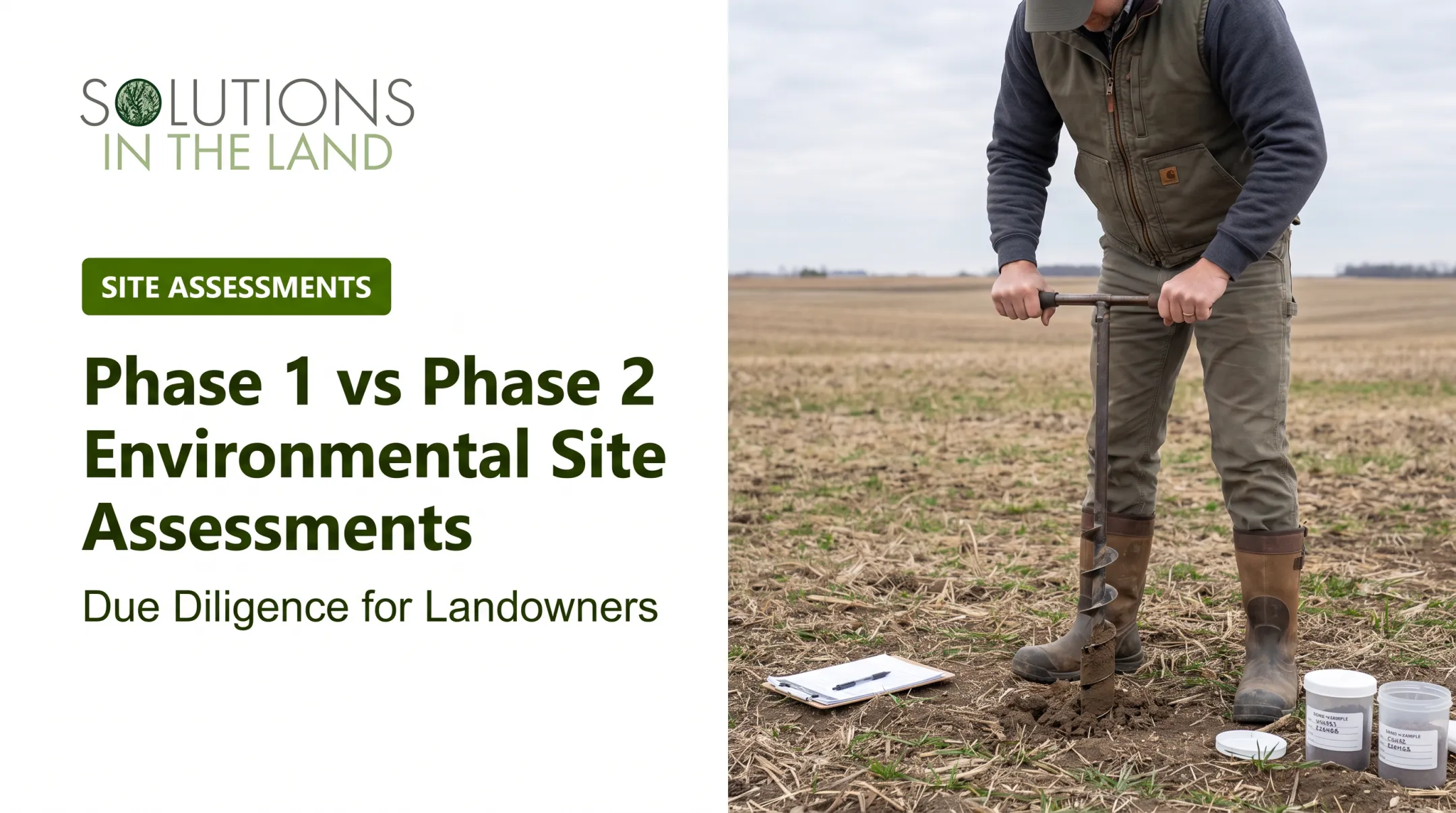
Phase 2 follows ASTM E1903-19. It uses physical sampling of soil, groundwater, soil vapor, or sediment based on what Phase 1 flagged. Those samples go to a lab for analysis.
| Factor | Phase 1 | Phase 2 |
|---|---|---|
| Method | Records, interviews, visual inspection | Physical sampling and lab analysis |
| Invasive? | No | Yes, when warranted |
| Main output | Identifies RECs | Characterizes actual contamination |
A REC identified in Phase 1 doesn't prove contamination exists, and it doesn't mandate a specific cleanup path. It signals that a professional needs to weigh in on next steps.
Findings from a Phase 2, if one's ordered, can reshape negotiations, financing terms, property valuation, and construction plans. Don't order a Phase 2 as a shortcut around understanding your Phase 1/AAI obligations. Talk to your lender and Environmental Professional first.

Conclusion
Treat 180 days as your practical review point, and one year as the outer AAI boundary for the completed assessment. Confirm both against your specific transaction's requirements. Federal timing rules are a starting point, not the final word.
Before you rely on any Phase 1 ESA, confirm:
- The dates of the report's critical components (not just the cover date)
- The ASTM standard used
- Whether site conditions have changed since the last inspection
- Lender or program approval of the existing report
- Whether an update or a new ESA makes more sense
With due diligence complete, many landowners shift from compliance to productive land use. Solutions in the Land works with landowners on whole-system farm planning and regenerative agriculture consulting, helping turn a better-understood parcel into a sustainably managed operation.
Frequently Asked Questions
How long is a Phase 1 Environmental Site Assessment (ESA) valid?
Under federal AAI rules, critical components remain current for 180 days, and the full assessment has a one-year outer limit. Lenders, states, or contracts may require a shorter window.
How long does a Phase 1 ESA take to complete?
Completion time varies with property history, records access, interview scheduling, and agency response times. Ask your consultant for a timeline tied to the specific site.
What does a Phase 1 Environmental Site Assessment include?
It includes historical records research, a site walk-through, interviews with owners and operators, an environmental lien search, and a written report identifying potential concerns.
What triggers a Phase 1 ESA?
Common triggers include property acquisition, refinancing, redevelopment, lender requirements, brownfield or grant programs, and land with a history of potentially contaminating uses.
What is the difference between a Phase 1 and Phase 2 Environmental Site Assessment?
Phase 1 is a non-invasive review of records and site observations. Phase 2 uses physical sampling and lab analysis to confirm or rule out contamination flagged in Phase 1.