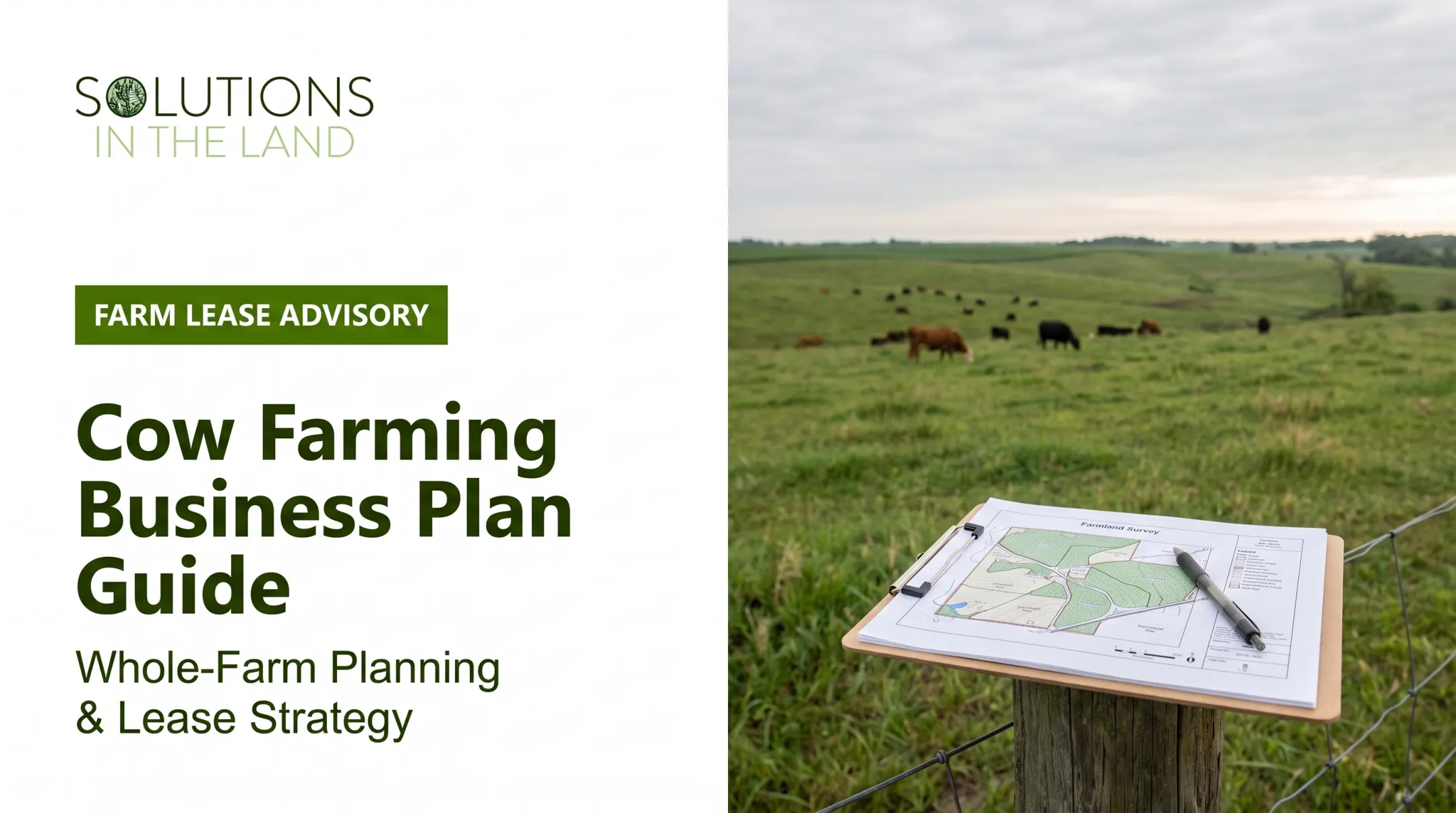

Interest in cattle operations is climbing for several reasons: demand for local, pasture-raised beef, a pull toward regenerative land stewardship, family-farm succession, and the appeal of building a diversified agricultural business. Beginning farmers, existing landowners, commodity producers, ranch families, and investors are all asking the same question — where do I start?
This guide walks through how to build a cattle farm business plan from the ground up, covering the decisions, numbers, and timelines that actually determine whether an operation survives its first few years.
Key Takeaways
- Define your enterprise model, customers, land base, herd strategy, and finances before you buy a single animal.
- Profitability hinges on carrying capacity, input costs, and management skill—not herd size.
- Startup costs, working capital, and cash-flow timing matter as much as your sale price.
- Grow in stages, track results against projections, and revise the plan as conditions change.
What Is and Why Start a Cattle Farm Business?
A cattle farm business is an agricultural operation that raises, manages, purchases, finishes, or sells cattle through a deliberate production and marketing system. Cattle farming takes several forms, each with its own capital needs and risk profile:
- Cow-calf: breed cows and sell weaned calves annually
- Stocker/backgrounding: buy weaned calves and add weight on grass before resale
- Finishing: feed cattle to market weight for slaughter
- Seedstock: raise and sell breeding-quality animals
- Dairy: produce and sell milk
- Custom grazing: charge a fee to graze someone else's cattle on your land
- Direct-to-consumer beef: sell processed beef directly to customers
Each format delivers different value to buyers: feeder cattle, finished beef, breeding stock, milk, grazing capacity, or conservation outcomes. None of it works simply by owning cattle.
Does the Market Support a New Operation?
USDA reported 94.2 million cattle and calves in the U.S. as of July 2026, with beef cow numbers at 28.5 million, down 1% year over year — a tightening supply picture, according to USDA's cattle inventory report. Tight supply can support stronger prices, but it doesn't guarantee your farm turns a profit. Land costs, forage limits, and management still decide that.

Starting makes sense when the basics are already in place:
- Suitable land base for your chosen model
- Identifiable buyer or market channel
- Reliable water and working infrastructure
- Management capacity to run day-to-day operations
- Financing for working capital, not just startup costs
If the goal is long-term land building rather than quick income, regenerative grazing can improve soil health and open secondary revenue over time. Build that path into the business plan from day one, not as an afterthought.
What to Know Before You Start a Cattle Farm Business
Most beginners underestimate the daily grind. Before you commit capital, get clear on what the work actually demands day to day and across the seasons.
Daily and seasonal demands include:
- Animal observation, water checks, and feeding
- Fencing repairs and pasture moves
- Calving, breeding, and health monitoring
- Equipment upkeep and recordkeeping
- Sharp seasonal peaks around calving and weaning
Some tasks can be outsourced: veterinary care, hay production, custom grazing, meat processing, transportation, and bookkeeping. Others, like daily herd observation, generally can't.
Income Doesn't Arrive on Your Schedule
Breeding cycles, growing periods, weaning, finishing, and buyer payment terms all delay revenue. A cow-calf operation typically runs a 365-day calving interval before a calf is ready to sell. Stocker operations may turn cattle in 90 to 119 days on pasture, per Kansas State's stocker management guide. That's faster, but still not instant cash.
A gradual growth strategy tends to beat buying a full herd on day one. Responsible stocking ties directly to forage availability, pasture recovery, animal welfare, and how much debt your cash flow can actually service. A whole-system farm plan from Solutions in the Land can help landowners connect site-specific resources, regenerative practices, and market opportunities into one coherent strategy. It suits some operations well, though it is not a requirement for every farm.
Early Decisions That Matter When Starting a Cattle Farm Business
Most early failures trace back to mismatched assumptions: overestimating carrying capacity, underpricing product, or ignoring working capital needs. Fixing those assumptions before launch beats fixing them after.
Before buying cattle, define:
- The enterprise and product (weaned calves, finished beef, breeding stock, milk, grazing services)
- Who actually pays for it, and at what price
- Your land's forage quality, water reliability, fencing, and handling facilities
- Local competition: sale barns, direct buyers, processors, and other producers
Build a Complete Cost Picture
Your budget needs to cover more than the animals themselves:
- Land, cattle, fencing, water systems, and handling equipment
- Feed, veterinary care, fuel, and labor
- Insurance, taxes, financing, processing, transport, and marketing
Then stress-test it. What happens to your margin if feed costs spike, sale prices drop, or conception rates fall short?
USDA's September 2026 outlook shows August 2026 slaughter-steer prices at $228.27 per hundredweight, roughly $15 below the same month in 2025. That gap is a reminder that current price forecasts can shift the numbers on your spreadsheet fast.

Finally, check the regulatory side before you commit capital:
- Business registration and zoning
- Water and environmental rules
- Cattle ID and movement requirements
- Meat-processing pathways and liability insurance
These vary by state, and skipping them creates expensive surprises later.
How to Start a Cattle Farm Business – Step by Step
Treat these as connected planning stages, not a checklist to rush through. New operations most often stumble by skipping validation, underpricing the product, or overstocking before the operating system is stable.
Step 1 – Choose the Enterprise Model and Validate the Market
Define your production model, target animal, sales product, and geographic market. Compare commodity auction sales against wholesale, branded, and direct-to-consumer routes.
Then test it:
- Talk to buyers, processors, and livestock markets before assuming demand
- Confirm willingness to pay and delivery requirements — not just polite interest
- Research the breed, genetics, calving season, and forage system that fit your target market
Common miss: picking a cattle type or premium claim first, then hunting for a buyer afterward.
Step 2 – Match Land, Herd Capacity, and Operating Resources
Calculate carrying capacity using site-specific pasture condition, rainfall, forage growth, and recovery periods.
NDSU's carrying capacity research recommends starting with 25% harvest efficiency for most native pastures grazed season-long. Treat that figure as a conservative baseline, not permission to push pastures harder.
Inventory your land ownership terms, fencing, water infrastructure, handling facilities, and labor availability. Build a phased stocking plan where herd size follows forage capacity, not the income number you want to hit.
Common miss: buying cattle before confirming water access, fencing, or winter feed.
Step 3 – Build the Financial, Legal, and Risk Plan
Prepare startup and operating budgets, a seasonal cash-flow forecast, a break-even analysis, and financing assumptions using current agricultural cost sources.
- Separate one-time capital costs from recurring expenses
- Calculate working capital needed before your first dependable sales cycle
- Set up recordkeeping for births, deaths, sales, weights, treatments, and costs
- Add risk controls for drought, disease, market volatility, and equipment failure
Common miss: showing a profitable annual projection while ignoring the months where expenses hit before any cattle sell.
Step 4 – Launch, Measure, and Improve the Operation
Put the legal and supply foundation in place for your state and sales channel:
- Business structure, registrations, permits, and insurance
- Supplier relationships for feed, vet care, and livestock needs
- Repeatable workflows for feeding, rotation, breeding, vaccinations, and financial recording
Then review on a fixed cadence: monthly for cash and operations, seasonally for forage and herd performance, and annually for strategy. Compare actual cost per animal, weaning rates, and sale price against your original assumptions.
Owners who want outside help can use Solutions in the Land for whole-system farm planning tied to site-specific grazing, soil health, and business decisions.
Common miss: expanding herd size before your farm has stable records, adequate forage, and proof that margins hold in a bad year.

Conclusion
A cattle farm business plan ties the enterprise model, land and herd capacity, daily operations, market route, financial projections, and risk controls into one working document.
Validation, realistic assumptions, responsible stocking, and cash-flow discipline matter far more than launching fast or chasing a set herd size.
Treat your plan as something you review and refine, not a document you file away. Forage conditions change. Markets shift. Costs move. Your plan should move with them.
When you need a site-specific plan or a second set of eyes on assumptions, Solutions in the Land helps landowners and operators build practical whole-system farm plans.
Frequently Asked Questions
What is the best way to start a cattle farm?
Validate market demand first, then choose your enterprise model and assess land and water resources. Build a realistic budget, confirm legal requirements for your state, and start at a manageable scale—growing only as your records prove the numbers work.
How profitable is beef cattle farming?
Profitability varies widely by enterprise type, land costs, forage quality, herd performance, input prices, and sales channel. Calculate your own numbers using current cost and price data for your specific operation; no single figure applies industry-wide.
What is the profit margin on cattle?
Gross margin (sale price minus direct costs) differs from net profit, which also accounts for land, labor, infrastructure, financing, and overhead. Cattle sale price alone tells you almost nothing about actual profitability.
How many cattle do I need to be profitable?
Profitability depends on carrying capacity, fixed costs, production performance, and market price. Calculate a break-even head count specific to your land and cost structure rather than chasing a standard herd size.
How much profit from 10 cows per month?
Cow-calf revenue is seasonal, tied to calving and weaning cycles, not a steady monthly paycheck. Any estimate needs to account for feed, health costs, pasture use, and labor across the full annual cycle.
How much would a 10,000-acre cattle farm be worth?
Value depends on location, land quality, water access, improvements, carrying capacity, and comparable sales in the area. A professional agricultural appraisal is the only reliable way to establish an accurate figure.