
Introduction
Tenant farming lets a farmer work land they don't own, while giving the landowner rental income without the daily grind of running the operation. It's one of the oldest arrangements in American agriculture, and it remains one of the most common.
Nearly 40% of farmland in the lower 48 states is currently rented, according to USDA's Economic Research Service.
Both sides face real challenges. Tenants struggle with securing predictable access to land and enough latitude to make sound operating decisions. Landowners need reliable income, responsible stewardship, and protection of their property's long-term value.
This guide covers the practical side of tenant farming: definitions, lease types, agreement terms, relationship management, and how leases can support regenerative farming goals. Agricultural tenancy rules vary significantly by state, so treat this as a starting point, not a substitute for state-specific legal guidance.
Key Takeaways
- Tenant farming gives operators use of land they do not own in exchange for rent, a crop share, or another agreed payment
- Cash rent, crop-share, flexible leases, and custom farming each split financial risk and control differently
- Put rent, duration, farming practices, improvements, insurance, access, succession, and termination in a written lease
- Clear communication and shared stewardship goals protect profit, soil health, and the landowner–tenant relationship
What Is Tenant Farming?
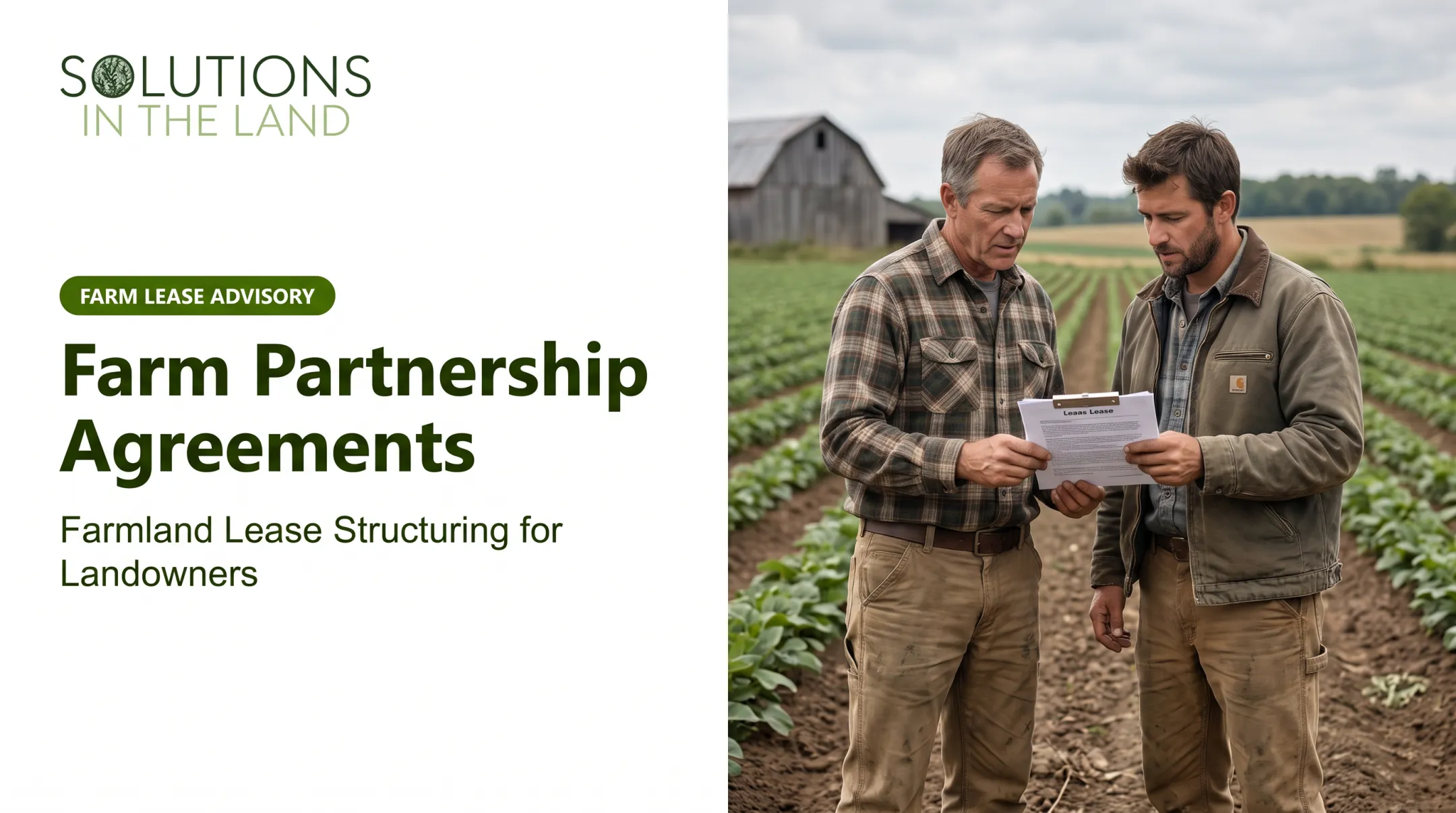
At its simplest, tenant farming is an arrangement where a farmer operates land owned by someone else. The tenant handles planting, harvesting, and day-to-day decisions. The landowner holds title and collects rent, a crop share, or another agreed return. USDA identifies the farm operator — the person responsible for management decisions — separately from the owner, since one person can own land while another runs it.
How Tenant Farmers Differ From Other Roles
The terminology gets mixed up constantly, so here's a clearer breakdown:
- Tenant farmer/operator — Rents land for cash or a crop share and makes the operating decisions
- Sharecropper — A historical term tied to Reconstruction-era arrangements, often involving debt and landowner-supplied inputs; it isn't interchangeable with today's crop-share tenant
- Farm employee — Works for wages without acquiring any lease interest or crop entitlement
- Custom operator — Performs specific fieldwork for a fee while the landowner owns the crop and pays production costs
- Landowner-operator — Owns the land and runs the operation directly, with no tenant involved
These distinctions matter legally and financially. Confusing a custom farming contract with a lease, for instance, can lead to disputes over who owns the crop.
A Brief Historical Note
Tenant farming in the U.S. has roots stretching back to the post-Civil War South, where sharecropping and cash-rent tenancy coexisted. At Maryland's Hampton estate, some tenants paid landowners a share of the harvest while other laborers worked strictly for wages — evidence that "tenant" and "sharecropper" were never quite the same thing, even historically, according to National Park Service records. Modern leases operate under very different legal and economic conditions, so don't assume historical arrangements map cleanly onto today's contracts. Getting the role right up front—tenant, custom operator, or employee—makes cash-rent, crop-share, and flexible lease terms far easier to structure. Solutions in the Land helps landowners and operators sort those distinctions before the lease is drafted.
Types of Tenant Farming and Agricultural Lease Structures
Lease structure determines who bears risk and who keeps control. Iowa State's Ag Decision Maker program identifies four main arrangements used across the Midwest and beyond.
| Lease Type | How Payment Works | Main Risk Exposure |
|---|---|---|
| Fixed cash rent | Tenant pays agreed rent, keeps the crop | Tenant absorbs yield and price swings |
| Flexible cash rent | Rent adjusts with price, yield, or revenue triggers | Risk shared between owner and tenant |
| Crop share | Owner takes a share of crop/proceeds, may share input costs | Both parties tied to production outcomes |
| Custom farming | Owner pays operator a per-acre fee, keeps the entire crop | Owner retains most financial risk |
Cash Rent vs. Crop Share vs. Flexible Leases
Fixed cash rent is straightforward: the tenant controls production and keeps whatever the crop brings in, good or bad.
Crop-share arrangements are common for corn and soybeans in the Midwest, frequently split 50/50. Input costs for seed, chemicals, fertilizer, and drying are divided by agreement.
Flexible leases split the difference. Rent might adjust based on:
- Commodity price at a set discovery date (often tied to USDA or CME data)
- Actual yield, verified through crop-insurance APH, FSA records, or scale tickets
- Gross revenue per acre, or a blended formula combining several factors
A well-built flexible lease spells out base rent, any bonus or floor mechanisms, and the exact price-discovery date. Vague formulas cause more arguments than fixed rents ever do.
Custom Farming: A Different Animal
Custom farming isn't tenant farming at all. The landowner buys the inputs, owns the crop, and pays an operator a per-acre rate for fieldwork. This shifts nearly all financial risk to the owner while giving them more control over practices like tillage and conservation. Know the distinction before assuming a "custom operator" has tenant rights.

So, How Much Does It Cost to Rent an Acre?
There's no honest single number. Rent depends on several factors:
- Soil productivity, drainage, and access
- Crop or livestock use and local market conditions
- Improvements already in place and the lease structure itself
Rather than repeating an outdated national average, check current data through the USDA NASS Cash Rents by County survey or your state's extension office. Iowa State, for example, publishes an annual county-level survey that separates cropland by quality tier.
Building a Clear Agricultural Tenancy Agreement
A handshake deal might work for a season. It falls apart the moment ownership changes, a tenant stays past expiration, improvements get disputed, or someone's memory of "what we agreed" conveniently shifts. A written agreement protects both sides.
Core Business Terms
Every agreement should nail down:
- Legal description of the land and the names of all parties
- Lease duration and renewal process, including what happens if neither side acts
- Rent amount, due dates, and any security or guarantee
- Permitted uses and procedures for documenting any changes mid-term
Operational and Improvement Details
Beyond the basics, spell out who handles what:
- Seed, fertilizer, and chemical purchases
- Equipment, labor, fencing, and building upkeep
- Conservation practices, crop insurance, and government program participation
- Compliance with local ordinances and environmental rules
Improvements deserve their own section. Drainage tile, irrigation, lime applications, fencing, and storage structures represent real investment. The lease should specify who approves them, how costs get shared, who owns the improvement, and what happens at lease end: removal, reimbursement, or transfer.
Exit and Dispute Provisions
Transitions cause more conflict than any other lease issue. Cover:
- Notice requirements and what counts as valid delivery
- Treatment of already-planted crops and harvest access
- Livestock, pasture, and personal property removal timelines
- Successor or heir rights if ownership changes
- Holdover tenancy and mediation procedures
State law varies widely here. A few common notice rules:
- Iowa generally requires notice by September 1 for a March 1 termination
- Illinois applies a four-month written-notice rule to year-to-year tenancies without a fixed end date
- Ohio defaults to a September 1 notice deadline when a lease doesn't specify one
Each rule carries exceptions, and agricultural lien laws differ by state too, according to the National Agricultural Law Center. Get a state-specific legal review before signing. Don't assume rules from a neighboring state apply to your land.
Building a Strong Landowner-Tenant Farmer Relationship
Good leases prevent disputes. Good relationships prevent misunderstandings from becoming disputes in the first place.
Set Expectations Before the First Season
Before planting starts, walk the property together. Review baseline soil conditions and infrastructure. Write down shared goals and agree on how often you'll communicate. Iowa State recommends at least twice-yearly meetings between landlord and tenant, more if the arrangement is crop-share, since the owner's return depends directly on farm decisions.
Keep Rent Discussions Grounded in Data
Base rent conversations on local market information, realistic production economics, land quality, and any conservation investments already made. Guessing, or anchoring to what a neighbor pays without context, breeds resentment fast.
Build a Communication Rhythm
A short list of regular touchpoints keeps both sides informed:
- Pre-season planning and input decisions
- Planting updates and early-season crop conditions
- Weather events or pest/disease concerns as they arise
- Harvest reporting and yield results
- Annual lease review before renewal decisions
Resolve Problems Early and Fairly
When disagreements happen, refer back to the written agreement first. Document facts as they occur rather than relying on memory later. Avoid making unilateral changes mid-season — that's when trust erodes fastest.
If a dispute escalates, a qualified mediator, farm manager, extension professional, or attorney can help. Ohio's certified agricultural mediation program, for instance, handles farm-lease negotiation and enforcement disputes at no or reduced cost. Several other states have replicated this model through USDA's Agricultural Mediation Program network.

Making Tenant Farming Economically and Environmentally Resilient
Lease terms shape land stewardship more than most people realize. Since about 40% of U.S. farmland is tenant-operated, how those leases are written has real consequences for soil health and water quality nationwide.
What the Research Actually Shows
Standard cash rent leases typically carry no conservation obligations for the tenant. That gap is structural: a tenant with no long-term guarantee has little incentive to invest in practices that pay off years down the road.
USDA research found limited evidence that cash-rented land systematically lags owner-operated land on conservation adoption overall, though cover-crop uptake ran lower on share-rented fields in several surveyed years. The takeaway: lease design matters more than lease label.
Soil-health practices also need time. NRCS research points to a three-to-five-year window before some benefits become measurable, and abandoning a practice after just a year or two can undo the progress made. Short or uncertain lease terms make that kind of investment harder to justify for either party.
Aligning Lease Terms With Stewardship Goals
Conservation-minded leases can specify:
- Cover-crop species mix, plus planting and termination windows
- No-till, strip-till, or reduced-till requirements with documentation
- Nutrient-management-plan compliance following state extension or NRCS standards
- Manure-application setbacks, rate limits, and seasonal restrictions
- Soil-test cadence and reporting schedules
- Filter strips or pollinator habitat along field margins
Measuring Progress Together
Agree on a small set of indicators both parties will track. Common choices include:
- Soil-test trends
- Erosion observations
- Input efficiency
- Yield stability
- Tenant profitability
Whatever you pick, base it on your own farm's data rather than borrowed assumptions from another region.
This is where whole-system farm planning earns its keep. At Solutions in the Land, we help landowners and tenant operators build site-specific plans that connect crop selection, market opportunities, soil health, water management, and lease structure into one coherent strategy, including regenerative agriculture consulting and organic transition planning where those fit the operation.
No plan guarantees a specific yield or dollar outcome. A lease built around shared stewardship goals still gives both sides a stronger path to long-term success than a one-page handshake.

Frequently Asked Questions
What are agricultural tenancies?
An agricultural tenancy is an arrangement where a farmer uses and operates land owned by another party under agreed rent, crop-share, revenue-share, or other terms. Legal definitions and protections vary by state.
What is a land tenancy agreement?
It's the written contract governing the landowner-tenant relationship, covering land use, rent, duration, responsibilities, improvements, insurance, renewal, and termination. It's the document both parties rely on when questions arise.
What are the different types of tenancies?
Common structures include cash-rent, crop-share, flexible or hybrid leases, pasture arrangements, and custom farming. Each allocates risk and control between owner and tenant differently.
How do I lease land to a tenant farmer?
Start with a property assessment and tenant screening, then select a lease structure and document every responsibility in writing. Get a state-specific legal review before signing, ideally before the growing season starts.
How can I terminate an agricultural tenancy?
Termination depends on your written agreement and applicable state law, including notice timing, renewal or holdover provisions, and how planted crops or livestock get handled. Always confirm specifics with a qualified attorney in your state.
Can a tenant claim ownership of the land?
No — tenancy alone generally doesn't create ownership rights. That said, possession disputes can involve state-specific legal doctrines, so review your lease terms and consult an attorney if a question ever comes up.